Element 050
Tin (Sn)
The metal that joined copper to make bronze. Today tin mostly holds electronics together as solder and coats food cans.
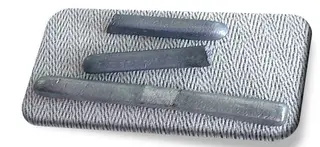
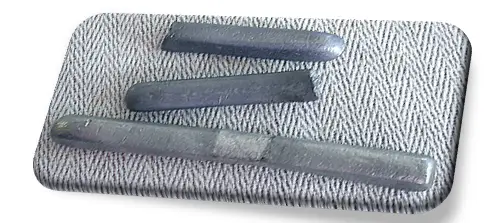
Tin is a soft, silvery metal that melts at a low temperature, about 232 °C. It resists corrosion and is non-toxic, so it is used in contact with food.
Below about 13 °C, ordinary white tin can slowly turn into gray tin, a brittle powder. In practice this “tin pest” is rare and very slow.
Quick answers
- What is tin?
- Tin (Sn) is a post-transition metal with atomic number 50. It is a solid at room temperature. The metal that joined copper to make bronze. Today tin mostly holds electronics together as solder and coats food cans.
- Where is tin found?
- Tin is mined from the mineral cassiterite (tin oxide). China, Indonesia and Myanmar are major producers.
- What is tin used for?
- Its main uses are solder; tinplate; chemicals and glass. Most tin is used in solder that joins components on circuit boards.
At a glance
| Atomic number | 50 |
|---|---|
| Symbol | Sn |
| Standard atomic weight | 118.71 ± 0.01 |
| Natural isotopes | 10 (IUPAC CIAAW 2024) |
| Family | Post-transition metal |
| Group | Group 14 |
| Period | Period 5 |
| Block | p |
| Electron configuration | [Kr] 4d10 5s2 5p2 orbital diagram → |
| State at room temperature | Solid |
| Melting point | 231.93 °C (449.5 °F, 505.08 K) |
| Boiling point | 2,602 °C (4,715 °F, 2,875 K) |
| Density | 7.287 g/cm³ |
| Electronegativity (Pauling) | 1.96 |
| Atomic radius | 217 pm |
| First ionization energy | 7.344 eV |
| Oxidation states | +4, +2 |
| Discovery | Known since ancient times |
Discovery
Tin has been used for about 5,000 years. Alloyed with copper, it made bronze and gave its name to the Bronze Age. Tin ore was traded over long distances because it is found in only a few places.
Where the name comes from
From Old English tin. The symbol Sn comes from the Latin stannum.
Where is tin found?
Tin is mined from the mineral cassiterite (tin oxide). China, Indonesia and Myanmar are major producers.
Where every element is found →
What is tin used for?
- Solder. Most tin is used in solder that joins components on circuit boards. Modern lead-free solders are mostly tin.
- Tinplate. “Tin” cans are steel with a thin tin coating that stops rust.
- Chemicals and glass. Tin compounds are used in plastics and coatings; flat window glass is made by floating molten glass on a bath of molten tin.
- Alloys. Bronze, pewter and some bearing metals contain tin.
What every element is used for → · Where are the elements found? →
Common compounds
| Compound | Formula | Note |
|---|---|---|
| Tin(IV) oxide | SnO₂ | The ore cassiterite. |
Notable isotopes
- Sn-1120.97%
- Sn-1140.66%
- Sn-1150.34%
- Sn-11614.54%
- Sn-1177.68%
- Sn-11824.22%
- Sn-1198.59%
- Sn-12032.58%
- Sn-1224.63%
- Sn-1245.79%
Percent by number of atoms. The light band shows the range over which the share varies in natural samples. Source: IUPAC CIAAW 2024
| Isotope | Half-life | Note |
|---|---|---|
| Tin-120 | Stable | The most common isotope, about 32.6% of natural tin. Tin has 10 stable isotopes, more than any other element. |
| Tin-118 | Stable | About 24.2%. |
| Tin-116 | Stable | About 14.5%. |
Safety
Metal is low-risk
Tin metal has low toxicity. Some organic tin compounds are toxic and their use is restricted.
Did you know?
- Bend a bar of tin and you hear a faint crackle, the “tin cry”, as its crystals rub against each other.
- A popular story says the tin buttons of Napoleon’s army crumbled in the Russian cold. It has never been confirmed.
- Pewter, used for mugs and plates, is mostly tin.
Frequently asked questions
Are tin cans made of tin?
Mostly not. They are steel (or aluminum) cans; steel cans have a very thin tin coating.
What is tin pest?
At low temperatures white tin can slowly change into brittle gray tin. Small amounts of other metals in modern alloys prevent it.
Is tin a metal?
Yes. Tin is a metal, one of the post-transition metals.
What are the properties of tin?
Atomic number 50, symbol Sn, atomic mass 118.71. It is a solid at room temperature. It melts at 231.93 °C (449.5 °F) and boils at 2,602 °C (4,715 °F). Density 7.287 g/cm³. Electronegativity 1.96 (Pauling).
Sources
- Royal Society of Chemistry: Tin
- Encyclopaedia Britannica: Tin
- USGS Mineral Commodity Summaries: Tin
- NNDC NuDat 3 (nuclear data)
- PubChem Periodic Table (NIH)
- IUPAC/CIAAW standard atomic weights
- Royal Society of Chemistry, Periodic Table
- Wikipedia: Tin
Last checked: 16 November 2026
Other group 14 elements
Carbon
The element of life. Diamond, graphite and graphene are all pure carbon, and every living thing is built around carbon atoms.
Silicon
The second most abundant element in Earth’s crust and the heart of every computer chip. Sand, glass and quartz are mostly silicon and oxygen.
Germanium
The metalloid of the first transistors. Today it carries light in optical fibers and lets night-vision cameras see in infrared.
Lead
A heavy, soft metal used since antiquity. It stores energy in car batteries and blocks radiation, but it is toxic and has been removed from petrol and paint.
Flerovium
A superheavy element named after the Flerov Laboratory in Dubna. It may lie near the predicted “island of stability”.