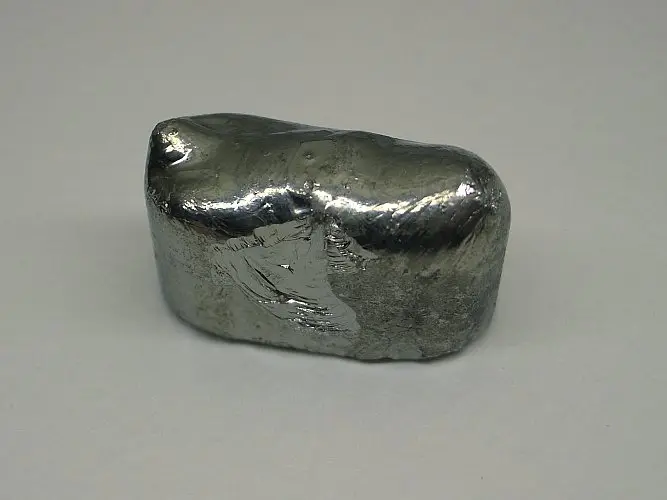
Germanium is a hard, shiny, gray-white metalloid and a semiconductor, chemically similar to silicon and tin.
It is transparent to infrared light, which makes it valuable for thermal-imaging lenses.
Quick answers
- What is germanium?
- Germanium (Ge) is a metalloid with atomic number 32. It is a solid at room temperature. The metalloid of the first transistors. Today it carries light in optical fibers and lets night-vision cameras see in infrared.
- Where is germanium found?
- Germanium is recovered as a by-product of zinc ores and coal fly ash. China is the largest producer.
- What is germanium used for?
- Its main uses are fiber optics; infrared optics; electronics and solar cells. Germanium dioxide in the core of optical fibers guides light signals.
At a glance
| Atomic number | 32 |
|---|---|
| Symbol | Ge |
| Standard atomic weight | 72.630 ± 0.008 |
| Natural isotopes | 5 (IUPAC CIAAW 2024) |
| Family | Metalloid |
| Group | Group 14 |
| Period | Period 4 |
| Block | p |
| Electron configuration | [Ar] 3d10 4s2 4p2 orbital diagram → |
| State at room temperature | Solid |
| Melting point | 938.3 °C (1,720.9 °F, 1,211.4 K) |
| Boiling point | 2,833 °C (5,131 °F, 3,106 K) |
| Density | 5.323 g/cm³ |
| Electronegativity (Pauling) | 2.01 |
| Atomic radius | 211 pm |
| First ionization energy | 7.9 eV |
| Oxidation states | +4, +2 |
| Discovery | 1886 · Clemens Winkler |
Discovery
Mendeleev predicted an “eka-silicon” in 1871. In 1886 the German chemist Clemens Winkler found it in the silver mineral argyrodite, and its properties matched the prediction remarkably well.
Where the name comes from
From Germania, the Latin name for Germany.
Where is germanium found?
Germanium is recovered as a by-product of zinc ores and coal fly ash. China is the largest producer.
Where every element is found →
What is germanium used for?
- Fiber optics. Germanium dioxide in the core of optical fibers guides light signals.
- Infrared optics. Lenses and windows for thermal cameras and night-vision devices.
- Electronics and solar cells. Silicon–germanium chips and high-efficiency solar cells for satellites.
- Plastics. A germanium catalyst is used to make some PET plastic.
What every element is used for → · Where are the elements found? →
Common compounds
| Compound | Formula | Note |
|---|---|---|
| Germanium dioxide | GeO₂ | Used in the core of optical fibers. |
Notable isotopes
- Ge-7020.52%
- Ge-7227.45%
- Ge-737.76%
- Ge-7436.52%
- Ge-767.75%
Percent by number of atoms. The light band shows the range over which the share varies in natural samples. Source: IUPAC CIAAW 2024
| Isotope | Half-life | Note |
|---|---|---|
| Germanium-74 | Stable | The most common isotope, about 36%. |
| Germanium-76 | far longer than the age of the universe | Studied in experiments on the nature of neutrinos. |
Safety
Low hazard; avoid supplements
Germanium metal has low toxicity. Some germanium compounds sold as health supplements have caused kidney damage; they have no proven benefit.
Did you know?
- The first transistor, built at Bell Labs in 1947, used germanium.
- Gallium, scandium and germanium are the three most famous confirmations of Mendeleev’s predictions.
- Like water and silicon, germanium expands slightly when it freezes.
Frequently asked questions
Why was germanium replaced by silicon in chips?
Silicon is far more abundant and forms a stable oxide layer, and silicon devices tolerate higher temperatures.
Is germanium a metal?
It is a metalloid: shiny like a metal but brittle and semiconducting.
What are the properties of germanium?
Atomic number 32, symbol Ge, atomic mass 72.630. It is a solid at room temperature. It melts at 938.3 °C (1,720.9 °F) and boils at 2,833 °C (5,131 °F). Density 5.323 g/cm³. Electronegativity 2.01 (Pauling).
Sources
- Royal Society of Chemistry: Germanium
- Encyclopaedia Britannica: Germanium
- USGS Mineral Commodity Summaries: Germanium
- NNDC NuDat 3 (nuclear data)
- PubChem Periodic Table (NIH)
- IUPAC/CIAAW standard atomic weights
- Royal Society of Chemistry, Periodic Table
- Wikipedia: Germanium
Last checked: 16 November 2026
Other group 14 elements
Carbon
The element of life. Diamond, graphite and graphene are all pure carbon, and every living thing is built around carbon atoms.
Silicon
The second most abundant element in Earth’s crust and the heart of every computer chip. Sand, glass and quartz are mostly silicon and oxygen.
Tin
The metal that joined copper to make bronze. Today tin mostly holds electronics together as solder and coats food cans.
Lead
A heavy, soft metal used since antiquity. It stores energy in car batteries and blocks radiation, but it is toxic and has been removed from petrol and paint.
Flerovium
A superheavy element named after the Flerov Laboratory in Dubna. It may lie near the predicted “island of stability”.