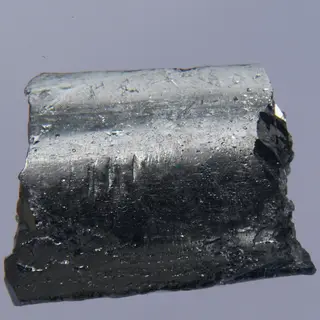
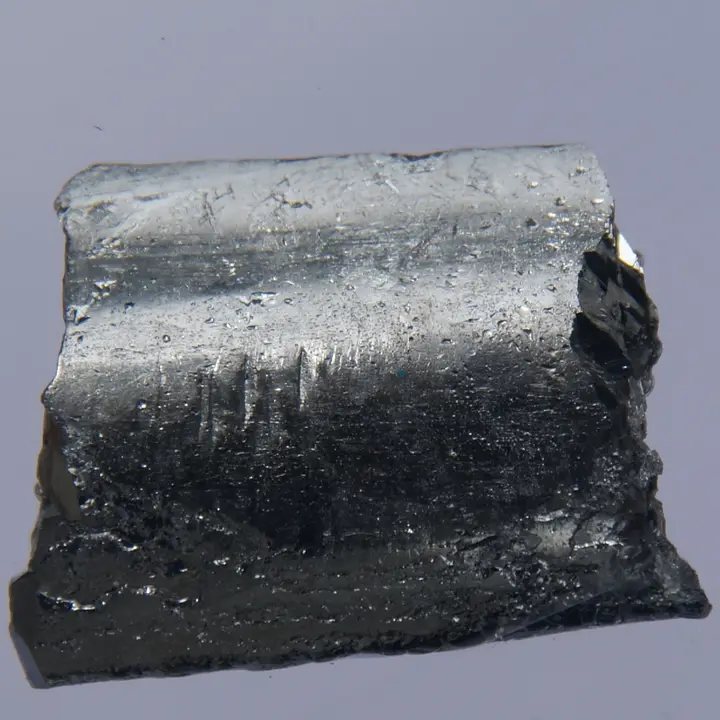
Antimony is a shiny, silvery-gray metalloid that is hard but brittle. Like water, it expands slightly when it solidifies.
Its sulfide, stibnite, was ground into kohl, a black eye cosmetic, in ancient Egypt.
Quick answers
- What is antimony?
- Antimony (Sb) is a metalloid with atomic number 51. It is a solid at room temperature. A brittle, silvery metalloid used since ancient times as black eye make-up. Today it mainly makes plastics flame-resistant.
- Where is antimony found?
- Antimony is mined mainly as stibnite (antimony sulfide). China is the largest producer.
- What is antimony used for?
- Its main uses are flame retardants, lead alloys and plastics. Antimony trioxide helps plastics, textiles and electronics resist fire.
At a glance
| Atomic number | 51 |
|---|---|
| Symbol | Sb |
| Standard atomic weight | 121.76 ± 0.01 |
| Natural isotopes | 2 (IUPAC CIAAW 2024) |
| Family | Metalloid |
| Group | Group 15 |
| Period | Period 5 |
| Block | p |
| Electron configuration | [Kr] 4d10 5s2 5p3 orbital diagram → |
| State at room temperature | Solid |
| Melting point | 630.63 °C (1,167.1 °F, 903.78 K) |
| Boiling point | 1,587 °C (2,888 °F, 1,860 K) |
| Density | 6.685 g/cm³ |
| Electronegativity (Pauling) | 2.05 |
| Atomic radius | 206 pm |
| First ionization energy | 8.64 eV |
| Oxidation states | +5, +3, -3 |
| Discovery | Known since ancient times |
Discovery
Antimony compounds have been used for thousands of years. It is not known who first isolated the element; detailed descriptions appeared in Europe in the 16th and 17th centuries.
Where the name comes from
The origin of “antimony” is uncertain. The symbol Sb comes from the Latin stibium, the name for stibnite.
Where is antimony found?
Antimony is mined mainly as stibnite (antimony sulfide). China is the largest producer.
Where every element is found →
What is antimony used for?
- Flame retardants. Antimony trioxide helps plastics, textiles and electronics resist fire.
- Lead alloys. It hardens lead in batteries, cable sheathing and ammunition.
- Plastics. An antimony catalyst is used to make PET bottles.
- Electronics. Used in some semiconductors and infrared detectors.
What every element is used for → · Where are the elements found? →
Common compounds
| Compound | Formula | Note |
|---|---|---|
| Antimony trisulfide | Sb₂S₃ | The ore stibnite; part of some ancient kohl eye paints. |
| Antimony trioxide | Sb₂O₃ | Used in flame retardants. |
Notable isotopes
- Sb-12157.21%
- Sb-12342.79%
Percent by number of atoms. The light band shows the range over which the share varies in natural samples. Source: IUPAC CIAAW 2024
| Isotope | Half-life | Note |
|---|---|---|
| Antimony-121 | Stable | About 57% of natural antimony. |
| Antimony-123 | Stable | About 43% of natural antimony. |
Safety
Toxic in larger amounts
Antimony and many of its compounds are toxic if swallowed or inhaled in significant amounts. Workplace exposure is limited.
Did you know?
- In the Middle Ages there were “everlasting pills” of antimony: swallowed as a laxative, recovered, washed and used again. It was a dangerous practice.
- Old printers’ type metal contained antimony, which expands as it cools and fills the mold sharply.
- Kohl eyeliner, made from stibnite, links antimony with cosmetics going back thousands of years.
Frequently asked questions
Is antimony a metal?
It is a metalloid: metallic in appearance, but brittle and a poor conductor compared with true metals.
What is antimony used for today?
Mostly as a flame retardant, and in lead alloys and plastics manufacture.
What are the properties of antimony?
Atomic number 51, symbol Sb, atomic mass 121.76. It is a solid at room temperature. It melts at 630.63 °C (1,167.1 °F) and boils at 1,587 °C (2,888 °F). Density 6.685 g/cm³. Electronegativity 2.05 (Pauling).
Sources
- Royal Society of Chemistry: Antimony
- Encyclopaedia Britannica: Antimony
- USGS Mineral Commodity Summaries: Antimony
- NNDC NuDat 3 (nuclear data)
- PubChem Periodic Table (NIH)
- IUPAC/CIAAW standard atomic weights
- Royal Society of Chemistry, Periodic Table
- Wikipedia: Antimony
Last checked: 16 November 2026
Other group 15 elements
Nitrogen
The gas that makes up most of the air we breathe. Nitrogen is in every protein and in DNA, and fertilizers made from it feed billions of people.
Phosphorus
An element first extracted from urine. It is in our bones, our DNA and the fertilizers that grow our food.
Arsenic
A notorious poison and a useful semiconductor ingredient. Arsenic in groundwater still affects millions of people.
Bismuth
A heavy metal famous for rainbow-colored, staircase-shaped crystals. Unusually for a heavy metal, it has low toxicity and is even used in stomach remedies.
Moscovium
A superheavy element named after the Moscow region, made in a Russian–American collaboration.