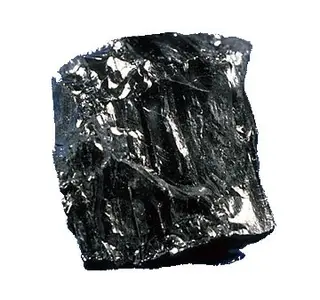
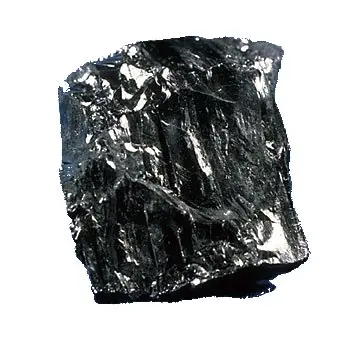
Carbon is a nonmetal that can bond to itself in long chains and rings. This gives it more compounds than any other element except hydrogen, and it is the basis of organic chemistry.
Pure carbon comes in several forms, called allotropes. In diamond the atoms form a rigid 3D network; in graphite they form flat, slippery sheets.
Quick answers
- What is carbon?
- Carbon (C) is a nonmetal with atomic number 6. It is a solid at room temperature. The element of life. Diamond, graphite and graphene are all pure carbon, and every living thing is built around carbon atoms.
- Where is carbon found?
- Carbon is the fourth most abundant element in the universe by mass. It forms inside stars when three helium nuclei fuse.
- What is carbon used for?
- Its main uses are steel, fuels and graphite. Adding a small amount of carbon to iron makes steel, which is far stronger than pure iron.
At a glance
| Atomic number | 6 |
|---|---|
| Symbol | C |
| Standard atomic weight | 12.011 ± 0.002 |
| Natural isotopes | 2 (IUPAC CIAAW 2024) |
| Family | Nonmetal |
| Group | Group 14 |
| Period | Period 2 |
| Block | p |
| Electron configuration | [He] 2s2 2p2 orbital diagram → |
| State at room temperature | Solid |
| Melting point | Does not melt at normal pressure; sublimes at about 3,640 °C. |
| Boiling point | Unknown |
| Density | 2.267 g/cm³ |
| Electronegativity (Pauling) | 2.55 |
| Atomic radius | 170 pm |
| First ionization energy | 11.26 eV |
| Oxidation states | +4, +2, -4 |
| Discovery | Known since ancient times |
Discovery
Charcoal and soot have been used since prehistoric times, and diamonds have been prized for thousands of years. Carbon has no single discoverer.
Antoine Lavoisier listed carbon as an element in 1789. New forms were found much later: buckminsterfullerene in 1985, and graphene, a single sheet of graphite, was isolated in 2004.
Where the name comes from
From the Latin carbo, coal or charcoal.
Where is carbon found?
Carbon is the fourth most abundant element in the universe by mass. It forms inside stars when three helium nuclei fuse.
On Earth it is found in coal, oil and natural gas, in carbonate rocks such as limestone, in carbon dioxide in the air and in all living things.
Where every element is found →
What is carbon used for?
- Steel. Adding a small amount of carbon to iron makes steel, which is far stronger than pure iron.
- Fuels. Coal, oil and natural gas release energy when their carbon burns, producing carbon dioxide.
- Graphite. Pencil “lead”, lubricants and the negative electrode of most lithium-ion batteries are made of graphite.
- Diamonds and carbon fiber. Industrial diamonds cut and grind hard materials; carbon fiber makes light, stiff bicycles, aircraft parts and sports gear.
What every element is used for → · Where are the elements found? →
Common compounds
| Compound | Formula | Note |
|---|---|---|
| Carbon dioxide | CO₂ | Greenhouse gas released by breathing and burning. |
| Carbon monoxide | CO | Toxic, odorless gas formed when fuel burns without enough oxygen. |
| Calcium carbonate | CaCO₃ | Limestone, marble, chalk and seashells. |
Notable isotopes
- C-1298.84–99.04%
- C-130.96–1.16%
Percent by number of atoms. The light band shows the range over which the share varies in natural samples. Source: IUPAC CIAAW 2024
| Isotope | Half-life | Note |
|---|---|---|
| Carbon-12 | Stable | About 98.9% of natural carbon. Since 1961 it has been the reference for atomic masses. |
| Carbon-13 | Stable | About 1.1% of natural carbon. Used in NMR spectroscopy and medical breath tests. |
| Carbon-14 | about 5,700 years | Radioactive. Made in the atmosphere by cosmic rays; used to date once-living material (radiocarbon dating). |
Safety
Low hazard; its gases are another matter
Solid carbon is not toxic. Fine carbon dust can irritate the lungs.
Burning carbon fuels without enough air produces carbon monoxide, an odorless and very poisonous gas.
Did you know?
- Diamond and graphite are made of exactly the same atoms; only their arrangement differs.
- Andre Geim and Konstantin Novoselov won the 2010 Nobel Prize in Physics for their work on graphene.
- At normal pressure carbon does not melt. At about 3,640 °C it turns straight into a gas.
Frequently asked questions
Why is carbon so important for life?
Carbon atoms can form four strong bonds, including with each other, so they build the long, varied molecules life needs: proteins, DNA, fats and sugars.
How does radiocarbon dating work?
Living things take in carbon-14 while alive. After death it decays with a half-life of about 5,700 years, so the amount left shows roughly how long ago the organism died.
Is carbon a metal?
No. Carbon is a nonmetal.
What are the properties of carbon?
Atomic number 6, symbol C, atomic mass 12.011. It is a solid at room temperature. Density 2.267 g/cm³. Electronegativity 2.55 (Pauling).
Sources
- Royal Society of Chemistry: Carbon
- Encyclopaedia Britannica: Carbon
- Nobel Prize in Physics 2010 (graphene)
- NNDC NuDat 3 (nuclear data)
- PubChem Periodic Table (NIH)
- IUPAC/CIAAW standard atomic weights
- Royal Society of Chemistry, Periodic Table
- Wikipedia: Carbon
Last checked: 16 November 2026
Other group 14 elements
Silicon
The second most abundant element in Earth’s crust and the heart of every computer chip. Sand, glass and quartz are mostly silicon and oxygen.
Germanium
The metalloid of the first transistors. Today it carries light in optical fibers and lets night-vision cameras see in infrared.
Tin
The metal that joined copper to make bronze. Today tin mostly holds electronics together as solder and coats food cans.
Lead
A heavy, soft metal used since antiquity. It stores energy in car batteries and blocks radiation, but it is toxic and has been removed from petrol and paint.
Flerovium
A superheavy element named after the Flerov Laboratory in Dubna. It may lie near the predicted “island of stability”.