Element 082
Lead (Pb)
A heavy, soft metal used since antiquity. It stores energy in car batteries and blocks radiation, but it is toxic and has been removed from petrol and paint.
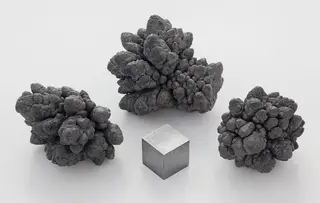
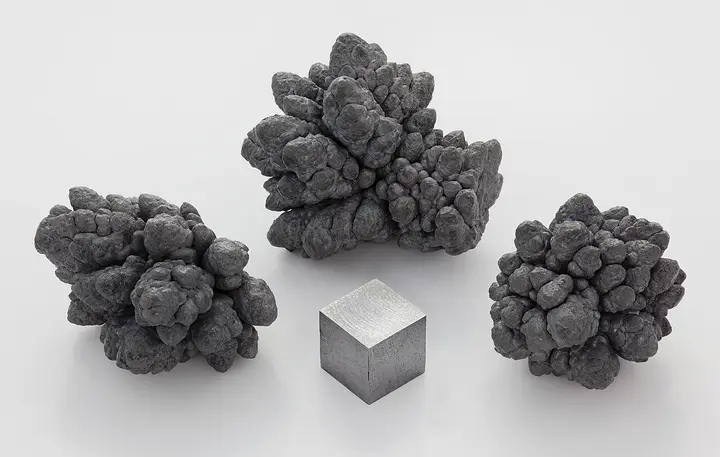
Lead is a dense, soft, bluish-gray metal that melts at about 327 °C. It is easy to cast and shape and resists corrosion.
It is also a cumulative poison. Lead harms the brain and nervous system, especially in children, so its use in everyday products has been sharply reduced.
Quick answers
- What is lead?
- Lead (Pb) is a post-transition metal with atomic number 82. It is a solid at room temperature. A heavy, soft metal used since antiquity. It stores energy in car batteries and blocks radiation, but it is toxic and has been removed from petrol and paint.
- Where is lead found?
- Lead is mined mainly from galena (lead sulfide), often together with zinc and silver. Much of today’s lead is recycled from old batteries.
- What is lead used for?
- Its main uses are batteries; radiation shielding; construction and weights. Most lead goes into lead–acid batteries for vehicles and backup power.
At a glance
| Atomic number | 82 |
|---|---|
| Symbol | Pb |
| Standard atomic weight | 207.2 ± 1.1 |
| Natural isotopes | 4 (IUPAC CIAAW 2024) |
| Family | Post-transition metal |
| Group | Group 14 |
| Period | Period 6 |
| Block | p |
| Electron configuration | [Xe] 4f14 5d10 6s2 6p2 orbital diagram → |
| State at room temperature | Solid |
| Melting point | 327.46 °C (621.4 °F, 600.61 K) |
| Boiling point | 1,749 °C (3,180 °F, 2,022 K) |
| Density | 11.342 g/cm³ |
| Electronegativity (Pauling) | 2.33 |
| Atomic radius | 202 pm |
| First ionization energy | 7.417 eV |
| Oxidation states | +4, +2 |
| Discovery | Known since ancient times |
Discovery
Lead has been smelted for thousands of years. The Romans used it widely for water pipes, which is where the word “plumbing” comes from.
Where the name comes from
From Old English lēad. The symbol Pb comes from the Latin plumbum, also the root of “plumber”.
Where is lead found?
Lead is mined mainly from galena (lead sulfide), often together with zinc and silver. Much of today’s lead is recycled from old batteries.
Where every element is found →
What is lead used for?
- Batteries. Most lead goes into lead–acid batteries for vehicles and backup power.
- Radiation shielding. Lead aprons and bricks block X-rays and gamma rays.
- Construction and weights. Roofing and flashing, ballast, counterweights and some ammunition.
What every element is used for → · Where are the elements found? →
Common compounds
| Compound | Formula | Note |
|---|---|---|
| Lead(II) sulfide | PbS | The ore galena. |
Notable isotopes
- Pb-2040–1.58%
- Pb-2061.9–86.73%
- Pb-2070.35–23.51%
- Pb-2083.38–97.75%
Percent by number of atoms. The light band shows the range over which the share varies in natural samples. Source: IUPAC CIAAW 2024
| Isotope | Half-life | Note |
|---|---|---|
| Lead-206, -207, -208 | Stable | Stable isotopes that are the end products of uranium and thorium decay. |
| Lead-204 | Stable | The only stable lead isotope not made by radioactive decay. |
Safety
Toxic; no level is known to be safe
The World Health Organization states that there is no known safe level of lead exposure. Children are most at risk, from old lead paint dust, contaminated soil and some imported products.
Wash hands after handling lead, and use protective equipment when working with it.
Did you know?
- Pencils contain no lead: the “lead” is a mixture of graphite and clay.
- Ending leaded petrol caused a large fall in blood lead levels around the world. The last country stopped selling it in 2021.
- Uranium–lead dating measures how much uranium in a rock has decayed to lead to find its age.
Frequently asked questions
Why was lead removed from petrol?
Burning leaded petrol spread lead into the air and soil, raising blood lead levels and harming children’s development.
Do pencils contain lead?
No. Pencil cores are graphite mixed with clay. The name dates from when graphite was mistaken for a form of lead.
Is lead a metal?
Yes. Lead is a metal, one of the post-transition metals.
What are the properties of lead?
Atomic number 82, symbol Pb, atomic mass 207.2. It is a solid at room temperature. It melts at 327.46 °C (621.4 °F) and boils at 1,749 °C (3,180 °F). Density 11.342 g/cm³. Electronegativity 2.33 (Pauling).
Sources
- Royal Society of Chemistry: Lead
- Encyclopaedia Britannica: Lead
- World Health Organization: Lead poisoning
- UNEP: Era of leaded petrol over (2021)
- NNDC NuDat 3 (nuclear data)
- PubChem Periodic Table (NIH)
- IUPAC/CIAAW standard atomic weights
- Royal Society of Chemistry, Periodic Table
- Wikipedia: Lead
Last checked: 16 November 2026
Other group 14 elements
Carbon
The element of life. Diamond, graphite and graphene are all pure carbon, and every living thing is built around carbon atoms.
Silicon
The second most abundant element in Earth’s crust and the heart of every computer chip. Sand, glass and quartz are mostly silicon and oxygen.
Germanium
The metalloid of the first transistors. Today it carries light in optical fibers and lets night-vision cameras see in infrared.
Tin
The metal that joined copper to make bronze. Today tin mostly holds electronics together as solder and coats food cans.
Flerovium
A superheavy element named after the Flerov Laboratory in Dubna. It may lie near the predicted “island of stability”.