Element 049
Indium (In)
A very soft metal behind every touchscreen: indium tin oxide is a transparent coating that conducts electricity.
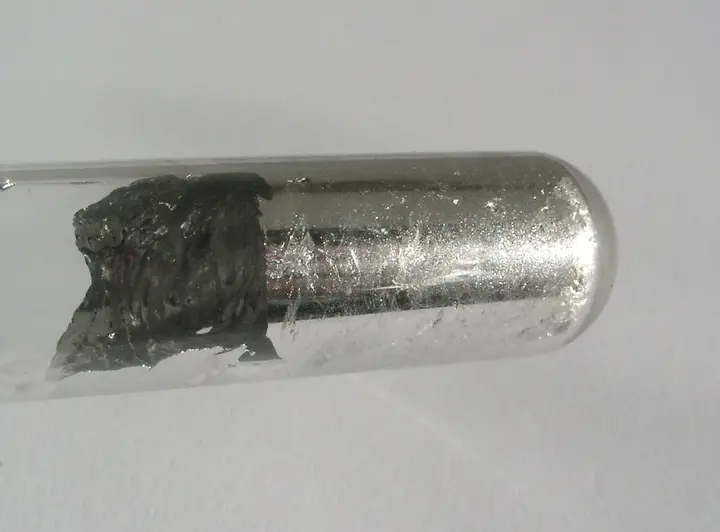
Indium is a soft, silvery metal, soft enough to scratch with a fingernail. It melts at about 157 °C.
Combined with tin oxide it forms a film that is both transparent and electrically conductive, used in screens and solar panels.
Quick answers
- What is indium?
- Indium (In) is a post-transition metal with atomic number 49. It is a solid at room temperature. A very soft metal behind every touchscreen: indium tin oxide is a transparent coating that conducts electricity.
- Where is indium found?
- Indium is rare and is recovered mainly as a by-product of zinc refining. China is the largest producer.
- What is indium used for?
- Its main uses are screens; solders and seals; semiconductors. Indium tin oxide is the transparent conductor in touchscreens, flat-panel displays and some solar cells.
At a glance
| Atomic number | 49 |
|---|---|
| Symbol | In |
| Standard atomic weight | 114.82 ± 0.01 |
| Natural isotopes | 2 (IUPAC CIAAW 2024) |
| Family | Post-transition metal |
| Group | Group 13 |
| Period | Period 5 |
| Block | p |
| Electron configuration | [Kr] 4d10 5s2 5p1 orbital diagram → |
| State at room temperature | Solid |
| Melting point | 156.60 °C (313.9 °F, 429.75 K) |
| Boiling point | 2,072 °C (3,761 °F, 2,345 K) |
| Density | 7.31 g/cm³ |
| Electronegativity (Pauling) | 1.78 |
| Atomic radius | 193 pm |
| First ionization energy | 5.786 eV |
| Oxidation states | +3 |
| Discovery | 1863 · Ferdinand Reich and Hieronymus Theodor Richter |
Discovery
In 1863 Ferdinand Reich and Hieronymus Theodor Richter at Freiberg, Germany, were examining zinc ore with a spectroscope and saw a brilliant indigo-blue line, which revealed a new element.
Where the name comes from
From indigo, after the color of its spectral line.
Where is indium found?
Indium is rare and is recovered mainly as a by-product of zinc refining. China is the largest producer.
Where every element is found →
What is indium used for?
- Screens. Indium tin oxide is the transparent conductor in touchscreens, flat-panel displays and some solar cells.
- Solders and seals. Low-melting indium solders and seals for glass and cryogenic equipment.
- Semiconductors. Indium compounds are used in LEDs, lasers and fast electronics.
What every element is used for → · Where are the elements found? →
Common compounds
| Compound | Formula | Note |
|---|---|---|
| Indium(III) oxide | In₂O₃ | With tin oxide, the transparent conductor in touchscreens. |
Notable isotopes
- In-1134.281%
- In-11595.719%
Percent by number of atoms. The light band shows the range over which the share varies in natural samples. Source: IUPAC CIAAW 2024
| Isotope | Half-life | Note |
|---|---|---|
| Indium-115 | far longer than the age of the universe | About 96% of natural indium; extremely weakly radioactive. |
| Indium-113 | Stable | The only stable isotope, about 4%. |
| Indium-111 | about 2.8 days | Used in medical imaging. |
Safety
Low hazard in normal use
Indium metal is not considered very toxic, but inhaling indium compounds at work can damage the lungs.
Did you know?
- Most natural indium is slightly radioactive, but it decays so slowly that this has no practical effect.
- Indium wets glass and sticks to it, so it is used to make airtight glass-to-metal seals.
- Like tin, indium makes a faint crackling “cry” when bent.
Frequently asked questions
What is indium tin oxide?
A mixture of indium oxide and tin oxide that conducts electricity while letting light through.
Is indium rare?
Yes. It is produced in small amounts, which makes it a critical raw material for electronics.
Is indium a metal?
Yes. Indium is a metal, one of the post-transition metals.
What are the properties of indium?
Atomic number 49, symbol In, atomic mass 114.82. It is a solid at room temperature. It melts at 156.60 °C (313.9 °F) and boils at 2,072 °C (3,761 °F). Density 7.31 g/cm³. Electronegativity 1.78 (Pauling).
Sources
- Royal Society of Chemistry: Indium
- Encyclopaedia Britannica: Indium
- USGS Mineral Commodity Summaries: Indium
- NNDC NuDat 3 (nuclear data)
- PubChem Periodic Table (NIH)
- IUPAC/CIAAW standard atomic weights
- Royal Society of Chemistry, Periodic Table
- Wikipedia: Indium
Last checked: 16 November 2026
Other group 13 elements
Boron
A hard metalloid best known from borax and heat-resistant glass. It also strengthens magnets and absorbs neutrons in nuclear reactors.
Aluminum
The most abundant metal in Earth’s crust. Light, rust-resistant and easy to recycle, it is in drinks cans, aircraft and power lines.
Gallium
A metal that melts in your hand, at about 30 °C. Gallium compounds light up LEDs and run fast electronics.
Thallium
A soft, highly toxic metal discovered through a bright green spectral line. It was once used in rat poison and features in crime novels.
Nihonium
The first element discovered in Asia, named after Japan.