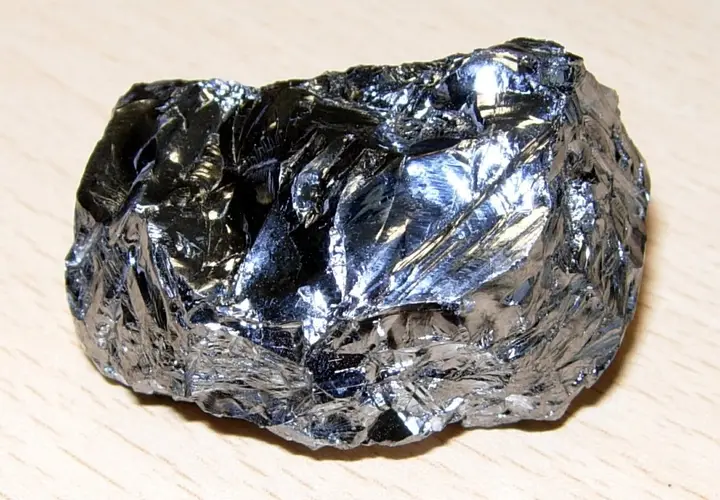
Silicon is a hard, brittle metalloid with a blue-gray metallic shine. It is a semiconductor: it conducts electricity better than an insulator but worse than a metal, and that conductivity can be finely controlled.
In nature it is almost always bonded to oxygen, as silica (silicon dioxide) and in the silicate minerals that make up most rocks.
Quick answers
- What is silicon?
- Silicon (Si) is a metalloid with atomic number 14. It is a solid at room temperature. The second most abundant element in Earth’s crust and the heart of every computer chip. Sand, glass and quartz are mostly silicon and oxygen.
- Where is silicon found?
- Silicon makes up about 28% of Earth’s crust by mass, second only to oxygen. Quartz, sand, feldspar and clay are all silicon compounds.
- What is silicon used for?
- Its main uses are electronics, solar panels and building materials. Ultra-pure silicon wafers are the base of computer chips, memory and most transistors.
At a glance
| Atomic number | 14 |
|---|---|
| Symbol | Si |
| Standard atomic weight | 28.085 ± 0.001 |
| Natural isotopes | 3 (IUPAC CIAAW 2024) |
| Family | Metalloid |
| Group | Group 14 |
| Period | Period 3 |
| Block | p |
| Electron configuration | [Ne] 3s2 3p2 orbital diagram → |
| State at room temperature | Solid |
| Melting point | 1,414 °C (2,577 °F, 1,687 K) |
| Boiling point | 3,265 °C (5,909 °F, 3,538 K) |
| Density | 2.33 g/cm³ |
| Electronegativity (Pauling) | 1.9 |
| Atomic radius | 210 pm |
| First ionization energy | 8.152 eV |
| Oxidation states | +4, +2, -4 |
| Discovery | 1824 · Jöns Jacob Berzelius |
Discovery
The Swedish chemist Jöns Jacob Berzelius isolated fairly pure silicon in 1824 by heating potassium fluorosilicate with potassium.
Where the name comes from
From the Latin silex, flint. The “-on” ending, like carbon and boron, was chosen because it behaves more like a nonmetal than a metal.
Where is silicon found?
Silicon makes up about 28% of Earth’s crust by mass, second only to oxygen. Quartz, sand, feldspar and clay are all silicon compounds.
Where every element is found →
What is silicon used for?
- Electronics. Ultra-pure silicon wafers are the base of computer chips, memory and most transistors.
- Solar panels. Most solar cells are made of silicon.
- Building materials. Silica is the main ingredient of glass, and silicates are in cement, concrete and bricks.
- Silicones and alloys. Silicones make sealants, lubricants and flexible cookware; silicon also strengthens aluminum alloys.
What every element is used for → · Where are the elements found? →
Common compounds
| Compound | Formula | Note |
|---|---|---|
| Silicon dioxide | SiO₂ | Silica: the main component of quartz and sand. |
| Silicon carbide | SiC | Very hard abrasive and a material for power electronics. |
Notable isotopes
- Si-2892.191–92.318%
- Si-294.645–4.699%
- Si-303.037–3.11%
Percent by number of atoms. The light band shows the range over which the share varies in natural samples. Source: IUPAC CIAAW 2024
| Isotope | Half-life | Note |
|---|---|---|
| Silicon-28 | Stable | About 92.2% of natural silicon. |
| Silicon-29 | Stable | About 4.7%. |
| Silicon-30 | Stable | About 3.1%. |
Safety
Silica dust harms the lungs
Silicon itself is not considered toxic.
Breathing fine crystalline silica dust over a long time, for example when cutting stone or concrete, can cause silicosis, a serious lung disease. Workplaces control dust for this reason.
Did you know?
- Silicon Valley in California is named after the silicon chips its companies made.
- Science fiction often imagines silicon-based life, because silicon, like carbon, can form four bonds.
- Silicon for electronics can be purified to better than 99.9999999%.
Frequently asked questions
Silicon or silicone?
Silicon is the element. Silicones are synthetic polymers made of silicon, oxygen, carbon and hydrogen, used in sealants and kitchenware.
Why are chips made of silicon?
Silicon is a semiconductor that is abundant, forms a stable protective oxide and can be grown as near-perfect crystals.
Is silicon a metal?
Not quite. Silicon is a metalloid: in some properties it resembles the metals, in others the nonmetals.
What are the properties of silicon?
Atomic number 14, symbol Si, atomic mass 28.085. It is a solid at room temperature. It melts at 1,414 °C (2,577 °F) and boils at 3,265 °C (5,909 °F). Density 2.33 g/cm³. Electronegativity 1.9 (Pauling).
Read more on OkButWhy
Sources
- Royal Society of Chemistry: Silicon
- Encyclopaedia Britannica: Silicon
- NIOSH: Health effects of crystalline silica
- NNDC NuDat 3 (nuclear data)
- PubChem Periodic Table (NIH)
- IUPAC/CIAAW standard atomic weights
- Royal Society of Chemistry, Periodic Table
- Wikipedia: Silicon
Last checked: 16 November 2026
Other group 14 elements
Carbon
The element of life. Diamond, graphite and graphene are all pure carbon, and every living thing is built around carbon atoms.
Germanium
The metalloid of the first transistors. Today it carries light in optical fibers and lets night-vision cameras see in infrared.
Tin
The metal that joined copper to make bronze. Today tin mostly holds electronics together as solder and coats food cans.
Lead
A heavy, soft metal used since antiquity. It stores energy in car batteries and blocks radiation, but it is toxic and has been removed from petrol and paint.
Flerovium
A superheavy element named after the Flerov Laboratory in Dubna. It may lie near the predicted “island of stability”.