Element 081
Thallium (Tl)
A soft, highly toxic metal discovered through a bright green spectral line. It was once used in rat poison and features in crime novels.
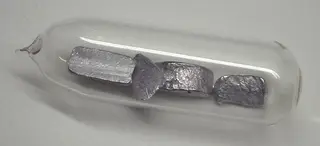
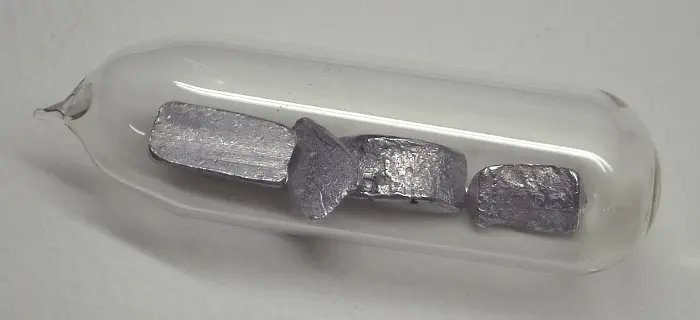
Thallium is a soft, gray metal that can be cut with a knife. It tarnishes quickly in air.
Thallium compounds are extremely toxic, tasteless and odorless, which is why their use as pesticides has been banned in many countries.
Quick answers
- What is thallium?
- Thallium (Tl) is a post-transition metal with atomic number 81. It is a solid at room temperature. A soft, highly toxic metal discovered through a bright green spectral line. It was once used in rat poison and features in crime novels.
- Where is thallium found?
- Thallium is recovered in small amounts from the processing of copper, lead and zinc ores.
- What is thallium used for?
- Its main uses are electronics and optics; medicine. Some infrared optics, detectors and special glasses.
At a glance
| Atomic number | 81 |
|---|---|
| Symbol | Tl |
| Standard atomic weight | 204.38 ± 0.01 |
| Natural isotopes | 2 (IUPAC CIAAW 2024) |
| Family | Post-transition metal |
| Group | Group 13 |
| Period | Period 6 |
| Block | p |
| Electron configuration | [Xe] 4f14 5d10 6s2 6p1 orbital diagram → |
| State at room temperature | Solid |
| Melting point | 304 °C (579 °F, 577 K) |
| Boiling point | 1,473 °C (2,683 °F, 1,746 K) |
| Density | 11.8 g/cm³ |
| Electronegativity (Pauling) | 1.62 |
| Atomic radius | 196 pm |
| First ionization energy | 6.108 eV |
| Oxidation states | +3, +1 |
| Discovery | 1861 · William Crookes |
Discovery
In 1861 William Crookes in England saw a bright green line in the spectrum of residues from a sulfuric acid plant and identified a new element. Claude-Auguste Lamy isolated the metal in France in 1862.
Where the name comes from
From the Greek thallos, a green shoot, after its bright green spectral line.
Where is thallium found?
Thallium is recovered in small amounts from the processing of copper, lead and zinc ores.
Where every element is found →
What is thallium used for?
- Electronics and optics. Some infrared optics, detectors and special glasses.
- Medicine. Thallium-201 was used for heart scans.
What every element is used for → · Where are the elements found? →
Notable isotopes
- Tl-20329.44–29.59%
- Tl-20570.41–70.56%
Percent by number of atoms. The light band shows the range over which the share varies in natural samples. Source: IUPAC CIAAW 2024
| Isotope | Half-life | Note |
|---|---|---|
| Thallium-205 | Stable | About 70% of natural thallium. |
| Thallium-203 | Stable | About 30% of natural thallium. |
| Thallium-201 | about 3 days | Used in medical imaging. |
Safety
Highly toxic
Thallium and its compounds are poisonous and can be absorbed through the skin. They are handled only with strict precautions.
Did you know?
- Thallium’s toxicity has long appeared in crime fiction; Agatha Christie’s novel The Pale Horse centers on thallium poisoning.
- Crookes was elected a Fellow of the Royal Society in 1863, largely for his discovery of thallium.
- Thallium is unusual in forming many stable compounds with a charge of +1.
Frequently asked questions
Why is thallium so dangerous?
Thallium ions mimic potassium in the body and disrupt many cell processes.
Is thallium still used in poisons?
Its use in rat and insect poisons has been banned in many countries.
Is thallium a metal?
Yes. Thallium is a metal, one of the post-transition metals.
What are the properties of thallium?
Atomic number 81, symbol Tl, atomic mass 204.38. It is a solid at room temperature. It melts at 304 °C (579 °F) and boils at 1,473 °C (2,683 °F). Density 11.8 g/cm³. Electronegativity 1.62 (Pauling).
Sources
- Royal Society of Chemistry: Thallium
- Encyclopaedia Britannica: Thallium
- USGS Mineral Commodity Summaries: Thallium
- NNDC NuDat 3 (nuclear data)
- PubChem Periodic Table (NIH)
- IUPAC/CIAAW standard atomic weights
- Royal Society of Chemistry, Periodic Table
- Wikipedia: Thallium
Last checked: 16 November 2026
Other group 13 elements
Boron
A hard metalloid best known from borax and heat-resistant glass. It also strengthens magnets and absorbs neutrons in nuclear reactors.
Aluminum
The most abundant metal in Earth’s crust. Light, rust-resistant and easy to recycle, it is in drinks cans, aircraft and power lines.
Gallium
A metal that melts in your hand, at about 30 °C. Gallium compounds light up LEDs and run fast electronics.
Indium
A very soft metal behind every touchscreen: indium tin oxide is a transparent coating that conducts electricity.
Nihonium
The first element discovered in Asia, named after Japan.