Element 080 · also quicksilver
Mercury (Hg)
The only metal that is liquid at room temperature. Once used in thermometers, it is now restricted worldwide because it is toxic.
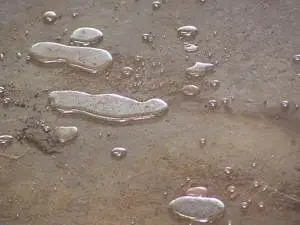
Mercury is a heavy, silvery metal that melts at about −39 °C. Its droplets roll into shiny beads because of very high surface tension.
It evaporates slowly at room temperature, and its vapor is toxic. Mercury compounds can build up in fish and travel up the food chain.
Quick answers
- What is mercury?
- Mercury (Hg) is a transition metal with atomic number 80. The only metal that is liquid at room temperature. Once used in thermometers, it is now restricted worldwide because it is toxic.
- Where is mercury found?
- Mercury is found mainly as the red mineral cinnabar (mercury sulfide). Volcanoes and burning coal release mercury into the air.
- What is mercury used for?
- Its main uses are lighting, dental amalgam and industry. Fluorescent lamps contain a little mercury vapor; they are being replaced by LEDs.
At a glance
| Atomic number | 80 |
|---|---|
| Symbol | Hg |
| Standard atomic weight | 200.59 ± 0.01 |
| Natural isotopes | 7 (IUPAC CIAAW 2024) |
| Family | Transition metal |
| Group | Group 12 |
| Period | Period 6 |
| Block | d |
| Electron configuration | [Xe] 4f14 5d10 6s2 orbital diagram → |
| State at room temperature | Liquid |
| Melting point | −38.83 °C (−37.9 °F, 234.32 K) |
| Boiling point | 356.73 °C (674.1 °F, 629.88 K) |
| Density | 13.534 g/cm³ |
| Electronegativity (Pauling) | 2 |
| Atomic radius | 209 pm |
| First ionization energy | 10.438 eV |
| Oxidation states | +2, +1 |
| Discovery | Known since ancient times |
Discovery
Mercury has been known since ancient times. It was found in Egyptian tombs, and ancient Chinese and Indian alchemists studied it.
Where the name comes from
Named after the Roman god Mercury, the swift messenger, and the planet. The symbol Hg comes from the Latin hydrargyrum, “water-silver”.
Where is mercury found?
Mercury is found mainly as the red mineral cinnabar (mercury sulfide). Volcanoes and burning coal release mercury into the air.
Where every element is found →
What is mercury used for?
- Lighting. Fluorescent lamps contain a little mercury vapor; they are being replaced by LEDs.
- Dental amalgam. Some tooth fillings are mercury alloys, though their use is being phased down.
- Industry. Mercury was used in making chlorine and in measuring instruments; these uses are being phased out.
- Gold mining. Small-scale gold mining still uses mercury, and is now the largest source of mercury pollution.
What every element is used for → · Where are the elements found? →
Common compounds
| Compound | Formula | Note |
|---|---|---|
| Mercury(II) sulfide | HgS | Red cinnabar ore. |
Notable isotopes
- Hg-1960.15%
- Hg-19810.04%
- Hg-19916.94%
- Hg-20023.14%
- Hg-20113.17%
- Hg-20229.74%
- Hg-2046.82%
Percent by number of atoms. The light band shows the range over which the share varies in natural samples. Source: IUPAC CIAAW 2024
| Isotope | Half-life | Note |
|---|---|---|
| Mercury-202 | Stable | The most common isotope, about 29.9% of natural mercury. Mercury has seven stable isotopes. |
| Mercury-200 | Stable | About 23.1%. |
| Mercury-199 | Stable | About 16.9%. |
Safety
Toxic vapor and compounds
Breathing mercury vapor damages the nervous system and kidneys. Methylmercury in fish is a particular concern for pregnant women and young children.
If a mercury thermometer breaks, do not use a vacuum cleaner. Ventilate the room and follow official clean-up guidance.
Did you know?
- The English name comes from the Roman god Mercury; the fast-flowing metal was linked to the messenger god’s speed.
- Mercury’s surface tension is so high that small droplets stay almost spherical and do not wet glass.
- Relativistic effects in heavy atoms help explain why mercury melts at such a low temperature: they bind its outer electrons more tightly.
Frequently asked questions
Why is mercury liquid at room temperature?
Its outer electrons are held so tightly that mercury atoms bond only weakly to each other, so it melts at about −39 °C.
What is the Minamata Convention?
A global treaty, in force since 2017, that limits the mining, use and release of mercury. It is named after a Japanese town poisoned by mercury pollution.
Is mercury a metal?
Yes. Mercury is a metal, one of the transition metals.
What are the properties of mercury?
Atomic number 80, symbol Hg, atomic mass 200.59. It is a liquid at room temperature. It melts at −38.83 °C (−37.9 °F) and boils at 356.73 °C (674.1 °F). Density 13.534 g/cm³. Electronegativity 2 (Pauling).
Sources
- Royal Society of Chemistry: Mercury
- Encyclopaedia Britannica: Mercury
- Minamata Convention on Mercury
- US EPA: What to do if a mercury thermometer breaks
- NNDC NuDat 3 (nuclear data)
- PubChem Periodic Table (NIH)
- IUPAC/CIAAW standard atomic weights
- Royal Society of Chemistry, Periodic Table
- Wikipedia: Mercury
Last checked: 16 November 2026
Other group 12 elements
Zinc
The metal that stops steel from rusting. Zinc coats car bodies and fences, goes into brass and batteries, and is an essential nutrient.
Cadmium
A soft, bluish metal behind bright yellow and red paints and some batteries. It is toxic, so its use is now tightly restricted.
Copernicium
A superheavy element named after Nicolaus Copernicus. It is even more volatile than mercury, the element above it.