Element 031
Gallium (Ga)
A metal that melts in your hand, at about 30 °C. Gallium compounds light up LEDs and run fast electronics.
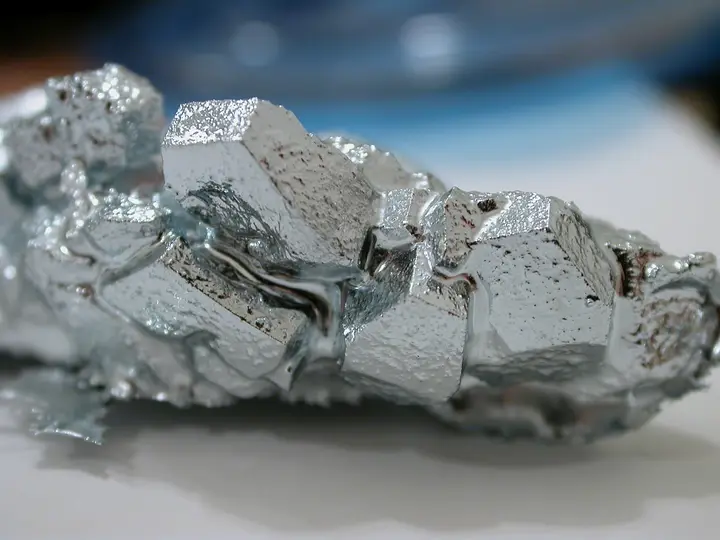
Gallium is a soft, silvery metal that melts at about 29.8 °C, just above room temperature, yet does not boil until well over 2,000 °C.
Like water, it expands when it freezes. Its compounds with nitrogen and arsenic are semiconductors used in LEDs, lasers, phones and solar cells.
Quick answers
- What is gallium?
- Gallium (Ga) is a post-transition metal with atomic number 31. It is a solid at room temperature. A metal that melts in your hand, at about 30 °C. Gallium compounds light up LEDs and run fast electronics.
- Where is gallium found?
- Gallium is not mined directly. It is recovered as a by-product of aluminum (bauxite) and zinc processing; China produces most of it.
- What is gallium used for?
- Its main uses are LEDs and lasers; electronics; solar cells. Gallium nitride makes blue and white LEDs and the lasers in Blu-ray players.
At a glance
| Atomic number | 31 |
|---|---|
| Symbol | Ga |
| Standard atomic weight | 69.723 ± 0.001 |
| Natural isotopes | 2 (IUPAC CIAAW 2024) |
| Family | Post-transition metal |
| Group | Group 13 |
| Period | Period 4 |
| Block | p |
| Electron configuration | [Ar] 3d10 4s2 4p1 orbital diagram → |
| State at room temperature | Solid |
| Melting point | 29.76 °C (85.6 °F, 302.91 K) |
| Boiling point | 2,204 °C (3,999 °F, 2,477 K) |
| Density | 5.91 g/cm³ |
| Electronegativity (Pauling) | 1.81 |
| Atomic radius | 187 pm |
| First ionization energy | 5.999 eV |
| Oxidation states | +3 |
| Discovery | 1875 · Paul-Émile Lecoq de Boisbaudran |
Discovery
Mendeleev predicted an “eka-aluminum” in 1871. In 1875 the French chemist Paul-Émile Lecoq de Boisbaudran spotted new violet lines in the spectrum of a zinc ore and isolated the metal that year.
Its measured properties matched Mendeleev’s predictions closely, helping establish the periodic table.
Where the name comes from
From Gallia, the Latin name for France.
Where is gallium found?
Gallium is not mined directly. It is recovered as a by-product of aluminum (bauxite) and zinc processing; China produces most of it.
Where every element is found →
What is gallium used for?
- LEDs and lasers. Gallium nitride makes blue and white LEDs and the lasers in Blu-ray players.
- Electronics. Gallium arsenide and gallium nitride chips handle high frequencies and power in phones, radar and chargers.
- Solar cells. High-efficiency solar cells on satellites use gallium compounds.
- Thermometers. Galinstan, a gallium alloy, replaces mercury in some thermometers.
What every element is used for → · Where are the elements found? →
Common compounds
| Compound | Formula | Note |
|---|---|---|
| Gallium nitride | GaN | The basis of blue and white LEDs. |
| Gallium arsenide | GaAs | Red LEDs and solar cells for spacecraft. |
Notable isotopes
- Ga-6960.108%
- Ga-7139.892%
Percent by number of atoms. The light band shows the range over which the share varies in natural samples. Source: IUPAC CIAAW 2024
| Isotope | Half-life | Note |
|---|---|---|
| Gallium-69 | Stable | About 60% of natural gallium. |
| Gallium-71 | Stable | About 40% of natural gallium. |
| Gallium-68 | about 68 minutes | Used in PET medical imaging. |
Safety
Low toxicity; harms aluminum
Gallium has low toxicity but can stain skin. It seeps into aluminum and makes it very brittle, so airlines treat it as dangerous goods.
Did you know?
- The 2014 Nobel Prize in Physics went to Isamu Akasaki, Hiroshi Amano and Shuji Nakamura for efficient blue LEDs made with gallium nitride.
- A spoon made of gallium melts in a cup of hot tea, an old chemists’ prank.
- Gallium stays liquid over a wider temperature range than almost any other element.
Frequently asked questions
Does gallium really melt in your hand?
Yes. It melts at about 29.8 °C, below body temperature.
Why is gallium important for LEDs?
Gallium nitride emits blue light efficiently, the basis of white LED lighting.
Is gallium a metal?
Yes. Gallium is a metal, one of the post-transition metals.
What are the properties of gallium?
Atomic number 31, symbol Ga, atomic mass 69.723. It is a solid at room temperature. It melts at 29.76 °C (85.6 °F) and boils at 2,204 °C (3,999 °F). Density 5.91 g/cm³. Electronegativity 1.81 (Pauling).
Sources
- Royal Society of Chemistry: Gallium
- Encyclopaedia Britannica: Gallium
- USGS Mineral Commodity Summaries: Gallium
- Nobel Prize in Physics 2014 (blue LEDs)
- NNDC NuDat 3 (nuclear data)
- PubChem Periodic Table (NIH)
- IUPAC/CIAAW standard atomic weights
- Royal Society of Chemistry, Periodic Table
- Wikipedia: Gallium
Last checked: 16 November 2026
Other group 13 elements
Boron
A hard metalloid best known from borax and heat-resistant glass. It also strengthens magnets and absorbs neutrons in nuclear reactors.
Aluminum
The most abundant metal in Earth’s crust. Light, rust-resistant and easy to recycle, it is in drinks cans, aircraft and power lines.
Indium
A very soft metal behind every touchscreen: indium tin oxide is a transparent coating that conducts electricity.
Thallium
A soft, highly toxic metal discovered through a bright green spectral line. It was once used in rat poison and features in crime novels.
Nihonium
The first element discovered in Asia, named after Japan.