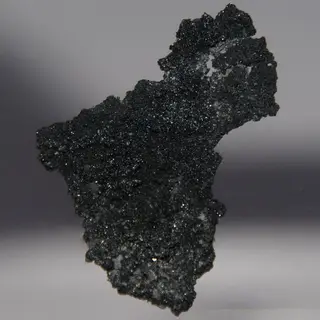
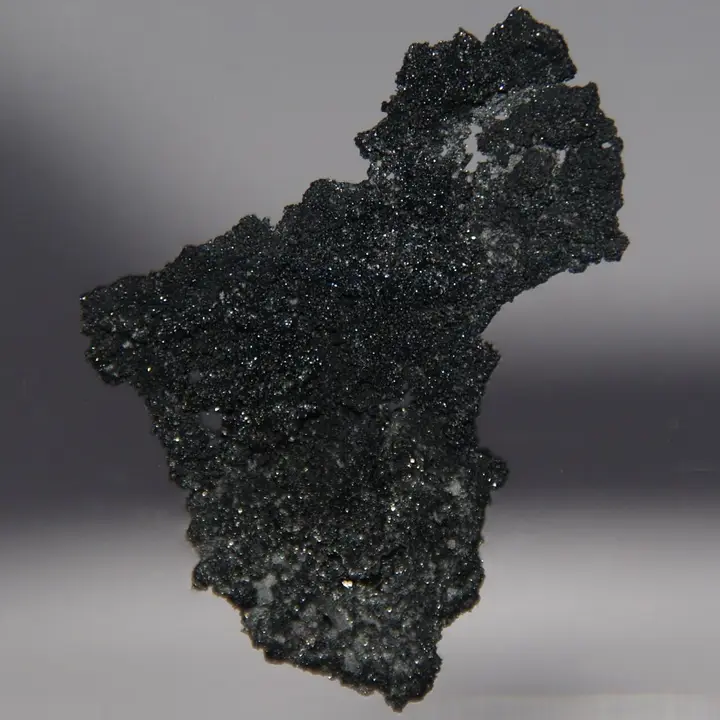
Pure boron is a hard, dark, brittle metalloid. It is rarely seen on its own; in nature it occurs as borate minerals such as borax.
Boron compounds are everywhere in daily life, from oven-proof glassware and glass-fiber insulation to detergents. Plants need small amounts to grow.
Quick answers
- What is boron?
- Boron (B) is a metalloid with atomic number 5. It is a solid at room temperature. A hard metalloid best known from borax and heat-resistant glass. It also strengthens magnets and absorbs neutrons in nuclear reactors.
- Where is boron found?
- Boron is concentrated in borate deposits left by evaporated lakes. Türkiye has by far the world’s largest known reserves.
- What is boron used for?
- Its main uses are glass and fiberglass; magnets; nuclear reactors. Borosilicate glass resists heat shock; glass fibers for insulation and composites contain boron.
At a glance
| Atomic number | 5 |
|---|---|
| Symbol | B |
| Standard atomic weight | 10.81 ± 0.02 |
| Natural isotopes | 2 (IUPAC CIAAW 2024) |
| Family | Metalloid |
| Group | Group 13 |
| Period | Period 2 |
| Block | p |
| Electron configuration | [He] 2s2 2p1 orbital diagram → |
| State at room temperature | Solid |
| Melting point | 2,075 °C (3,767 °F, 2,348 K) |
| Boiling point | 4,000 °C (7,232 °F, 4,273 K) |
| Density | 2.37 g/cm³ |
| Electronegativity (Pauling) | 2.04 |
| Atomic radius | 192 pm |
| First ionization energy | 8.298 eV |
| Oxidation states | +3 |
| Discovery | 1808 · Joseph Louis Gay-Lussac, Louis Jacques Thénard and Humphry Davy |
Discovery
In 1808 Joseph Louis Gay-Lussac and Louis Jacques Thénard in France, and Humphry Davy in England, independently obtained impure boron from boric acid. Fairly pure boron was not made until much later.
Where the name comes from
From borax, its best-known mineral. The word reached European languages through Arabic and Persian.
Where is boron found?
Boron is concentrated in borate deposits left by evaporated lakes. Türkiye has by far the world’s largest known reserves.
Where every element is found →
What is boron used for?
- Glass and fiberglass. Borosilicate glass resists heat shock; glass fibers for insulation and composites contain boron.
- Magnets. Neodymium–iron–boron magnets are the strongest permanent magnets, used in motors, wind turbines and headphones.
- Nuclear reactors. Boron-10 absorbs neutrons, so boron is used in control rods and shielding.
- Agriculture and cleaning. Boron is a plant micronutrient; borax is used in detergents.
What every element is used for → · Where are the elements found? →
Common compounds
| Compound | Formula | Note |
|---|---|---|
| Borax | Na₂B₄O₇·10H₂O | The best-known boron mineral. |
| Boric acid | H₃BO₃ | A weak acid used in some products. |
Notable isotopes
- B-1018.9–20.4%
- B-1179.6–81.1%
Percent by number of atoms. The light band shows the range over which the share varies in natural samples. Source: IUPAC CIAAW 2024
| Isotope | Half-life | Note |
|---|---|---|
| Boron-11 | Stable | About 80% of natural boron. |
| Boron-10 | Stable | About 20% of natural boron; a strong neutron absorber. |
Safety
Low hazard in normal use
Boron and borates have low toxicity at everyday exposures, but swallowing large amounts of boric acid or borax is harmful. Keep household products away from children.
Did you know?
- Boron is hardly made by fusion in stars. Most of the universe’s boron formed when cosmic rays broke apart heavier nuclei.
- Boron compounds color a flame green.
- Cubic boron nitride is one of the hardest known materials, second only to diamond among common ones.
Frequently asked questions
Is boron a metal?
No. It is a metalloid, with properties between metals and nonmetals.
Where does most boron come from?
From borate mines in Türkiye and the United States.
What are the properties of boron?
Atomic number 5, symbol B, atomic mass 10.81. It is a solid at room temperature. It melts at 2,075 °C (3,767 °F) and boils at 4,000 °C (7,232 °F). Density 2.37 g/cm³. Electronegativity 2.04 (Pauling).
Sources
- Royal Society of Chemistry: Boron
- Encyclopaedia Britannica: Boron
- USGS Mineral Commodity Summaries: Boron
- NNDC NuDat 3 (nuclear data)
- PubChem Periodic Table (NIH)
- IUPAC/CIAAW standard atomic weights
- Royal Society of Chemistry, Periodic Table
- Wikipedia: Boron
Last checked: 16 November 2026
Other group 13 elements
Aluminum
The most abundant metal in Earth’s crust. Light, rust-resistant and easy to recycle, it is in drinks cans, aircraft and power lines.
Gallium
A metal that melts in your hand, at about 30 °C. Gallium compounds light up LEDs and run fast electronics.
Indium
A very soft metal behind every touchscreen: indium tin oxide is a transparent coating that conducts electricity.
Thallium
A soft, highly toxic metal discovered through a bright green spectral line. It was once used in rat poison and features in crime novels.
Nihonium
The first element discovered in Asia, named after Japan.