Element 013 · also aluminum
Aluminum (Al)
The most abundant metal in Earth’s crust. Light, rust-resistant and easy to recycle, it is in drinks cans, aircraft and power lines.
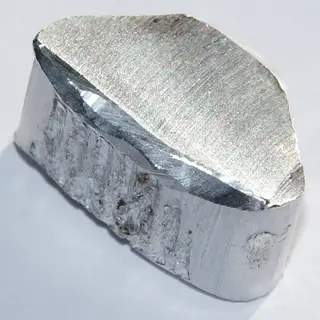
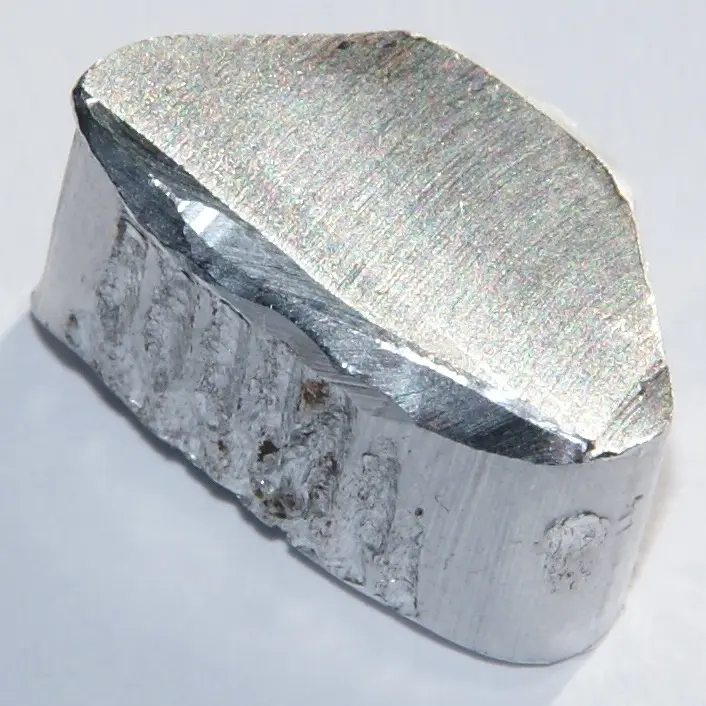
Aluminum (aluminum in British English) is a light, silvery metal. It weighs about a third as much as steel.
A thin, invisible layer of oxide forms on its surface and protects it from further corrosion. It also conducts heat and electricity well.
Quick answers
- What is aluminum?
- Aluminum (Al) is a post-transition metal with atomic number 13. It is a solid at room temperature. The most abundant metal in Earth’s crust. Light, rust-resistant and easy to recycle, it is in drinks cans, aircraft and power lines.
- Where is aluminum found?
- Aluminum makes up about 8% of Earth’s crust by mass, more than any other metal. It is never found free; the main ore is bauxite.
- What is aluminum used for?
- Its main uses are packaging, transport and construction. Drinks cans, foil and food trays.
At a glance
| Atomic number | 13 |
|---|---|
| Symbol | Al |
| Standard atomic weight | 26.982 ± 0.001 |
| Natural isotopes | 1 (IUPAC CIAAW 2024; a single isotope in nature) |
| Family | Post-transition metal |
| Group | Group 13 |
| Period | Period 3 |
| Block | p |
| Electron configuration | [Ne] 3s2 3p1 orbital diagram → |
| State at room temperature | Solid |
| Melting point | 660.29 °C (1,220.5 °F, 933.437 K) |
| Boiling point | 2,519 °C (4,566 °F, 2,792 K) |
| Density | 2.7 g/cm³ |
| Electronegativity (Pauling) | 1.61 |
| Atomic radius | 184 pm |
| First ionization energy | 5.986 eV |
| Oxidation states | +3 |
| Discovery | 1825 · Hans Christian Ørsted |
Discovery
The Danish physicist Hans Christian Ørsted made a small amount of impure aluminum in 1825; Friedrich Wöhler improved the method in 1827.
Aluminum stayed expensive until 1886, when Charles Martin Hall in the United States and Paul Héroult in France independently found a way to make it cheaply by electrolysis.
Where the name comes from
From the Latin alumen, alum, a long-known aluminum salt. Humphry Davy proposed the name; the “aluminium” spelling became standard in Britain and in IUPAC publications.
Where is aluminum found?
Aluminum makes up about 8% of Earth’s crust by mass, more than any other metal. It is never found free; the main ore is bauxite.
Where every element is found →
What is aluminum used for?
- Packaging. Drinks cans, foil and food trays.
- Transport. Aircraft, trains, cars and bicycles use aluminum alloys to save weight.
- Construction. Window frames, cladding and roofing.
- Electricity. Overhead power lines, because aluminum is light and conducts well.
What every element is used for → · Where are the elements found? →
Common compounds
| Compound | Formula | Note |
|---|---|---|
| Aluminum oxide | Al₂O₃ | Corundum, the material of rubies and sapphires. |
Notable isotopes
| Isotope | Half-life | Note |
|---|---|---|
| Aluminum-27 | Stable | All natural aluminum is this isotope. |
| Aluminum-26 | about 717,000 years | Made by cosmic rays. Used to date meteorites and rock surfaces. |
Safety
Metal is safe; fine powder is flammable
Solid aluminum is safe to handle. Very fine aluminum powder can burn or explode if it is dispersed in air near a flame.
Did you know?
- In 1884 a small cast-aluminum pyramid was placed on top of the Washington Monument. At the time aluminum was a precious, showy metal.
- Recycling aluminum takes only a small fraction of the energy needed to make new metal from bauxite.
- Pure aluminum melts at about 660 °C, lower than many structural metals.
Frequently asked questions
Aluminum or aluminum?
Both are correct. “Aluminum” is standard in American English; “aluminum” is used in British English and by IUPAC.
Does aluminum rust?
It does not rust like iron. A thin oxide layer forms immediately and protects the metal underneath.
Is aluminum a metal?
Yes. Aluminum is a metal, one of the post-transition metals.
What are the properties of aluminum?
Atomic number 13, symbol Al, atomic mass 26.982. It is a solid at room temperature. It melts at 660.29 °C (1,220.5 °F) and boils at 2,519 °C (4,566 °F). Density 2.7 g/cm³. Electronegativity 1.61 (Pauling).
Sources
- Royal Society of Chemistry: Aluminium
- Encyclopaedia Britannica: Aluminum
- NNDC NuDat 3 (nuclear data)
- PubChem Periodic Table (NIH)
- IUPAC/CIAAW standard atomic weights
- Royal Society of Chemistry, Periodic Table
- Wikipedia: Aluminum
Last checked: 16 November 2026
Other group 13 elements
Boron
A hard metalloid best known from borax and heat-resistant glass. It also strengthens magnets and absorbs neutrons in nuclear reactors.
Gallium
A metal that melts in your hand, at about 30 °C. Gallium compounds light up LEDs and run fast electronics.
Indium
A very soft metal behind every touchscreen: indium tin oxide is a transparent coating that conducts electricity.
Thallium
A soft, highly toxic metal discovered through a bright green spectral line. It was once used in rat poison and features in crime novels.
Nihonium
The first element discovered in Asia, named after Japan.