Element 011
Sodium (Na)
A soft, highly reactive metal that we eat every day as table salt. Its yellow glow lit city streets for decades.
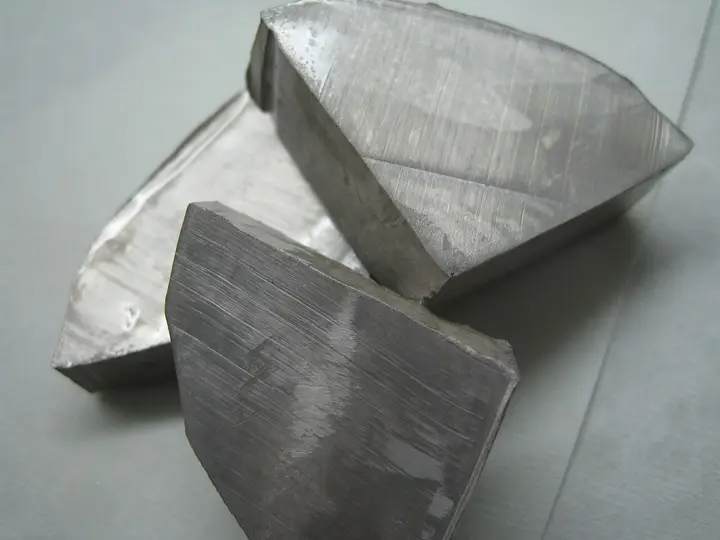
Sodium is a soft, silvery alkali metal that can be cut with a knife. It reacts vigorously with water and is stored under oil.
In compounds it is everywhere: in salt, baking soda and soap. The body needs sodium ions to carry nerve signals and balance fluids.
Quick answers
- What is sodium?
- Sodium (Na) is an alkali metal with atomic number 11. It is a solid at room temperature. A soft, highly reactive metal that we eat every day as table salt. Its yellow glow lit city streets for decades.
- Where is sodium found?
- Sodium is one of the most common elements in Earth’s crust. Seawater contains large amounts of dissolved sodium chloride, and thick salt deposits are left where ancient seas dried up.
- What is sodium used for?
- Its main uses are salt; street lights; baking and cleaning. Sodium chloride seasons and preserves food, de-ices roads and is the raw material for making chlorine and sodium hydroxide.
At a glance
| Atomic number | 11 |
|---|---|
| Symbol | Na |
| Standard atomic weight | 22.990 ± 0.001 |
| Natural isotopes | 1 (IUPAC CIAAW 2024; a single isotope in nature) |
| Family | Alkali metal |
| Group | Group 1 |
| Period | Period 3 |
| Block | s |
| Electron configuration | [Ne] 3s1 orbital diagram → |
| State at room temperature | Solid |
| Melting point | 97.80 °C (208 °F, 370.95 K) |
| Boiling point | 883 °C (1,621 °F, 1,156 K) |
| Density | 0.97 g/cm³ |
| Electronegativity (Pauling) | 0.93 |
| Atomic radius | 227 pm |
| First ionization energy | 5.139 eV |
| Oxidation states | +1 |
| Discovery | 1807 · Humphry Davy |
Discovery
In 1807 Humphry Davy passed an electric current through molten caustic soda (sodium hydroxide) and produced small beads of a shiny metal. A few days earlier he had made potassium the same way.
Where the name comes from
From soda. The symbol Na comes from the Latin natrium, from natron, a natural sodium carbonate mineral.
Where is sodium found?
Sodium is one of the most common elements in Earth’s crust. Seawater contains large amounts of dissolved sodium chloride, and thick salt deposits are left where ancient seas dried up.
Where every element is found →
What is sodium used for?
- Salt. Sodium chloride seasons and preserves food, de-ices roads and is the raw material for making chlorine and sodium hydroxide.
- Street lights. Sodium vapor lamps give an efficient yellow-orange light, although LEDs are now replacing them.
- Baking and cleaning. Sodium bicarbonate (baking soda) and sodium carbonate (washing soda) are common household chemicals.
- Nuclear reactors. Liquid sodium carries heat in some fast-neutron reactors.
What every element is used for → · Where are the elements found? →
Common compounds
| Compound | Formula | Note |
|---|---|---|
| Sodium chloride | NaCl | Table salt. |
| Sodium bicarbonate | NaHCO₃ | Baking soda; a raising agent in baking. |
| Sodium hydroxide | NaOH | Lye or caustic soda; used to make soap and paper. |
| Sodium hypochlorite | NaClO | The active ingredient in household bleach. |
Notable isotopes
| Isotope | Half-life | Note |
|---|---|---|
| Sodium-23 | Stable | All natural sodium is this isotope. |
| Sodium-22 | 2.6 years | A positron-emitting radioactive isotope, used in laboratories as a positron source. |
| Sodium-24 | about 15 hours | Has been used in industry to trace leaks and flows. |
Safety
Metal reacts violently with water
Sodium metal reacts with water to produce hydrogen gas and enough heat to set it alight.
In the diet, the World Health Organization recommends adults eat less than 5 g of salt a day, because too much is linked to high blood pressure.
Did you know?
- Sprinkle salt into a flame and it turns yellow. The color comes from light that sodium atoms give off at about 589 nanometers; it is also the second color of Element Atlas.
- Sodium floats on water: its density (0.97 g/cm³) is slightly less than water’s.
- Nerve cells send signals by moving sodium and potassium ions in and out across their membranes.
Frequently asked questions
Is sodium the same as salt?
No. Sodium is a reactive metal. Table salt is sodium chloride, a stable compound of sodium and chlorine.
Why is sodium kept in oil?
It reacts with water vapor and oxygen in the air. Oil keeps the air away.
Is sodium a metal?
Yes. Sodium is a metal, one of the alkali metals.
What are the properties of sodium?
Atomic number 11, symbol Na, atomic mass 22.990. It is a solid at room temperature. It melts at 97.80 °C (208 °F) and boils at 883 °C (1,621 °F). Density 0.97 g/cm³. Electronegativity 0.93 (Pauling).
Sources
- Royal Society of Chemistry: Sodium
- Encyclopaedia Britannica: Sodium
- World Health Organization: Salt reduction
- NNDC NuDat 3 (nuclear data)
- PubChem Periodic Table (NIH)
- IUPAC/CIAAW standard atomic weights
- Royal Society of Chemistry, Periodic Table
- Wikipedia: Sodium
Last checked: 16 November 2026
Other group 1 elements
Hydrogen
The lightest and most abundant element in the universe. Stars run on hydrogen, and every water molecule contains two hydrogen atoms.
Lithium
The lightest metal, light enough to float on water. Lithium-ion batteries in phones and electric cars depend on it.
Potassium
A soft metal that reacts violently with water and burns with a lilac flame. Our nerves and muscles need potassium, and so do crops.
Rubidium
A very reactive alkali metal that melts on a hot day. Rubidium atoms keep time in atomic clocks.
Cesium
A golden, extremely reactive metal that melts just above room temperature. The second, the unit of time, is defined by cesium atoms.
Francium
The last element discovered in nature and one of the most unstable. It decays within minutes, so its properties have never been measured.