Element 003
Lithium (Li)
The lightest metal, light enough to float on water. Lithium-ion batteries in phones and electric cars depend on it.
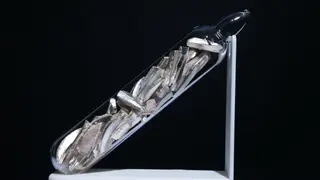
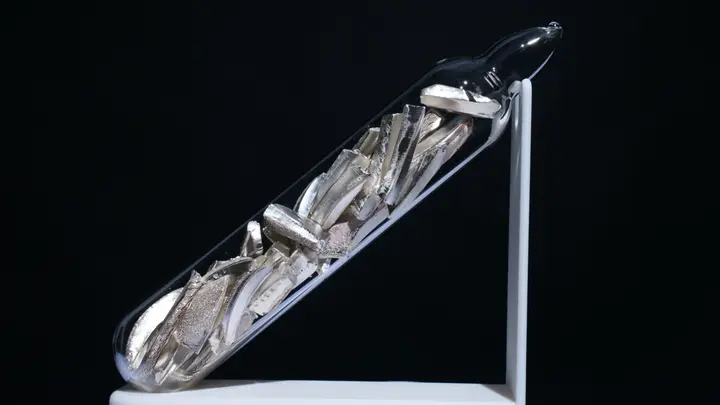
Lithium is a soft, silvery alkali metal. It is the least dense of all metals and can be cut with a knife.
Like the other alkali metals it reacts with water, though more gently than sodium or potassium. In air it quickly tarnishes, so it is stored under oil or in a dry atmosphere.
Quick answers
- What is lithium?
- Lithium (Li) is an alkali metal with atomic number 3. It is a solid at room temperature. The lightest metal, light enough to float on water. Lithium-ion batteries in phones and electric cars depend on it.
- Where is lithium found?
- Lithium is never found as a free metal. It is mined from hard-rock minerals such as spodumene, mainly in Australia, and extracted from salty brines under the salt flats of Chile and Argentina.
- What is lithium used for?
- Its main uses are batteries; glass and ceramics; lubricating grease. Rechargeable lithium-ion batteries now take most of the world’s lithium.
At a glance
| Atomic number | 3 |
|---|---|
| Symbol | Li |
| Standard atomic weight | 6.94 ± 0.06 |
| Natural isotopes | 2 (IUPAC CIAAW 2024) |
| Family | Alkali metal |
| Group | Group 1 |
| Period | Period 2 |
| Block | s |
| Electron configuration | [He] 2s1 orbital diagram → |
| State at room temperature | Solid |
| Melting point | 180.50 °C (356.9 °F, 453.65 K) |
| Boiling point | 1,342 °C (2,447 °F, 1,615 K) |
| Density | 0.534 g/cm³ |
| Electronegativity (Pauling) | 0.98 |
| Atomic radius | 182 pm |
| First ionization energy | 5.392 eV |
| Oxidation states | +1 |
| Discovery | 1817 · Johan August Arfwedson |
Discovery
In 1817 the Swedish chemist Johan August Arfwedson found a new alkali in the mineral petalite. He could not isolate the metal itself.
Small amounts of lithium metal were first made by electrolysis in 1821, and larger amounts by Robert Bunsen and Augustus Matthiessen in 1855.
Where the name comes from
From the Greek lithos, stone, because it was found in a mineral rather than in plant or animal matter like sodium and potassium.
Where is lithium found?
Lithium is never found as a free metal. It is mined from hard-rock minerals such as spodumene, mainly in Australia, and extracted from salty brines under the salt flats of Chile and Argentina.
Where every element is found →
What is lithium used for?
- Batteries. Rechargeable lithium-ion batteries now take most of the world’s lithium. They power phones, laptops and electric vehicles.
- Glass and ceramics. Lithium compounds lower melting temperatures and make heat-resistant glass and cookware.
- Lubricating grease. Lithium soaps thicken greases that stay stable over a wide temperature range.
- Medicine. Lithium salts are a long-established treatment for bipolar disorder, used only under medical supervision.
What every element is used for → · Where are the elements found? →
Common compounds
| Compound | Formula | Note |
|---|---|---|
| Lithium carbonate | Li₂CO₃ | A key raw material for batteries. |
| Lithium cobalt oxide | LiCoO₂ | Cathode material of many lithium-ion batteries. |
Notable isotopes
- Li-61.9–7.8%
- Li-792.2–98.1%
Percent by number of atoms. The light band shows the range over which the share varies in natural samples. Source: IUPAC CIAAW 2024
| Isotope | Half-life | Note |
|---|---|---|
| Lithium-7 | Stable | About 92.5% of natural lithium. |
| Lithium-6 | Stable | About 7.5% of natural lithium. Important in fusion research for breeding tritium. |
Safety
Reacts with water; damaged batteries can catch fire
Lithium metal reacts with water to give flammable hydrogen gas and a corrosive solution.
Damaged or overheated lithium-ion batteries can catch fire. Do not puncture them, and recycle them rather than putting them in household rubbish.
Did you know?
- Lithium compounds turn a flame deep crimson red.
- A little lithium formed in the first minutes after the Big Bang, along with hydrogen and helium.
- The 2019 Nobel Prize in Chemistry went to John B. Goodenough, M. Stanley Whittingham and Akira Yoshino for developing the lithium-ion battery.
Frequently asked questions
Does lithium float on water?
Yes. Its density is about 0.53 g/cm³, roughly half that of water, but it reacts with the water as it floats.
Where does most lithium come from?
Mainly from Australian hard-rock mines and from brines in South America; China refines a large share of it.
Is lithium a metal?
Yes. Lithium is a metal, one of the alkali metals.
What are the properties of lithium?
Atomic number 3, symbol Li, atomic mass 6.94. It is a solid at room temperature. It melts at 180.50 °C (356.9 °F) and boils at 1,342 °C (2,447 °F). Density 0.534 g/cm³. Electronegativity 0.98 (Pauling).
Sources
- Royal Society of Chemistry: Lithium
- Encyclopaedia Britannica: Lithium
- USGS Mineral Commodity Summaries: Lithium
- Nobel Prize in Chemistry 2019 (lithium-ion batteries)
- NNDC NuDat 3 (nuclear data)
- PubChem Periodic Table (NIH)
- IUPAC/CIAAW standard atomic weights
- Royal Society of Chemistry, Periodic Table
- Wikipedia: Lithium
Last checked: 16 November 2026
Other group 1 elements
Hydrogen
The lightest and most abundant element in the universe. Stars run on hydrogen, and every water molecule contains two hydrogen atoms.
Sodium
A soft, highly reactive metal that we eat every day as table salt. Its yellow glow lit city streets for decades.
Potassium
A soft metal that reacts violently with water and burns with a lilac flame. Our nerves and muscles need potassium, and so do crops.
Rubidium
A very reactive alkali metal that melts on a hot day. Rubidium atoms keep time in atomic clocks.
Cesium
A golden, extremely reactive metal that melts just above room temperature. The second, the unit of time, is defined by cesium atoms.
Francium
The last element discovered in nature and one of the most unstable. It decays within minutes, so its properties have never been measured.