Element 037
Rubidium (Rb)
A very reactive alkali metal that melts on a hot day. Rubidium atoms keep time in atomic clocks.
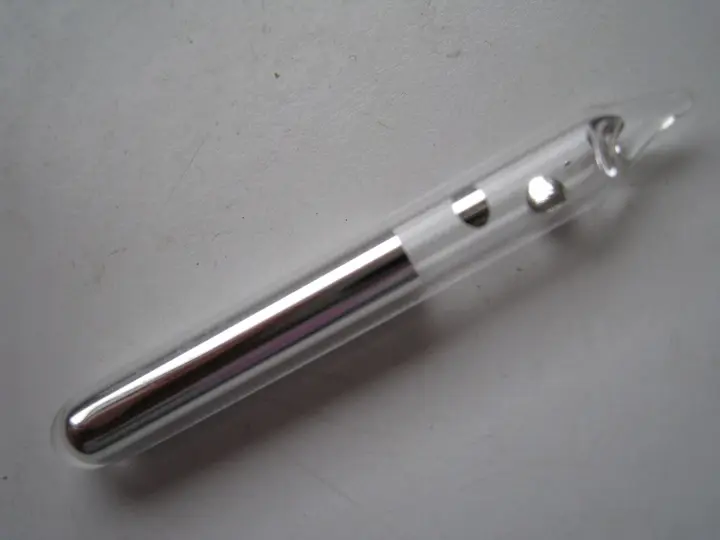
Rubidium is a soft, silvery-white alkali metal that melts at about 39 °C. It bursts into flame in air and reacts explosively with water.
Its atoms have a very regular natural vibration, which makes rubidium useful for precise clocks and laboratory physics.
Quick answers
- What is rubidium?
- Rubidium (Rb) is an alkali metal with atomic number 37. It is a solid at room temperature. A very reactive alkali metal that melts on a hot day. Rubidium atoms keep time in atomic clocks.
- Where is rubidium found?
- Rubidium is fairly common in Earth’s crust but forms no minerals of its own. It is recovered as a by-product of processing lithium and cesium minerals.
- What is rubidium used for?
- Its main uses are atomic clocks, research and dating rocks. Rubidium frequency standards keep time in telecommunications and satellite navigation systems.
At a glance
| Atomic number | 37 |
|---|---|
| Symbol | Rb |
| Standard atomic weight | 85.468 ± 0.001 |
| Natural isotopes | 2 (IUPAC CIAAW 2024) |
| Family | Alkali metal |
| Group | Group 1 |
| Period | Period 5 |
| Block | s |
| Electron configuration | [Kr] 5s1 orbital diagram → |
| State at room temperature | Solid |
| Melting point | 39.31 °C (102.8 °F, 312.46 K) |
| Boiling point | 688 °C (1,270 °F, 961 K) |
| Density | 1.53 g/cm³ |
| Electronegativity (Pauling) | 0.82 |
| Atomic radius | 303 pm |
| First ionization energy | 4.177 eV |
| Oxidation states | +1 |
| Discovery | 1861 · Robert Bunsen and Gustav Kirchhoff |
Discovery
In 1861 Robert Bunsen and Gustav Kirchhoff analyzed the mineral lepidolite with their new spectroscope and saw two deep red lines that belonged to no known element.
Where the name comes from
From the Latin rubidus, deep red, after the red lines in its spectrum.
Where is rubidium found?
Rubidium is fairly common in Earth’s crust but forms no minerals of its own. It is recovered as a by-product of processing lithium and cesium minerals.
Where every element is found →
What is rubidium used for?
- Atomic clocks. Rubidium frequency standards keep time in telecommunications and satellite navigation systems.
- Research. Rubidium atoms are cooled by lasers in experiments on quantum physics.
- Dating rocks. The decay of rubidium-87 to strontium-87 is used to date ancient rocks.
What every element is used for → · Where are the elements found? →
Notable isotopes
- Rb-8572.17%
- Rb-8727.83%
Percent by number of atoms. The light band shows the range over which the share varies in natural samples. Source: IUPAC CIAAW 2024
| Isotope | Half-life | Note |
|---|---|---|
| Rubidium-85 | Stable | About 72% of natural rubidium. |
| Rubidium-87 | about 49 billion years | About 28% of natural rubidium; very weakly radioactive. |
Safety
Ignites in air, explodes in water
Rubidium metal must be stored sealed under inert gas or oil. It reacts violently with water and can ignite spontaneously in air.
Did you know?
- In 1995 the first Bose–Einstein condensate was made from rubidium-87 atoms cooled to near absolute zero. The work earned the 2001 Nobel Prize in Physics.
- Natural rubidium is slightly radioactive, because about a quarter of it is rubidium-87.
- Rubidium and cesium were the first elements discovered with a spectroscope.
Frequently asked questions
Why is rubidium used in atomic clocks?
Its atoms switch between two energy states at an extremely stable frequency, which can be used as a time standard.
Is rubidium dangerous?
The metal is highly reactive; its compounds are of low toxicity.
Is rubidium a metal?
Yes. Rubidium is a metal, one of the alkali metals.
What are the properties of rubidium?
Atomic number 37, symbol Rb, atomic mass 85.468. It is a solid at room temperature. It melts at 39.31 °C (102.8 °F) and boils at 688 °C (1,270 °F). Density 1.53 g/cm³. Electronegativity 0.82 (Pauling).
Sources
- Royal Society of Chemistry: Rubidium
- Encyclopaedia Britannica: Rubidium
- Nobel Prize in Physics 2001 (Bose–Einstein condensation)
- NNDC NuDat 3 (nuclear data)
- PubChem Periodic Table (NIH)
- IUPAC/CIAAW standard atomic weights
- Royal Society of Chemistry, Periodic Table
- Wikipedia: Rubidium
Last checked: 16 November 2026
Other group 1 elements
Hydrogen
The lightest and most abundant element in the universe. Stars run on hydrogen, and every water molecule contains two hydrogen atoms.
Lithium
The lightest metal, light enough to float on water. Lithium-ion batteries in phones and electric cars depend on it.
Sodium
A soft, highly reactive metal that we eat every day as table salt. Its yellow glow lit city streets for decades.
Potassium
A soft metal that reacts violently with water and burns with a lilac flame. Our nerves and muscles need potassium, and so do crops.
Cesium
A golden, extremely reactive metal that melts just above room temperature. The second, the unit of time, is defined by cesium atoms.
Francium
The last element discovered in nature and one of the most unstable. It decays within minutes, so its properties have never been measured.