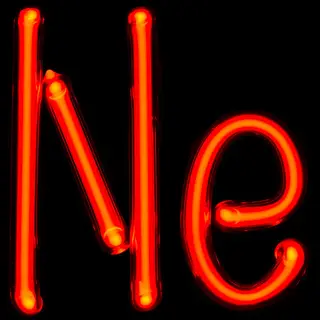
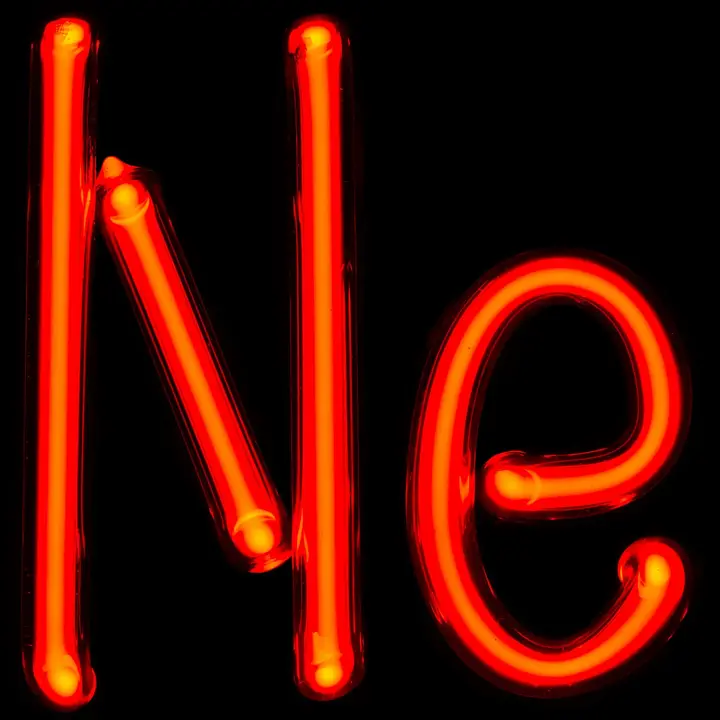
Neon is a colorless, odorless noble gas. Like helium, it has a full outer shell and forms no stable compounds.
When an electric current passes through neon at low pressure, it glows a vivid reddish orange. That glow gave its name to neon lighting.
Quick answers
- What is neon?
- Neon (Ne) is a noble gas with atomic number 10. It is a gas at room temperature. The noble gas behind glowing red-orange signs. Neon is rare in air but common in the universe.
- Where is neon found?
- Neon is only about 18 parts per million of Earth’s air, and it is obtained as a by-product of separating air into oxygen and nitrogen. In the universe as a whole it is one of the most abundant elements.
- What is neon used for?
- Its main uses are signs and lighting; lasers; cooling. Neon tubes give a red-orange light.
At a glance
| Atomic number | 10 |
|---|---|
| Symbol | Ne |
| Standard atomic weight | 20.180 ± 0.001 |
| Natural isotopes | 3 (IUPAC CIAAW 2024) |
| Family | Noble gas |
| Group | Group 18 |
| Period | Period 2 |
| Block | p |
| Electron configuration | [He] 2s2 2p6 orbital diagram → |
| State at room temperature | Gas |
| Melting point | −248.59 °C (−415.5 °F, 24.56 K) |
| Boiling point | −246.08 °C (−410.9 °F, 27.07 K) |
| Density | 0.8999 g/L (0 °C, 1 atm) |
| Electronegativity (Pauling) | Not defined or not measured |
| Atomic radius | 154 pm |
| First ionization energy | 21.565 eV |
| Oxidation states | 0 |
| Discovery | 1898 · William Ramsay and Morris Travers |
Discovery
In 1898 William Ramsay and Morris Travers in London cooled air until it liquefied, then let it slowly boil. One of the gases that came off glowed brilliant red in a discharge tube: neon.
Where the name comes from
From the Greek neos, new.
Where is neon found?
Neon is only about 18 parts per million of Earth’s air, and it is obtained as a by-product of separating air into oxygen and nitrogen. In the universe as a whole it is one of the most abundant elements.
Where every element is found →
What is neon used for?
- Signs and lighting. Neon tubes give a red-orange light. Other colors usually come from other gases or coatings inside the glass.
- Lasers. Helium–neon lasers were long used in barcode scanners and laboratories, and neon is a buffer gas in lasers that make computer chips.
- Cooling. Liquid neon is a refrigerant for very low temperatures.
What every element is used for → · Where are the elements found? →
Notable isotopes
- Ne-2090.48%
- Ne-210.27%
- Ne-229.25%
Percent by number of atoms. The light band shows the range over which the share varies in natural samples. Source: IUPAC CIAAW 2024
| Isotope | Half-life | Note |
|---|---|---|
| Neon-20 | Stable | About 90.5% of natural neon. |
| Neon-22 | Stable | About 9.3%. |
| Neon-21 | Stable | About 0.3%. |
Safety
Harmless, except in closed spaces
Neon is not toxic. Like any inert gas, it can displace oxygen in a confined space.
Did you know?
- True neon light is only red-orange. Blue “neon” signs usually contain argon with a little mercury vapor.
- Neon has no known stable neutral compounds.
- Neon sign tubes are shaped by hand, by craftspeople who heat glass tubing in a flame and bend it.
Frequently asked questions
Are all neon signs made with neon?
No. Only the red-orange ones are pure neon. Other colors use other gases, such as argon, or colored glass and phosphor coatings.
Where does neon come from?
It is separated from liquefied air, alongside oxygen, nitrogen and argon.
Is neon a metal?
No. Neon is a nonmetal, one of the noble gases.
What are the properties of neon?
Atomic number 10, symbol Ne, atomic mass 20.180. It is a gas at room temperature. It melts at −248.59 °C (−415.5 °F) and boils at −246.08 °C (−410.9 °F). Density 0.8999 g/L.
Sources
- Royal Society of Chemistry: Neon
- Encyclopaedia Britannica: Neon
- NNDC NuDat 3 (nuclear data)
- PubChem Periodic Table (NIH)
- IUPAC/CIAAW standard atomic weights
- Royal Society of Chemistry, Periodic Table
- Wikipedia: Neon
Last checked: 16 November 2026
Other group 18 elements
Helium
A light, unreactive gas first spotted in sunlight before it was found on Earth. It fills party balloons and keeps MRI magnets cold.
Argon
The third most common gas in the air we breathe. Argon is so unreactive that it shields welds and fills light bulbs and double glazing.
Krypton
A rare noble gas once used to define the length of the meter. It fills energy-saving windows and some high-performance lamps.
Xenon
A heavy, rare noble gas that glows blue in car headlights and pushes spacecraft with its ions. It was the first noble gas made to form a compound.
Radon
A radioactive gas that seeps from the ground into buildings. After smoking, it is a leading cause of lung cancer.
Oganesson
The heaviest known element, completing the seventh row of the periodic table. It is named after the physicist Yuri Oganessian.