Element 012
Magnesium (Mg)
A light, strong metal that burns with a dazzling white flame. It sits at the heart of chlorophyll, the green pigment of plants.
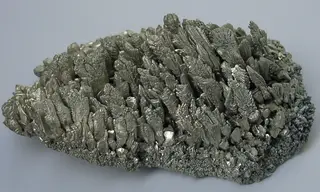
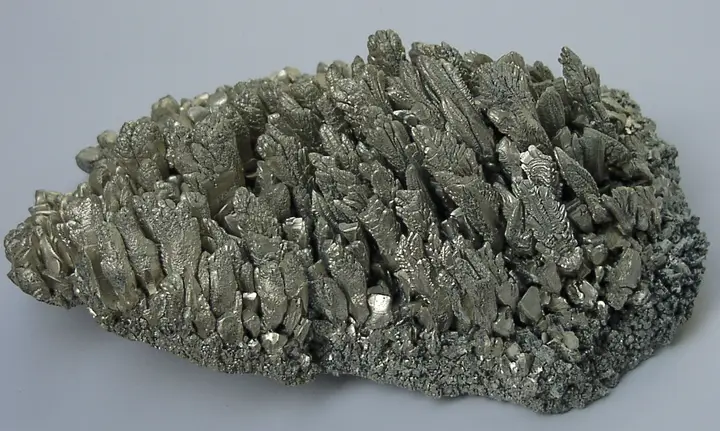
Magnesium is a shiny, silvery alkaline earth metal. With a density of about 1.74 g/cm³, it is the lightest metal used in structures.
Once lit, it burns with an intensely bright white light. Plants need it to make chlorophyll, and people need it for hundreds of chemical reactions in the body.
Quick answers
- What is magnesium?
- Magnesium (Mg) is an alkaline earth metal with atomic number 12. It is a solid at room temperature. A light, strong metal that burns with a dazzling white flame. It sits at the heart of chlorophyll, the green pigment of plants.
- Where is magnesium found?
- Magnesium is one of the most common elements in Earth’s crust, in minerals such as dolomite and magnesite. It is also one of the most abundant elements dissolved in seawater.
- What is magnesium used for?
- Its main uses are light alloys; fireworks and flares; heat-resistant materials. Mixed with aluminum, magnesium makes light, strong parts for cars, aircraft and laptops.
At a glance
| Atomic number | 12 |
|---|---|
| Symbol | Mg |
| Standard atomic weight | 24.305 ± 0.002 |
| Natural isotopes | 3 (IUPAC CIAAW 2024) |
| Family | Alkaline earth metal |
| Group | Group 2 |
| Period | Period 3 |
| Block | s |
| Electron configuration | [Ne] 3s2 orbital diagram → |
| State at room temperature | Solid |
| Melting point | 650 °C (1,202 °F, 923 K) |
| Boiling point | 1,090 °C (1,994 °F, 1,363 K) |
| Density | 1.74 g/cm³ |
| Electronegativity (Pauling) | 1.31 |
| Atomic radius | 173 pm |
| First ionization energy | 7.646 eV |
| Oxidation states | +2 |
| Discovery | 1755 · Joseph Black |
Discovery
In 1755 the Scottish chemist Joseph Black showed that magnesia (magnesium oxide) was different from lime (calcium oxide). This is usually taken as the recognition of magnesium as an element.
Humphry Davy made an impure sample of the metal in 1808, and Antoine Bussy produced it in pure form in 1831.
Where the name comes from
From Magnesia, a region of Thessaly in Greece, whose minerals included magnesium compounds.
Where is magnesium found?
Magnesium is one of the most common elements in Earth’s crust, in minerals such as dolomite and magnesite. It is also one of the most abundant elements dissolved in seawater.
Where every element is found →
What is magnesium used for?
- Light alloys. Mixed with aluminum, magnesium makes light, strong parts for cars, aircraft and laptops.
- Fireworks and flares. Its brilliant white flame lights up flares and fireworks.
- Heat-resistant materials. Magnesium oxide lines furnaces and kilns.
- Health and household. Magnesium sulfate (Epsom salt) and magnesium hydroxide (milk of magnesia) are familiar compounds.
What every element is used for → · Where are the elements found? →
Common compounds
| Compound | Formula | Note |
|---|---|---|
| Magnesium sulfate | MgSO₄·7H₂O | Epsom salt. |
| Magnesium oxide | MgO | Heat-resistant lining material for furnaces. |
Notable isotopes
- Mg-2478.88–79.05%
- Mg-259.988–10.034%
- Mg-2610.96–11.09%
Percent by number of atoms. The light band shows the range over which the share varies in natural samples. Source: IUPAC CIAAW 2024
| Isotope | Half-life | Note |
|---|---|---|
| Magnesium-24 | Stable | About 79% of natural magnesium. |
| Magnesium-25 | Stable | About 10%. |
| Magnesium-26 | Stable | About 11%. |
Safety
Burning magnesium is hard to put out
Magnesium fires burn extremely hot. Water and carbon dioxide make them worse; special dry powders are needed.
Do not look directly at burning magnesium: the light is intense.
Did you know?
- Magnesium sulfate is called Epsom salt after the English town of Epsom, where it was found in spring water.
- Without enough magnesium, plants cannot make enough chlorophyll and their leaves turn yellow.
- The word “magnet” comes from the same region of Magnesia, known for its magnetic lodestones.
Frequently asked questions
Why does magnesium burn so brightly?
Magnesium combines with oxygen very energetically, heating the magnesium oxide formed until it glows white-hot.
Is magnesium heavier than aluminum?
No. Magnesium is about one third lighter than aluminum.
Is magnesium a metal?
Yes. Magnesium is a metal, one of the alkaline earth metals.
What are the properties of magnesium?
Atomic number 12, symbol Mg, atomic mass 24.305. It is a solid at room temperature. It melts at 650 °C (1,202 °F) and boils at 1,090 °C (1,994 °F). Density 1.74 g/cm³. Electronegativity 1.31 (Pauling).
Sources
- Royal Society of Chemistry: Magnesium
- Encyclopaedia Britannica: Magnesium
- USGS Mineral Commodity Summaries: Magnesium
- NNDC NuDat 3 (nuclear data)
- PubChem Periodic Table (NIH)
- IUPAC/CIAAW standard atomic weights
- Royal Society of Chemistry, Periodic Table
- Wikipedia: Magnesium
Last checked: 16 November 2026
Other group 2 elements
Beryllium
A light, very stiff metal found in emeralds. It is transparent to X-rays, and the mirrors of the James Webb Space Telescope are made of it.
Calcium
The metal of bones, teeth, shells and limestone. Calcium compounds also make the cement and plaster we build with.
Strontium
The element that makes fireworks red, named after a Scottish village. A radioactive form from nuclear tests was once measured in children’s teeth.
Barium
A soft, reactive metal whose heavy compounds show up the gut on X-rays and turn fireworks green.
Radium
The intensely radioactive metal discovered by Marie and Pierre Curie. It once lit watch dials; today one radium isotope is used in cancer treatment.