Element 055 · also cesium
Cesium (Cs)
A golden, extremely reactive metal that melts just above room temperature. The second, the unit of time, is defined by cesium atoms.
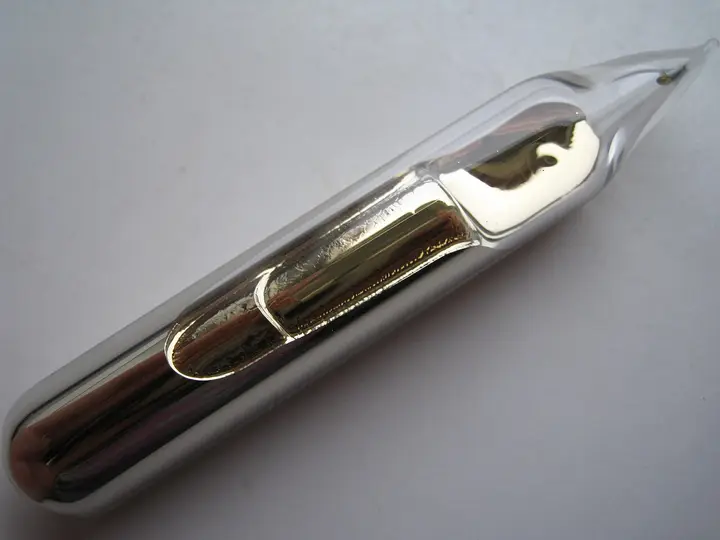
Cesium (cesium in British English) is a soft, pale gold alkali metal that melts at about 28 °C. It is one of the most reactive metals: it explodes on contact with water and ignites in air.
Atoms of cesium-133 absorb microwaves at an extremely precise frequency, which is the basis of atomic clocks and of the international definition of the second.
Quick answers
- What is cesium?
- Cesium (Cs) is an alkali metal with atomic number 55. A golden, extremely reactive metal that melts just above room temperature. The second, the unit of time, is defined by cesium atoms.
- Where is cesium found?
- Cesium is rare. It is mined mainly from the mineral pollucite.
- What is cesium used for?
- Its main uses are atomic clocks; drilling; research and electronics. Cesium clocks define the second and keep time for satellite navigation and the internet.
At a glance
| Atomic number | 55 |
|---|---|
| Symbol | Cs |
| Standard atomic weight | 132.91 ± 0.01 |
| Natural isotopes | 1 (IUPAC CIAAW 2024; a single isotope in nature) |
| Family | Alkali metal |
| Group | Group 1 |
| Period | Period 6 |
| Block | s |
| Electron configuration | [Xe] 6s1 orbital diagram → |
| State at room temperature | Solid |
| Melting point | 28.44 °C (83.2 °F, 301.59 K) |
| Boiling point | 671 °C (1,240 °F, 944 K) |
| Density | 1.93 g/cm³ |
| Electronegativity (Pauling) | 0.79 |
| Atomic radius | 343 pm |
| First ionization energy | 3.894 eV |
| Oxidation states | +1 |
| Discovery | 1860 · Robert Bunsen and Gustav Kirchhoff |
Discovery
In 1860 Robert Bunsen and Gustav Kirchhoff found two bright blue lines in the spectrum of mineral water from Bad Dürkheim, Germany. Cesium was the first element discovered with a spectroscope. The metal was isolated in 1882.
Where the name comes from
From the Latin caesius, sky blue, after the blue lines in its spectrum.
Where is cesium found?
Cesium is rare. It is mined mainly from the mineral pollucite.
Where every element is found →
What is cesium used for?
- Atomic clocks. Cesium clocks define the second and keep time for satellite navigation and the internet.
- Drilling. Dense cesium formate solutions are used in deep oil and gas wells.
- Research and electronics. Photoelectric cells and specialist optics.
What every element is used for → · Where are the elements found? →
Common compounds
| Compound | Formula | Note |
|---|---|---|
| Cesium chloride | CsCl | A salt whose crystal structure made it into the textbooks. |
Notable isotopes
| Isotope | Half-life | Note |
|---|---|---|
| Cesium-133 | Stable | The only stable isotope. Its microwave frequency defines the second. |
| Cesium-137 | about 30 years | A fission product released in nuclear accidents such as Chernobyl; also used in medical and industrial sources. |
| Cesium-134 | about 2.1 years | Another reactor-produced isotope. |
Safety
Violently reactive; radioactive isotope
Cesium metal must be sealed away from air and water.
Radioactive cesium-137 spreads easily in the environment. In 1987 an abandoned medical source in Goiânia, Brazil, caused a serious radiation accident.
Did you know?
- Since 1967 the second has been defined as 9,192,631,770 cycles of radiation from cesium-133 atoms.
- Cesium hydroxide is one of the strongest known bases.
- Cesium is one of only a few metals that are not silver or gray; the others are copper and gold.
Frequently asked questions
Cesium or cesium?
“Cesium” is the American spelling; “caesium” is used in British English and by IUPAC.
Why does cesium define the second?
Its atoms absorb a microwave frequency that is extremely stable and identical everywhere.
Is cesium a metal?
Yes. Cesium is a metal, one of the alkali metals.
What are the properties of cesium?
Atomic number 55, symbol Cs, atomic mass 132.91. It is a solid at room temperature. It melts at 28.44 °C (83.2 °F) and boils at 671 °C (1,240 °F). Density 1.93 g/cm³. Electronegativity 0.79 (Pauling).
Sources
- Royal Society of Chemistry: Caesium
- Encyclopaedia Britannica: Cesium
- BIPM: SI base unit, the second
- IAEA: The radiological accident in Goiânia (1988)
- NNDC NuDat 3 (nuclear data)
- PubChem Periodic Table (NIH)
- IUPAC/CIAAW standard atomic weights
- Royal Society of Chemistry, Periodic Table
- Wikipedia: Cesium
Last checked: 16 November 2026
Other group 1 elements
Hydrogen
The lightest and most abundant element in the universe. Stars run on hydrogen, and every water molecule contains two hydrogen atoms.
Lithium
The lightest metal, light enough to float on water. Lithium-ion batteries in phones and electric cars depend on it.
Sodium
A soft, highly reactive metal that we eat every day as table salt. Its yellow glow lit city streets for decades.
Potassium
A soft metal that reacts violently with water and burns with a lilac flame. Our nerves and muscles need potassium, and so do crops.
Rubidium
A very reactive alkali metal that melts on a hot day. Rubidium atoms keep time in atomic clocks.
Francium
The last element discovered in nature and one of the most unstable. It decays within minutes, so its properties have never been measured.