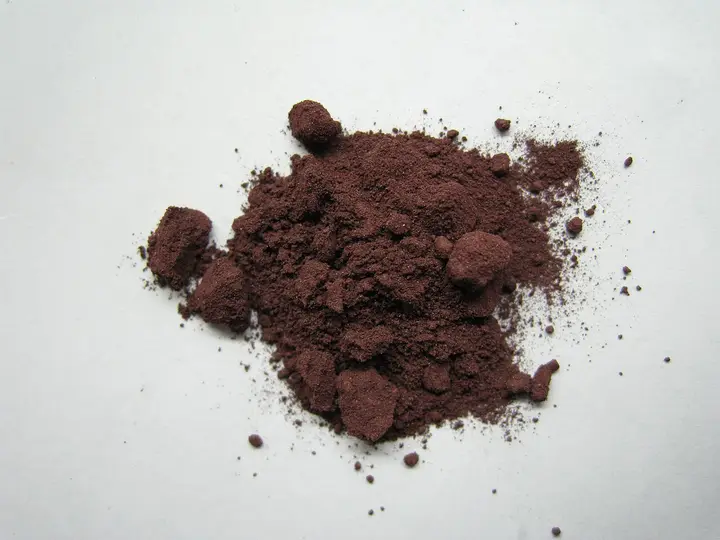
Phosphorus is a nonmetal that comes in several forms. White phosphorus is waxy, very reactive and glows faintly in the dark; red phosphorus is a much more stable powder.
Life depends on it: phosphate groups form the backbone of DNA and carry energy in cells as ATP. Bones and teeth are made largely of calcium phosphate.
Quick answers
- What is phosphorus?
- Phosphorus (P) is a nonmetal with atomic number 15. It is a solid at room temperature. An element first extracted from urine. It is in our bones, our DNA and the fertilizers that grow our food.
- Where is phosphorus found?
- Phosphorus is never found free. It is mined as phosphate rock, mainly in Morocco, China and the United States.
- What is phosphorus used for?
- Its main uses are fertilizers; matches; food and industry. Most mined phosphate becomes fertilizer.
At a glance
| Atomic number | 15 |
|---|---|
| Symbol | P |
| Standard atomic weight | 30.974 ± 0.001 |
| Natural isotopes | 1 (IUPAC CIAAW 2024; a single isotope in nature) |
| Family | Nonmetal |
| Group | Group 15 |
| Period | Period 3 |
| Block | p |
| Electron configuration | [Ne] 3s2 3p3 orbital diagram → |
| State at room temperature | Solid |
| Melting point | 44.2 °C (111.5 °F, 317.3 K) |
| Boiling point | 280.50 °C (536.9 °F, 553.65 K) |
| Density | 1.82 g/cm³ |
| Electronegativity (Pauling) | 2.19 |
| Atomic radius | 180 pm |
| First ionization energy | 10.487 eV |
| Oxidation states | +5, +3, -3 |
| Discovery | 1669 · Hennig Brand |
Discovery
In 1669 the German alchemist Hennig Brand boiled down large quantities of urine, hoping to find the philosopher’s stone. Instead he obtained a white substance that glowed in the dark. It was the first element discovered by a known person.
Where the name comes from
From the Greek phosphoros, light-bearer, because white phosphorus glows in the dark.
Where is phosphorus found?
Phosphorus is never found free. It is mined as phosphate rock, mainly in Morocco, China and the United States.
Where every element is found →
What is phosphorus used for?
- Fertilizers. Most mined phosphate becomes fertilizer. Crops cannot grow without phosphorus.
- Matches. The striking strip on a box of safety matches contains red phosphorus.
- Food and industry. Phosphates are used in food processing, water treatment and metal finishing.
- Batteries. Lithium iron phosphate (LFP) batteries power many electric cars and home storage systems.
What every element is used for → · Where are the elements found? →
Common compounds
| Compound | Formula | Note |
|---|---|---|
| Phosphoric acid | H₃PO₄ | Used to make fertilizers and in some soft drinks. |
| Hydroxyapatite | Ca₅(PO₄)₃(OH) | The mineral part of bone and tooth enamel. |
Notable isotopes
| Isotope | Half-life | Note |
|---|---|---|
| Phosphorus-31 | Stable | All natural phosphorus is this isotope. |
| Phosphorus-32 | about 14.3 days | A radioactive isotope used in biology research to label DNA. |
| Phosphorus-33 | about 25.3 days | Used as a tracer in biochemistry research. |
Safety
White phosphorus is dangerous
White phosphorus can catch fire on its own in air and is highly toxic. It is stored under water.
Red phosphorus is far more stable, but it is still flammable.
Did you know?
- The glow of white phosphorus comes from a slow reaction with oxygen, not from radioactivity. The word “phosphorescence” comes from phosphorus, though its glow is technically chemiluminescence.
- An adult human body contains about 700 grams of phosphorus, about 85% of it in bones and teeth.
- In 2020 researchers reported phosphine gas in the atmosphere of Venus. The finding is still debated.
Frequently asked questions
Why does phosphorus glow?
White phosphorus reacts slowly with oxygen in the air, and that reaction releases energy as faint green light.
Why is phosphorus important for farming?
Plants need it for DNA, energy transfer and root growth. Soils lose it as crops are harvested, so it is added as fertilizer.
Is phosphorus a metal?
No. Phosphorus is a nonmetal.
What are the properties of phosphorus?
Atomic number 15, symbol P, atomic mass 30.974. It is a solid at room temperature. It melts at 44.2 °C (111.5 °F) and boils at 280.50 °C (536.9 °F). Density 1.82 g/cm³. Electronegativity 2.19 (Pauling).
Sources
- Royal Society of Chemistry: Phosphorus
- Encyclopaedia Britannica: Phosphorus
- USGS Mineral Commodity Summaries: Phosphate rock
- NNDC NuDat 3 (nuclear data)
- PubChem Periodic Table (NIH)
- IUPAC/CIAAW standard atomic weights
- Royal Society of Chemistry, Periodic Table
- Wikipedia: Phosphorus
Last checked: 16 November 2026
Other group 15 elements
Nitrogen
The gas that makes up most of the air we breathe. Nitrogen is in every protein and in DNA, and fertilizers made from it feed billions of people.
Arsenic
A notorious poison and a useful semiconductor ingredient. Arsenic in groundwater still affects millions of people.
Antimony
A brittle, silvery metalloid used since ancient times as black eye make-up. Today it mainly makes plastics flame-resistant.
Bismuth
A heavy metal famous for rainbow-colored, staircase-shaped crystals. Unusually for a heavy metal, it has low toxicity and is even used in stomach remedies.
Moscovium
A superheavy element named after the Moscow region, made in a Russian–American collaboration.