Element 083
Bismuth (Bi)
A heavy metal famous for rainbow-colored, staircase-shaped crystals. Unusually for a heavy metal, it has low toxicity and is even used in stomach remedies.
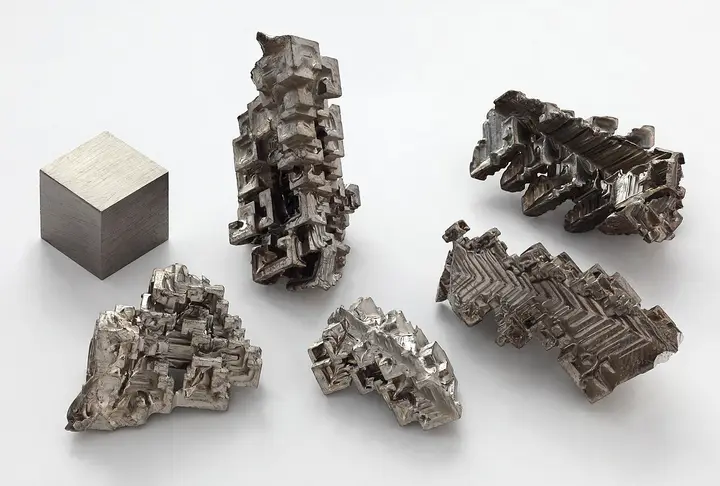
Bismuth is a brittle, silvery metal with a pinkish tinge. A thin oxide layer on its crystals creates iridescent colors.
It expands when it solidifies and is more strongly repelled by magnets (diamagnetic) than any other element.
Quick answers
- What is bismuth?
- Bismuth (Bi) is a post-transition metal with atomic number 83. It is a solid at room temperature. A heavy metal famous for rainbow-colored, staircase-shaped crystals. Unusually for a heavy metal, it has low toxicity and is even used in stomach remedies.
- Where is bismuth found?
- Bismuth is mostly recovered as a by-product of lead, copper and tungsten refining. China is the largest producer.
- What is bismuth used for?
- Its main uses are medicine, lead replacement and low-melting alloys. Bismuth subsalicylate is the active ingredient of some stomach-upset remedies.
At a glance
| Atomic number | 83 |
|---|---|
| Symbol | Bi |
| Standard atomic weight | 208.98 ± 0.01 |
| Natural isotopes | 1 (IUPAC CIAAW 2024; a single isotope in nature) |
| Family | Post-transition metal |
| Group | Group 15 |
| Period | Period 6 |
| Block | p |
| Electron configuration | [Xe] 4f14 5d10 6s2 6p3 orbital diagram → |
| State at room temperature | Solid |
| Melting point | 271.40 °C (520.5 °F, 544.55 K) |
| Boiling point | 1,564 °C (2,847 °F, 1,837 K) |
| Density | 9.807 g/cm³ |
| Electronegativity (Pauling) | 2.02 |
| Atomic radius | 207 pm |
| First ionization energy | 7.289 eV |
| Oxidation states | +5, +3 |
| Discovery | 1753 · Claude François Geoffroy |
Discovery
Bismuth was used in the Middle Ages but was often confused with lead and tin. In 1753 the French chemist Claude François Geoffroy showed that it was a distinct element.
Where the name comes from
From the German Wismut, of uncertain origin.
Where is bismuth found?
Bismuth is mostly recovered as a by-product of lead, copper and tungsten refining. China is the largest producer.
Where every element is found →
What is bismuth used for?
- Medicine. Bismuth subsalicylate is the active ingredient of some stomach-upset remedies.
- Lead replacement. Lead-free solders, shot and fishing weights.
- Low-melting alloys. Fire sprinkler plugs and safety fuses melt at low temperatures.
- Cosmetics. Bismuth oxychloride gives a pearly shimmer.
What every element is used for → · Where are the elements found? →
Common compounds
| Compound | Formula | Note |
|---|---|---|
| Bismuth oxychloride | BiOCl | Gives a pearly shimmer to cosmetics. |
Notable isotopes
| Isotope | Half-life | Note |
|---|---|---|
| Bismuth-209 | about 2 × 10¹⁹ years | Practically stable; its extremely slow decay was first detected in 2003. |
Safety
Low toxicity
Bismuth is among the least toxic heavy metals. Medicines containing it should be used as directed.
Did you know?
- The stepped, square spiral shape of lab-grown bismuth crystals forms because their edges grow faster than their faces.
- Bismuth was long thought to be the heaviest element with a stable isotope; that title now belongs to lead.
- Bismuth-209’s half-life is more than a billion times the age of the universe.
Frequently asked questions
Why are bismuth crystals rainbow-colored?
A very thin oxide layer forms on the surface, and light reflecting from it interferes to produce colors, like oil on water.
Is bismuth radioactive?
Technically yes, but its decay is so slow that it is effectively stable.
Is bismuth a metal?
Yes. Bismuth is a metal, one of the post-transition metals.
What are the properties of bismuth?
Atomic number 83, symbol Bi, atomic mass 208.98. It is a solid at room temperature. It melts at 271.40 °C (520.5 °F) and boils at 1,564 °C (2,847 °F). Density 9.807 g/cm³. Electronegativity 2.02 (Pauling).
Sources
- Royal Society of Chemistry: Bismuth
- Encyclopaedia Britannica: Bismuth
- de Marcillac et al. (2003), Nature: Alpha decay of bismuth-209
- NNDC NuDat 3 (nuclear data)
- PubChem Periodic Table (NIH)
- IUPAC/CIAAW standard atomic weights
- Royal Society of Chemistry, Periodic Table
- Wikipedia: Bismuth
Last checked: 16 November 2026
Other group 15 elements
Nitrogen
The gas that makes up most of the air we breathe. Nitrogen is in every protein and in DNA, and fertilizers made from it feed billions of people.
Phosphorus
An element first extracted from urine. It is in our bones, our DNA and the fertilizers that grow our food.
Arsenic
A notorious poison and a useful semiconductor ingredient. Arsenic in groundwater still affects millions of people.
Antimony
A brittle, silvery metalloid used since ancient times as black eye make-up. Today it mainly makes plastics flame-resistant.
Moscovium
A superheavy element named after the Moscow region, made in a Russian–American collaboration.