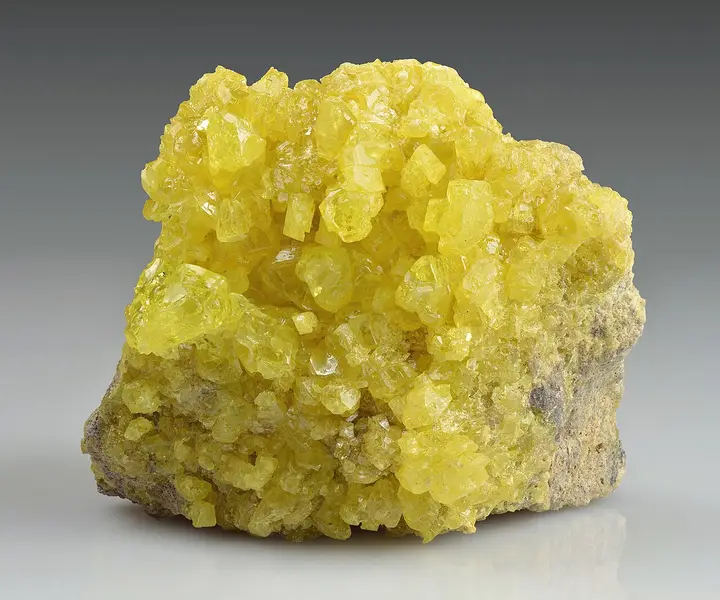
Sulfur is a bright yellow, brittle solid with almost no smell. The “rotten egg” smell people link with it actually comes from hydrogen sulfide gas.
It burns with a blue flame, giving off choking sulfur dioxide. Sulfur is also essential for life: two of the amino acids in proteins contain it.
Quick answers
- What is sulfur?
- Sulfur (S) is a nonmetal with atomic number 16. It is a solid at room temperature. A bright yellow nonmetal known since ancient times as brimstone. Sulfuric acid, made from it, is the world’s most produced industrial chemical.
- Where is sulfur found?
- Pure sulfur forms around volcanoes and hot springs. Today most sulfur is recovered as a by-product of cleaning natural gas and refining oil.
- What is sulfur used for?
- Its main uses are sulfuric acid, rubber and agriculture. Most sulfur is turned into sulfuric acid, which is used to make fertilizers, process metal ores and run car batteries.
At a glance
| Atomic number | 16 |
|---|---|
| Symbol | S |
| Standard atomic weight | 32.06 ± 0.02 |
| Natural isotopes | 4 (IUPAC CIAAW 2024) |
| Family | Nonmetal |
| Group | Group 16 |
| Period | Period 3 |
| Block | p |
| Electron configuration | [Ne] 3s2 3p4 orbital diagram → |
| State at room temperature | Solid |
| Melting point | 115.21 °C (239.4 °F, 388.36 K) |
| Boiling point | 444.60 °C (832.3 °F, 717.75 K) |
| Density | 2.067 g/cm³ |
| Electronegativity (Pauling) | 2.58 |
| Atomic radius | 180 pm |
| First ionization energy | 10.36 eV |
| Oxidation states | +6, +4, -2 |
| Discovery | Known since ancient times |
Discovery
Sulfur has been known since antiquity; it is the “brimstone” of old texts. In 1777 Antoine Lavoisier argued that it was an element rather than a compound.
Where the name comes from
From the Latin sulfur. IUPAC uses the spelling “sulfur”; “sulphur” is a traditional British spelling.
Where is sulfur found?
Pure sulfur forms around volcanoes and hot springs. Today most sulfur is recovered as a by-product of cleaning natural gas and refining oil.
Where every element is found →
What is sulfur used for?
- Sulfuric acid. Most sulfur is turned into sulfuric acid, which is used to make fertilizers, process metal ores and run car batteries.
- Rubber. Heating rubber with sulfur (vulcanization) makes it tough and elastic, as in tires.
- Agriculture. Sulfur is a plant nutrient and a fungicide.
- Gunpowder and matches. Black powder is a mixture of saltpeter, charcoal and sulfur.
What every element is used for → · Where are the elements found? →
Common compounds
| Compound | Formula | Note |
|---|---|---|
| Sulfuric acid | H₂SO₄ | One of the most produced industrial chemicals. |
| Sulfur dioxide | SO₂ | Sharp-smelling gas formed when sulfur burns. |
| Hydrogen sulfide | H₂S | Toxic gas that smells of rotten eggs. |
Notable isotopes
- S-3294.41–95.29%
- S-330.729–0.797%
- S-343.96–4.77%
- S-360.0129–0.0187%
Percent by number of atoms. The light band shows the range over which the share varies in natural samples. Source: IUPAC CIAAW 2024
| Isotope | Half-life | Note |
|---|---|---|
| Sulfur-32 | Stable | About 95% of natural sulfur. |
| Sulfur-34 | Stable | About 4.3%. |
| Sulfur-35 | about 87 days | A radioactive isotope used in biochemistry research to label proteins. |
Safety
Its gases are the main hazard
Solid sulfur has low toxicity but its dust can irritate the eyes and skin and is flammable.
Burning sulfur produces sulfur dioxide, which irritates the lungs. Hydrogen sulfide, found around volcanoes and sewers, is very toxic.
Did you know?
- Molten sulfur suddenly turns thick and sticky, like honey, when heated above about 160 °C.
- At Kawah Ijen volcano in Indonesia, burning sulfur gases create blue flames at night.
- Sulfur dioxide released by burning coal and oil is one of the main causes of acid rain.
Frequently asked questions
Does sulfur smell like rotten eggs?
Pure sulfur has hardly any smell. The rotten-egg odor comes from hydrogen sulfide (H₂S), a sulfur compound.
Sulfur or sulfur?
Both spellings exist. IUPAC and most scientific writing use “sulfur”; “sulphur” is an older British spelling.
Is sulfur a metal?
No. Sulfur is a nonmetal.
What are the properties of sulfur?
Atomic number 16, symbol S, atomic mass 32.06. It is a solid at room temperature. It melts at 115.21 °C (239.4 °F) and boils at 444.60 °C (832.3 °F). Density 2.067 g/cm³. Electronegativity 2.58 (Pauling).
Read more on OkButWhy
Sources
- Royal Society of Chemistry: Sulfur
- Encyclopaedia Britannica: Sulfur
- NNDC NuDat 3 (nuclear data)
- PubChem Periodic Table (NIH)
- IUPAC/CIAAW standard atomic weights
- Royal Society of Chemistry, Periodic Table
- Wikipedia: Sulfur
Last checked: 16 November 2026
Other group 16 elements
Oxygen
The gas we need to breathe and the most abundant element in Earth’s crust. It makes up about a fifth of the air.
Selenium
An element whose electrical conductivity changes with light. The body needs a little selenium, but too much is toxic.
Tellurium
A rare, silvery metalloid named after the Earth. It goes into thin-film solar panels and devices that turn heat into electricity.
Polonium
An intensely radioactive element discovered by Marie and Pierre Curie and named after Poland. Tiny amounts remove static electricity in industry.
Livermorium
A superheavy element named after Lawrence Livermore National Laboratory in California.