Nitrogen is a colorless, odorless gas. Its molecules (N2) are held together by a very strong triple bond, so the gas is quite unreactive.
Living things need nitrogen to build proteins and DNA, but most cannot use the gas directly. They depend on bacteria, lightning and fertilizers to turn it into usable compounds.
Quick answers
- What is nitrogen?
- Nitrogen (N) is a nonmetal with atomic number 7. It is a gas at room temperature. The gas that makes up most of the air we breathe. Nitrogen is in every protein and in DNA, and fertilizers made from it feed billions of people.
- Where is nitrogen found?
- Nitrogen makes up about 78% of the air by volume. It is also found in nitrate minerals and in all living things.
- What is nitrogen used for?
- Its main uses are fertilizers, food packaging and liquid nitrogen. The Haber–Bosch process turns nitrogen from the air into ammonia.
At a glance
| Atomic number | 7 |
|---|---|
| Symbol | N |
| Standard atomic weight | 14.007 ± 0.001 |
| Natural isotopes | 2 (IUPAC CIAAW 2024) |
| Family | Nonmetal |
| Group | Group 15 |
| Period | Period 2 |
| Block | p |
| Electron configuration | [He] 2s2 2p3 orbital diagram → |
| State at room temperature | Gas |
| Melting point | −210.00 °C (−346 °F, 63.15 K) |
| Boiling point | −195.79 °C (−320.4 °F, 77.36 K) |
| Density | 1.2506 g/L (0 °C, 1 atm) |
| Electronegativity (Pauling) | 3.04 |
| Atomic radius | 155 pm |
| First ionization energy | 14.534 eV |
| Oxidation states | +5, +4, +3, +2, +1, -1, -2, -3 |
| Discovery | 1772 · Daniel Rutherford |
Discovery
In 1772 the Scottish physician Daniel Rutherford showed that air in which a mouse had died and a candle had gone out still contained a gas that could not support life. He called it “noxious air”.
Antoine Lavoisier named the gas azote, “lifeless”. The English name came in 1790 from Jean-Antoine Chaptal.
Where the name comes from
From the Greek nitron (saltpeter, a nitrogen compound) and genes (forming). In French and several other languages it is still called azote, “lifeless”.
Where is nitrogen found?
Nitrogen makes up about 78% of the air by volume. It is also found in nitrate minerals and in all living things.
Where every element is found →
What is nitrogen used for?
- Fertilizers. The Haber–Bosch process turns nitrogen from the air into ammonia. Most nitrogen fertilizers are made from it.
- Food packaging. Bags of crisps and other snacks are filled with nitrogen to keep oxygen out and food fresh.
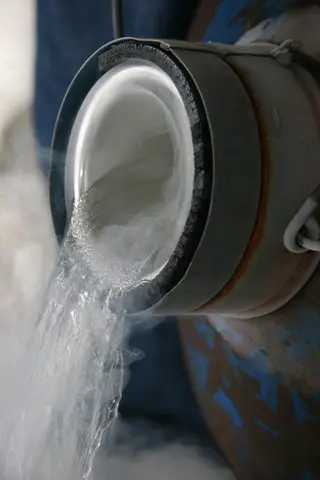
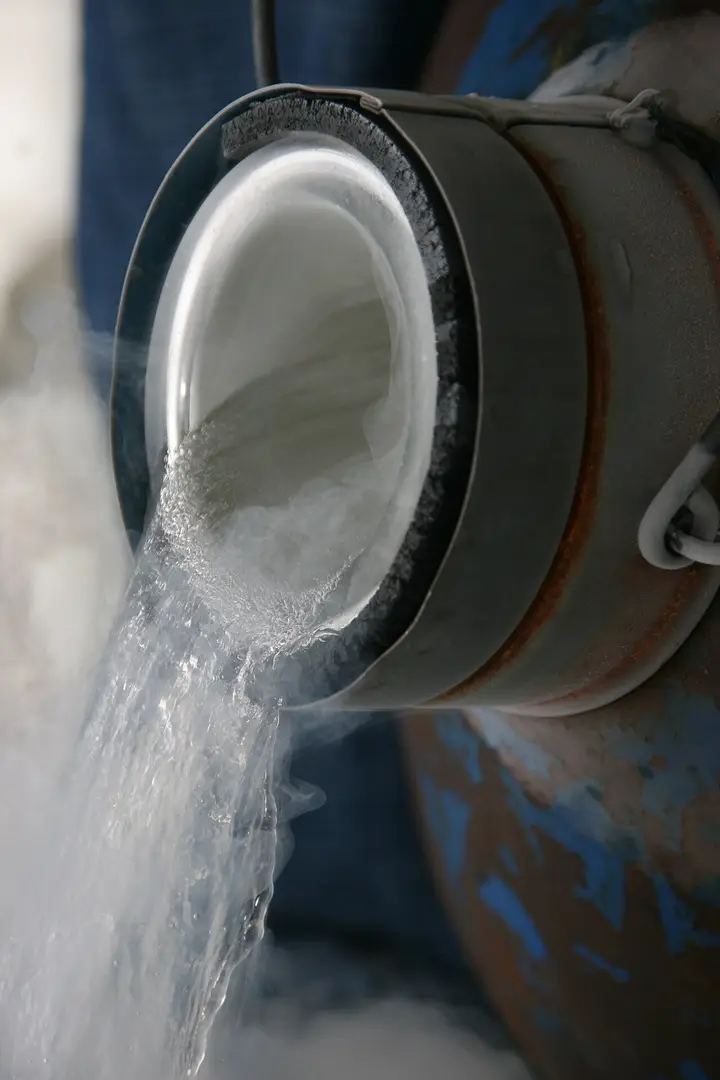
- Liquid nitrogen. At −196 °C, liquid nitrogen freezes food quickly and stores biological samples.
- Industry. Nitrogen provides an unreactive atmosphere for making electronics and handling flammable chemicals.
What every element is used for → · Where are the elements found? →
Common compounds
| Compound | Formula | Note |
|---|---|---|
| Ammonia | NH₃ | The starting point for most nitrogen fertilizers. |
| Nitric acid | HNO₃ | Strong acid used in industry, mainly to make fertilizers. |
| Potassium nitrate | KNO₃ | Saltpeter; an old fertilizer and an ingredient of gunpowder. |
Notable isotopes
- N-1499.578–99.663%
- N-150.337–0.422%
Percent by number of atoms. The light band shows the range over which the share varies in natural samples. Source: IUPAC CIAAW 2024
| Isotope | Half-life | Note |
|---|---|---|
| Nitrogen-14 | Stable | About 99.6% of natural nitrogen. |
| Nitrogen-15 | Stable | About 0.4%. Used to trace nitrogen in farming and ecology research. |
| Nitrogen-13 | about 10 minutes | One of the radioactive isotopes used in PET scans. |
Safety
Can suffocate in closed spaces
Nitrogen is not toxic, but in a closed space it can displace oxygen without any warning smell.
Liquid nitrogen causes severe cold burns and must never be sealed in a closed container: as it boils, pressure builds up.
Did you know?
- Fritz Haber won the 1918 Nobel Prize in Chemistry for synthesizing ammonia. Carl Bosch, who scaled it up for industry, shared the 1931 prize.
- Bacteria living in nodules on the roots of peas, beans and clover fix nitrogen from the air, which is why these plants enrich the soil.
- Divers breathing compressed air at depth can suffer “nitrogen narcosis”, an effect similar to drunkenness.
Frequently asked questions
Is nitrogen gas dangerous to breathe?
We breathe it all the time: it is most of the air. It becomes dangerous only when it replaces oxygen in a confined space.
Why is nitrogen so unreactive?
The two atoms in an N₂ molecule share a triple bond, one of the strongest bonds in chemistry, and breaking it takes a lot of energy.
Is nitrogen a metal?
No. Nitrogen is a nonmetal.
What are the properties of nitrogen?
Atomic number 7, symbol N, atomic mass 14.007. It is a gas at room temperature. It melts at −210.00 °C (−346 °F) and boils at −195.79 °C (−320.4 °F). Density 1.2506 g/L. Electronegativity 3.04 (Pauling).
Sources
- Royal Society of Chemistry: Nitrogen
- Encyclopaedia Britannica: Nitrogen
- Nobel Prize in Chemistry 1918 (Fritz Haber)
- NNDC NuDat 3 (nuclear data)
- PubChem Periodic Table (NIH)
- IUPAC/CIAAW standard atomic weights
- Royal Society of Chemistry, Periodic Table
- Wikipedia: Nitrogen
Last checked: 16 November 2026
Other group 15 elements
Phosphorus
An element first extracted from urine. It is in our bones, our DNA and the fertilizers that grow our food.
Arsenic
A notorious poison and a useful semiconductor ingredient. Arsenic in groundwater still affects millions of people.
Antimony
A brittle, silvery metalloid used since ancient times as black eye make-up. Today it mainly makes plastics flame-resistant.
Bismuth
A heavy metal famous for rainbow-colored, staircase-shaped crystals. Unusually for a heavy metal, it has low toxicity and is even used in stomach remedies.
Moscovium
A superheavy element named after the Moscow region, made in a Russian–American collaboration.