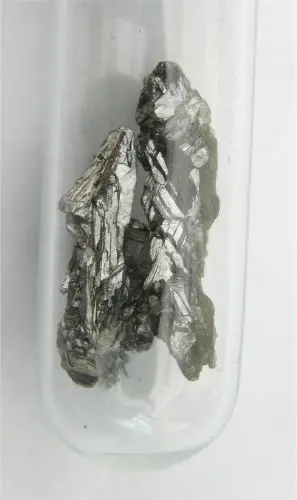
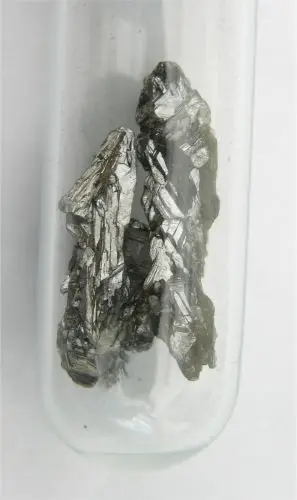
Arsenic is a gray, brittle metalloid. At normal pressure it does not melt but turns straight into a vapor when heated to about 615 °C.
Its compounds are toxic, and arsenic was a favorite poison in history. It is also used, in tiny amounts, to make semiconductors such as gallium arsenide.
Quick answers
- What is arsenic?
- Arsenic (As) is a metalloid with atomic number 33. It is a solid at room temperature. A notorious poison and a useful semiconductor ingredient. Arsenic in groundwater still affects millions of people.
- Where is arsenic found?
- Arsenic is found in many sulfide minerals and as a by-product of copper and gold smelting. It also occurs naturally in groundwater in some regions.
- What is arsenic used for?
- Its main uses are semiconductors, alloys and wood preservation. Gallium arsenide is used in high-speed electronics, LEDs and solar cells.
At a glance
| Atomic number | 33 |
|---|---|
| Symbol | As |
| Standard atomic weight | 74.922 ± 0.001 |
| Natural isotopes | 1 (IUPAC CIAAW 2024; a single isotope in nature) |
| Family | Metalloid |
| Group | Group 15 |
| Period | Period 4 |
| Block | p |
| Electron configuration | [Ar] 3d10 4s2 4p3 orbital diagram → |
| State at room temperature | Solid |
| Melting point | Does not melt at normal pressure; sublimes (turns straight to gas) at about 615 °C. It melts only under high pressure. |
| Boiling point | Unknown |
| Density | 5.776 g/cm³ |
| Electronegativity (Pauling) | 2.18 |
| Atomic radius | 185 pm |
| First ionization energy | 9.815 eV |
| Oxidation states | +5, +3, -3 |
| Discovery | 1250 · Albertus Magnus (credited) |
Discovery
Arsenic compounds such as the yellow mineral orpiment were known in antiquity. The German scholar Albertus Magnus is often credited with isolating the element around 1250.
Where the name comes from
From the Greek arsenikon, the name for yellow orpiment, which goes back to the Persian zarnikh, golden.
Where is arsenic found?
Arsenic is found in many sulfide minerals and as a by-product of copper and gold smelting. It also occurs naturally in groundwater in some regions.
Where every element is found →
What is arsenic used for?
- Semiconductors. Gallium arsenide is used in high-speed electronics, LEDs and solar cells.
- Alloys. Small amounts harden lead in batteries and ammunition.
- Wood preservation. Arsenic-based wood preservatives were widely used, but are now restricted in many countries.
What every element is used for → · Where are the elements found? →
Common compounds
| Compound | Formula | Note |
|---|---|---|
| Arsenic trioxide | As₂O₃ | Poisonous; also used, under medical supervision, to treat one type of leukemia. |
| Arsenic trisulfide | As₂S₃ | The yellow mineral orpiment. |
| Gallium arsenide | GaAs | Red LEDs and solar cells for spacecraft. |
Notable isotopes
| Isotope | Half-life | Note |
|---|---|---|
| Arsenic-75 | Stable | All natural arsenic is this isotope. |
| Arsenic-74 | about 17.8 days | A radioactive isotope used in research. |
Safety
Toxic
Arsenic compounds are poisonous, and long-term exposure through drinking water is linked to cancer and skin disease. The World Health Organization considers it a major public health concern in affected regions.
Did you know?
- The Marsh test, devised by James Marsh in 1836, could detect arsenic in a body and helped found forensic chemistry.
- Scheele’s green, a popular 19th-century pigment, contained arsenic; wallpaper colored with it is thought to have made people ill.
- Arsenic sublimes: at normal pressure it goes straight from solid to gas.
Frequently asked questions
Why is arsenic poisonous?
Arsenic compounds interfere with enzymes and the way cells produce energy.
Is there arsenic in drinking water?
In some regions, groundwater naturally contains arsenic. Water supplies are tested and treated to meet safety limits.
Is arsenic a metal?
Not quite. Arsenic is a metalloid: in some properties it resembles the metals, in others the nonmetals.
What are the properties of arsenic?
Atomic number 33, symbol As, atomic mass 74.922. It is a solid at room temperature. Density 5.776 g/cm³. Electronegativity 2.18 (Pauling).
Sources
- Royal Society of Chemistry: Arsenic
- Encyclopaedia Britannica: Arsenic
- World Health Organization: Arsenic
- NNDC NuDat 3 (nuclear data)
- PubChem Periodic Table (NIH)
- IUPAC/CIAAW standard atomic weights
- Royal Society of Chemistry, Periodic Table
- Wikipedia: Arsenic
Last checked: 16 November 2026
Other group 15 elements
Nitrogen
The gas that makes up most of the air we breathe. Nitrogen is in every protein and in DNA, and fertilizers made from it feed billions of people.
Phosphorus
An element first extracted from urine. It is in our bones, our DNA and the fertilizers that grow our food.
Antimony
A brittle, silvery metalloid used since ancient times as black eye make-up. Today it mainly makes plastics flame-resistant.
Bismuth
A heavy metal famous for rainbow-colored, staircase-shaped crystals. Unusually for a heavy metal, it has low toxicity and is even used in stomach remedies.
Moscovium
A superheavy element named after the Moscow region, made in a Russian–American collaboration.