Oxygen is a colorless, odorless gas made of O2 molecules. It is highly reactive and combines with almost every other element.
Animals use oxygen to release energy from food, and plants release it during photosynthesis. Another form of the element, ozone (O3), shields the surface from ultraviolet light high in the atmosphere.
Quick answers
- What is oxygen?
- Oxygen (O) is a nonmetal with atomic number 8. It is a gas at room temperature. The gas we need to breathe and the most abundant element in Earth’s crust. It makes up about a fifth of the air.
- Where is oxygen found?
- Oxygen is about 21% of the air by volume and roughly 46% of Earth’s crust by mass, mostly in silicate and oxide minerals. It is also the third most abundant element in the universe.
- What is oxygen used for?
- Its main uses are steelmaking; medicine; welding and cutting. Blowing pure oxygen through molten iron burns off excess carbon.
At a glance
| Atomic number | 8 |
|---|---|
| Symbol | O |
| Standard atomic weight | 15.999 ± 0.001 |
| Natural isotopes | 3 (IUPAC CIAAW 2024) |
| Family | Nonmetal |
| Group | Group 16 |
| Period | Period 2 |
| Block | p |
| Electron configuration | [He] 2s2 2p4 orbital diagram → |
| State at room temperature | Gas |
| Melting point | −218.79 °C (−361.8 °F, 54.36 K) |
| Boiling point | −183.0 °C (−297.3 °F, 90.2 K) |
| Density | 1.429 g/L (0 °C, 1 atm) |
| Electronegativity (Pauling) | 3.44 |
| Atomic radius | 152 pm |
| First ionization energy | 13.618 eV |
| Oxidation states | -2 |
| Discovery | 1774 · Carl Wilhelm Scheele and Joseph Priestley |
Discovery
Carl Wilhelm Scheele in Sweden made oxygen in the early 1770s, but his results were not published until 1777. Joseph Priestley in England produced it independently in 1774 by heating mercury oxide.
Antoine Lavoisier recognized that the gas was an element, explained its role in burning and gave it its name.
Where the name comes from
From the Greek oxys (sharp, acid) and genes (forming): “acid-former”. Lavoisier believed all acids contained oxygen, which turned out to be wrong.
Where is oxygen found?
Oxygen is about 21% of the air by volume and roughly 46% of Earth’s crust by mass, mostly in silicate and oxide minerals. It is also the third most abundant element in the universe.
Where every element is found →
What is oxygen used for?
- Steelmaking. Blowing pure oxygen through molten iron burns off excess carbon. This is the largest industrial use of oxygen.
- Medicine. Patients with breathing problems receive extra oxygen in hospitals and at home.
- Welding and cutting. Oxygen mixed with acetylene burns hot enough to cut and weld steel.
- Rockets. Liquid oxygen is the oxidizer for many rocket engines.
What every element is used for → · Where are the elements found? →
Common compounds
| Compound | Formula | Note |
|---|---|---|
| Water | H₂O | The compound life depends on: two hydrogen atoms and one oxygen. |
| Ozone | O₃ | In the upper atmosphere it screens out ultraviolet light. |
| Silicon dioxide | SiO₂ | Silica: the main component of quartz and sand. |
Notable isotopes
- O-1699.738–99.776%
- O-170.0367–0.04%
- O-180.187–0.222%
Percent by number of atoms. The light band shows the range over which the share varies in natural samples. Source: IUPAC CIAAW 2024
| Isotope | Half-life | Note |
|---|---|---|
| Oxygen-16 | Stable | About 99.76% of natural oxygen. |
| Oxygen-17 | Stable | About 0.04%. |
| Oxygen-18 | Stable | About 0.2%. The share of oxygen-18 in ice cores and fossils helps estimate past climate temperatures. |
Safety
Makes fires burn fiercely
Oxygen does not burn itself, but materials burn far more intensely in oxygen-enriched air. Medical oxygen must be kept away from flames and smoking.
Liquid oxygen causes cold burns and can make clothing and other materials highly flammable.
Did you know?
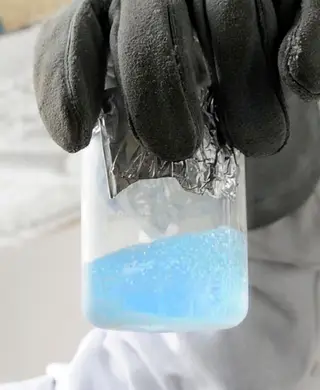
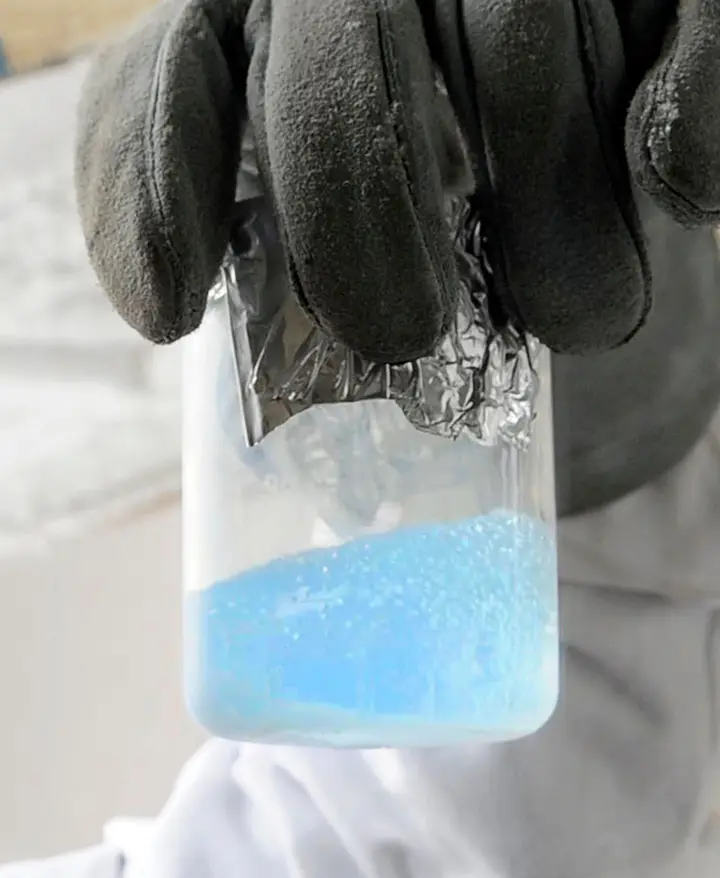
- Liquid oxygen is pale blue and is attracted by a magnet.
- Before photosynthesis took off, Earth’s atmosphere had almost no free oxygen.
- Hydrochloric acid (HCl) contains no oxygen, which disproved Lavoisier’s idea behind the name.
Frequently asked questions
Who discovered oxygen?
Carl Wilhelm Scheele and Joseph Priestley discovered it independently in the 1770s; Antoine Lavoisier named it and explained what it does.
Is oxygen flammable?
No. Oxygen does not burn, but it makes other things burn much faster and hotter.
Is oxygen a metal?
No. Oxygen is a nonmetal.
What are the properties of oxygen?
Atomic number 8, symbol O, atomic mass 15.999. It is a gas at room temperature. It melts at −218.79 °C (−361.8 °F) and boils at −183.0 °C (−297.3 °F). Density 1.429 g/L. Electronegativity 3.44 (Pauling).
Sources
- Royal Society of Chemistry: Oxygen
- Encyclopaedia Britannica: Oxygen
- NNDC NuDat 3 (nuclear data)
- PubChem Periodic Table (NIH)
- IUPAC/CIAAW standard atomic weights
- Royal Society of Chemistry, Periodic Table
- Wikipedia: Oxygen
Last checked: 16 November 2026
Other group 16 elements
Sulfur
A bright yellow nonmetal known since ancient times as brimstone. Sulfuric acid, made from it, is the world’s most produced industrial chemical.
Selenium
An element whose electrical conductivity changes with light. The body needs a little selenium, but too much is toxic.
Tellurium
A rare, silvery metalloid named after the Earth. It goes into thin-film solar panels and devices that turn heat into electricity.
Polonium
An intensely radioactive element discovered by Marie and Pierre Curie and named after Poland. Tiny amounts remove static electricity in industry.
Livermorium
A superheavy element named after Lawrence Livermore National Laboratory in California.