Element 004
Beryllium (Be)
A light, very stiff metal found in emeralds. It is transparent to X-rays, and the mirrors of the James Webb Space Telescope are made of it.
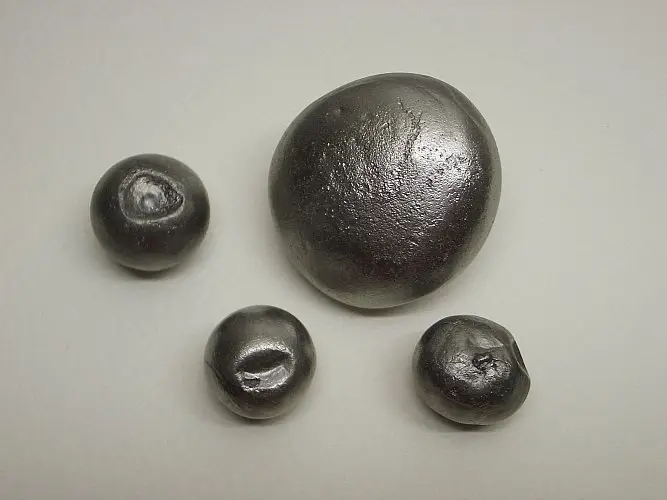
Beryllium is a hard, steel-gray alkaline earth metal. It is lighter than aluminum (density about 1.85 g/cm³) yet much stiffer, and it keeps its shape across a wide range of temperatures.
X-rays pass through it easily, so thin beryllium sheets are used as windows in X-ray equipment. Its dust, however, is toxic.
Quick answers
- What is beryllium?
- Beryllium (Be) is an alkaline earth metal with atomic number 4. It is a solid at room temperature. A light, very stiff metal found in emeralds. It is transparent to X-rays, and the mirrors of the James Webb Space Telescope are made of it.
- Where is beryllium found?
- Beryllium is rare in Earth’s crust. It is mined mainly from the minerals bertrandite and beryl; the United States is the largest producer.
- What is beryllium used for?
- Its main uses are space and aerospace; x-ray windows; copper–beryllium alloys. Light, stiff and stable, beryllium is used in satellites, telescopes and aircraft parts.
At a glance
| Atomic number | 4 |
|---|---|
| Symbol | Be |
| Standard atomic weight | 9.0122 ± 0.0001 |
| Natural isotopes | 1 (IUPAC CIAAW 2024; a single isotope in nature) |
| Family | Alkaline earth metal |
| Group | Group 2 |
| Period | Period 2 |
| Block | s |
| Electron configuration | [He] 2s2 orbital diagram → |
| State at room temperature | Solid |
| Melting point | 1,287 °C (2,348 °F, 1,560 K) |
| Boiling point | 2,471 °C (4,480 °F, 2,744 K) |
| Density | 1.85 g/cm³ |
| Electronegativity (Pauling) | 1.57 |
| Atomic radius | 153 pm |
| First ionization energy | 9.323 eV |
| Oxidation states | +2 |
| Discovery | 1798 · Louis-Nicolas Vauquelin |
Discovery
In 1798 the French chemist Louis-Nicolas Vauquelin found a new oxide in beryl and emerald. The metal itself was isolated in 1828 by Friedrich Wöhler and Antoine Bussy, working independently.
Where the name comes from
From beryl, the mineral it was found in. Emerald and aquamarine are both varieties of beryl.
Where is beryllium found?
Beryllium is rare in Earth’s crust. It is mined mainly from the minerals bertrandite and beryl; the United States is the largest producer.
Where every element is found →
What is beryllium used for?
- Space and aerospace. Light, stiff and stable, beryllium is used in satellites, telescopes and aircraft parts.
- X-ray windows. It lets X-rays through while keeping air out of X-ray tubes and detectors.
- Copper–beryllium alloys. Strong, springy and non-sparking, used for connectors, springs and safety tools.
What every element is used for → · Where are the elements found? →
Common compounds
| Compound | Formula | Note |
|---|---|---|
| Beryl | Be₃Al₂Si₆O₁₈ | The mineral of emerald and aquamarine. |
| Beryllium oxide | BeO | A ceramic that conducts heat extremely well. |
Notable isotopes
| Isotope | Half-life | Note |
|---|---|---|
| Beryllium-9 | Stable | The only stable isotope; all natural beryllium. |
| Beryllium-10 | about 1.39 million years | Made by cosmic rays in the atmosphere; used to date ice cores and sediments. |
| Beryllium-7 | about 53 days | Also made by cosmic rays; used to trace air movements. |
Safety
Dust is toxic
Breathing beryllium dust or fumes can cause chronic beryllium disease, a serious lung condition, and beryllium is classed as a human carcinogen. It is handled under strict workplace controls.
Solid beryllium parts and gemstones are not a hazard in normal use.
Did you know?
- The 18 hexagonal mirror segments of the James Webb Space Telescope are beryllium coated with a thin layer of gold.
- Emeralds get their green color not from beryllium but from small amounts of chromium or vanadium in the crystal.
- Beryllium-10 made by cosmic rays helps scientists date ice and rock layers.
Frequently asked questions
Is beryllium in emeralds?
Yes. Emerald is a green form of beryl, a beryllium aluminum silicate.
Why is beryllium used in telescopes?
It is light and stiff and barely changes shape in the extreme cold of space.
Is beryllium a metal?
Yes. Beryllium is a metal, one of the alkaline earth metals.
What are the properties of beryllium?
Atomic number 4, symbol Be, atomic mass 9.0122. It is a solid at room temperature. It melts at 1,287 °C (2,348 °F) and boils at 2,471 °C (4,480 °F). Density 1.85 g/cm³. Electronegativity 1.57 (Pauling).
Sources
- Royal Society of Chemistry: Beryllium
- Encyclopaedia Britannica: Beryllium
- USGS Mineral Commodity Summaries: Beryllium
- NASA: James Webb Space Telescope mirrors
- NNDC NuDat 3 (nuclear data)
- PubChem Periodic Table (NIH)
- IUPAC/CIAAW standard atomic weights
- Royal Society of Chemistry, Periodic Table
- Wikipedia: Beryllium
Last checked: 16 November 2026
Other group 2 elements
Magnesium
A light, strong metal that burns with a dazzling white flame. It sits at the heart of chlorophyll, the green pigment of plants.
Calcium
The metal of bones, teeth, shells and limestone. Calcium compounds also make the cement and plaster we build with.
Strontium
The element that makes fireworks red, named after a Scottish village. A radioactive form from nuclear tests was once measured in children’s teeth.
Barium
A soft, reactive metal whose heavy compounds show up the gut on X-rays and turn fireworks green.
Radium
The intensely radioactive metal discovered by Marie and Pierre Curie. It once lit watch dials; today one radium isotope is used in cancer treatment.