Element 038
Strontium (Sr)
The element that makes fireworks red, named after a Scottish village. A radioactive form from nuclear tests was once measured in children’s teeth.
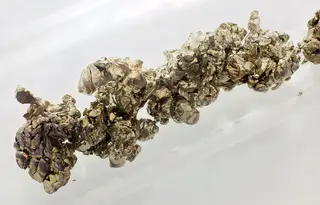
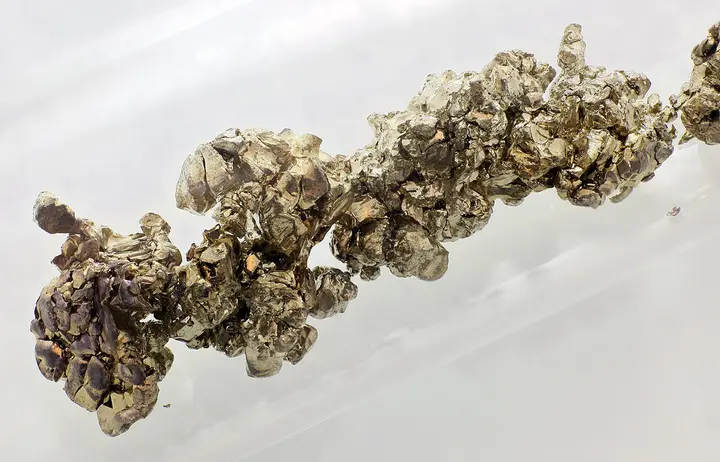
Strontium is a soft, silvery alkaline earth metal that reacts readily with water and air. Its compounds give a brilliant crimson flame.
Chemically it resembles calcium, so the body takes it into bones. This is harmless for natural strontium but a concern for radioactive strontium-90.
Quick answers
- What is strontium?
- Strontium (Sr) is an alkaline earth metal with atomic number 38. It is a solid at room temperature. The element that makes fireworks red, named after a Scottish village. A radioactive form from nuclear tests was once measured in children’s teeth.
- Where is strontium found?
- Strontium is mined mainly as celestine (strontium sulfate); China and Spain are major producers.
- What is strontium used for?
- Its main uses are fireworks and flares; magnets; glow-in-the-dark materials. Strontium salts produce red colors in fireworks and emergency flares.
At a glance
| Atomic number | 38 |
|---|---|
| Symbol | Sr |
| Standard atomic weight | 87.62 ± 0.01 |
| Natural isotopes | 4 (IUPAC CIAAW 2024) |
| Family | Alkaline earth metal |
| Group | Group 2 |
| Period | Period 5 |
| Block | s |
| Electron configuration | [Kr] 5s2 orbital diagram → |
| State at room temperature | Solid |
| Melting point | 777 °C (1,430 °F, 1,050 K) |
| Boiling point | 1,382 °C (2,519 °F, 1,655 K) |
| Density | 2.64 g/cm³ |
| Electronegativity (Pauling) | 0.95 |
| Atomic radius | 249 pm |
| First ionization energy | 5.695 eV |
| Oxidation states | +2 |
| Discovery | 1790 · Adair Crawford |
Discovery
In 1790 Adair Crawford and William Cruickshank recognized that a mineral from lead mines near Strontian, Scotland, contained a new “earth”. Humphry Davy isolated the metal in 1808.
Where the name comes from
From Strontian, the village in the Scottish Highlands where the mineral strontianite was found.
Where is strontium found?
Strontium is mined mainly as celestine (strontium sulfate); China and Spain are major producers.
Where every element is found →
What is strontium used for?
- Fireworks and flares. Strontium salts produce red colors in fireworks and emergency flares.
- Magnets. Strontium ferrite is used in inexpensive permanent magnets, such as fridge magnets and small motors.
- Glow-in-the-dark materials. Strontium aluminate pigments glow for hours after exposure to light.
What every element is used for → · Where are the elements found? →
Common compounds
| Compound | Formula | Note |
|---|---|---|
| Strontium sulfate | SrSO₄ | The mineral celestine. |
| Strontium carbonate | SrCO₃ | The mineral strontianite. |
Notable isotopes
- Sr-840.56%
- Sr-869.86%
- Sr-877%
- Sr-8882.58%
Percent by number of atoms. The light band shows the range over which the share varies in natural samples. Source: IUPAC CIAAW 2024
| Isotope | Half-life | Note |
|---|---|---|
| Strontium-88 | Stable | About 83% of natural strontium. |
| Strontium-87 | Stable | Partly formed by decay of rubidium-87; used to date rocks. |
| Strontium-90 | about 28.9 years | A radioactive fission product that can build up in bones. |
Safety
Reactive metal; radioactive isotope
Strontium metal reacts with water and can ignite in air when finely divided.
Natural strontium compounds have low toxicity. Radioactive strontium-90 from nuclear fallout is a health hazard because it is stored in bone.
Did you know?
- In the 1950s and 1960s, researchers in the United States measured strontium-90 from atmospheric nuclear tests in children’s baby teeth. The work fed into debates that led to the ban on atmospheric testing.
- Strontian is one of a handful of small places that have given their name to an element; Ytterby in Sweden gave its name to four.
- Rubidium–strontium dating, based on the slow decay of rubidium-87 into strontium-87, helps determine the age of very old rocks.
Frequently asked questions
Why are red fireworks red?
Strontium compounds in the firework emit red light when heated.
Is strontium radioactive?
Natural strontium is not. Strontium-90, made in nuclear fission, is radioactive.
Is strontium a metal?
Yes. Strontium is a metal, one of the alkaline earth metals.
What are the properties of strontium?
Atomic number 38, symbol Sr, atomic mass 87.62. It is a solid at room temperature. It melts at 777 °C (1,430 °F) and boils at 1,382 °C (2,519 °F). Density 2.64 g/cm³. Electronegativity 0.95 (Pauling).
Sources
- Royal Society of Chemistry: Strontium
- Encyclopaedia Britannica: Strontium
- USGS Mineral Commodity Summaries: Strontium
- NNDC NuDat 3 (nuclear data)
- NNDC ENSDF: Sr-90 (Basu & McCutchan, Nuclear Data Sheets 165, 2020)
- PubChem Periodic Table (NIH)
- IUPAC/CIAAW standard atomic weights
- Royal Society of Chemistry, Periodic Table
- Wikipedia: Strontium
Last checked: 16 November 2026
Other group 2 elements
Beryllium
A light, very stiff metal found in emeralds. It is transparent to X-rays, and the mirrors of the James Webb Space Telescope are made of it.
Magnesium
A light, strong metal that burns with a dazzling white flame. It sits at the heart of chlorophyll, the green pigment of plants.
Calcium
The metal of bones, teeth, shells and limestone. Calcium compounds also make the cement and plaster we build with.
Barium
A soft, reactive metal whose heavy compounds show up the gut on X-rays and turn fireworks green.
Radium
The intensely radioactive metal discovered by Marie and Pierre Curie. It once lit watch dials; today one radium isotope is used in cancer treatment.