Element 048
Cadmium (Cd)
A soft, bluish metal behind bright yellow and red paints and some batteries. It is toxic, so its use is now tightly restricted.
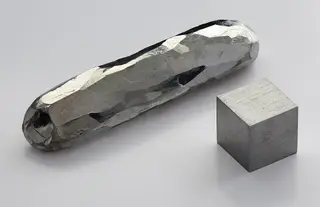
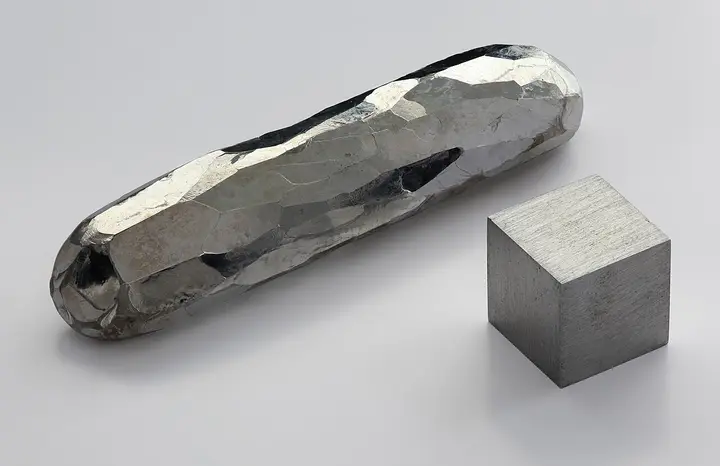
Cadmium is a soft, silvery-blue metal closely related to zinc, which it usually accompanies in ores.
It absorbs neutrons well and forms brightly colored compounds, but it builds up in the body and is toxic.
Quick answers
- What is cadmium?
- Cadmium (Cd) is a transition metal with atomic number 48. It is a solid at room temperature. A soft, bluish metal behind bright yellow and red paints and some batteries. It is toxic, so its use is now tightly restricted.
- Where is cadmium found?
- Cadmium is recovered as a by-product of zinc refining.
- What is cadmium used for?
- Its main uses are batteries, pigments and solar panels. Nickel–cadmium rechargeable batteries, now largely replaced.
At a glance
| Atomic number | 48 |
|---|---|
| Symbol | Cd |
| Standard atomic weight | 112.41 ± 0.01 |
| Natural isotopes | 8 (IUPAC CIAAW 2024) |
| Family | Transition metal |
| Group | Group 12 |
| Period | Period 5 |
| Block | d |
| Electron configuration | [Kr] 4d10 5s2 orbital diagram → |
| State at room temperature | Solid |
| Melting point | 321.07 °C (609.9 °F, 594.22 K) |
| Boiling point | 767 °C (1,412 °F, 1,040 K) |
| Density | 8.69 g/cm³ |
| Electronegativity (Pauling) | 1.69 |
| Atomic radius | 158 pm |
| First ionization energy | 8.994 eV |
| Oxidation states | +2 |
| Discovery | 1817 · Friedrich Stromeyer |
Discovery
In 1817 the German chemist Friedrich Stromeyer noticed that a zinc compound changed color when heated in a way pure zinc compounds should not. He traced the effect to a new metal.
Where the name comes from
From cadmia, the Latin name for zinc ore, from the Greek kadmeia, linked to Cadmus, legendary founder of Thebes.
Where is cadmium found?
Cadmium is recovered as a by-product of zinc refining.
Where every element is found →
What is cadmium used for?
- Batteries. Nickel–cadmium rechargeable batteries, now largely replaced.
- Pigments. Cadmium yellows, oranges and reds are used in artists’ paints and some plastics.
- Solar panels. Cadmium telluride thin-film solar panels.
- Nuclear reactors. Cadmium absorbs neutrons in control rods.
What every element is used for → · Where are the elements found? →
Common compounds
| Compound | Formula | Note |
|---|---|---|
| Cadmium sulfide | CdS | The pigment cadmium yellow. |
| Cadmium telluride | CdTe | Material of thin-film solar panels. |
Notable isotopes
- Cd-1061.245%
- Cd-1080.888%
- Cd-11012.47%
- Cd-11112.795%
- Cd-11224.109%
- Cd-11312.227%
- Cd-11428.754%
- Cd-1167.512%
Percent by number of atoms. The light band shows the range over which the share varies in natural samples. Source: IUPAC CIAAW 2024
| Isotope | Half-life | Note |
|---|---|---|
| Cadmium-114 | Stable | About 28.7% of natural cadmium. |
| Cadmium-112 | Stable | About 24.1%. |
| Cadmium-113 | far longer than the age of the universe | About 12.2%. It absorbs neutrons very strongly and decays very slowly. |
Safety
Toxic and carcinogenic
Cadmium damages the kidneys and bones and can cause cancer when inhaled. Its use in consumer products is restricted in many countries.
Did you know?
- In Japan in the first half of the 20th century, cadmium from mines polluted a river and caused a painful bone disease called “itai-itai” (it hurts, it hurts).
- Painters such as Claude Monet used the new cadmium yellow paints in the late 19th century.
- Cadmium is one of the substances restricted in electronics by the EU RoHS directive.
Frequently asked questions
Why is cadmium dangerous?
It accumulates in the body over many years and damages kidneys and bones.
Is cadmium still used in paints?
Yes, in some artists’ paints, where its pigments are valued for stable, bright colors.
Is cadmium a metal?
Yes. Cadmium is a metal, one of the transition metals.
What are the properties of cadmium?
Atomic number 48, symbol Cd, atomic mass 112.41. It is a solid at room temperature. It melts at 321.07 °C (609.9 °F) and boils at 767 °C (1,412 °F). Density 8.69 g/cm³. Electronegativity 1.69 (Pauling).
Sources
- Royal Society of Chemistry: Cadmium
- Encyclopaedia Britannica: Cadmium
- World Health Organization: Cadmium
- NNDC NuDat 3 (nuclear data)
- PubChem Periodic Table (NIH)
- IUPAC/CIAAW standard atomic weights
- Royal Society of Chemistry, Periodic Table
- Wikipedia: Cadmium
Last checked: 16 November 2026
Other group 12 elements
Zinc
The metal that stops steel from rusting. Zinc coats car bodies and fences, goes into brass and batteries, and is an essential nutrient.
Mercury
The only metal that is liquid at room temperature. Once used in thermometers, it is now restricted worldwide because it is toxic.
Copernicium
A superheavy element named after Nicolaus Copernicus. It is even more volatile than mercury, the element above it.