Element 030
Zinc (Zn)
The metal that stops steel from rusting. Zinc coats car bodies and fences, goes into brass and batteries, and is an essential nutrient.
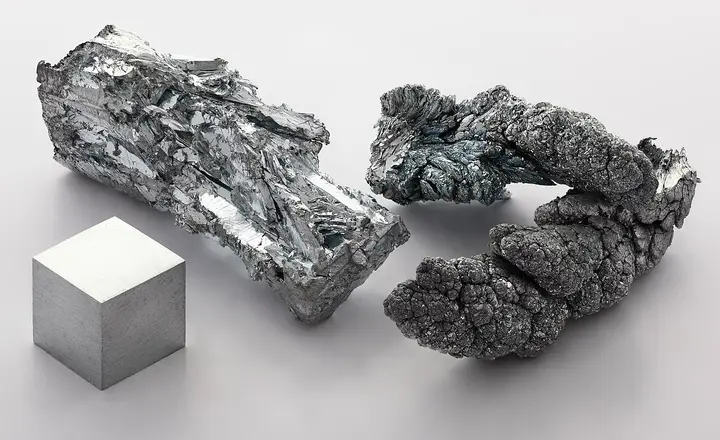
Zinc is a bluish-white transition metal. It is brittle at room temperature but becomes easy to shape when warmed slightly.
A layer of zinc protects steel even where it is scratched, because zinc corrodes first. The body needs small amounts of zinc for growth, healing and the immune system.
Quick answers
- What is zinc?
- Zinc (Zn) is a transition metal with atomic number 30. It is a solid at room temperature. The metal that stops steel from rusting. Zinc coats car bodies and fences, goes into brass and batteries, and is an essential nutrient.
- Where is zinc found?
- Zinc is mined mainly from the mineral sphalerite (zinc sulfide), often together with lead. China is the largest producer.
- What is zinc used for?
- Its main uses are galvanizing; brass and alloys; zinc oxide. About half of all zinc coats steel to protect it from rust.
At a glance
| Atomic number | 30 |
|---|---|
| Symbol | Zn |
| Standard atomic weight | 65.38 ± 0.02 |
| Natural isotopes | 5 (IUPAC CIAAW 2024) |
| Family | Transition metal |
| Group | Group 12 |
| Period | Period 4 |
| Block | d |
| Electron configuration | [Ar] 3d10 4s2 orbital diagram → |
| State at room temperature | Solid |
| Melting point | 419.53 °C (787.2 °F, 692.68 K) |
| Boiling point | 907 °C (1,664 °F, 1,180 K) |
| Density | 7.134 g/cm³ |
| Electronegativity (Pauling) | 1.65 |
| Atomic radius | 139 pm |
| First ionization energy | 9.394 eV |
| Oxidation states | +2 |
| Discovery | 1746 · Andreas Sigismund Marggraf |
Discovery
Brass, a copper–zinc alloy, was made in antiquity, and zinc metal was produced in India centuries before it was understood in Europe.
In 1746 the German chemist Andreas Sigismund Marggraf isolated zinc and described its properties, and he is usually credited with its discovery in Europe.
Where the name comes from
From the German Zink. Its origin is uncertain; it is often linked to Zinke, a spike or prong, possibly after the shape of zinc crystals.
Where is zinc found?
Zinc is mined mainly from the mineral sphalerite (zinc sulfide), often together with lead. China is the largest producer.
Where every element is found →
What is zinc used for?
- Galvanizing. About half of all zinc coats steel to protect it from rust.
- Brass and alloys. Brass and zinc die-casting alloys are used in taps, locks, zips and car parts.
- Zinc oxide. Used in rubber, ceramics, paints and mineral sunscreens.
- Batteries. Zinc is the negative electrode of alkaline and zinc–air batteries.
What every element is used for → · Where are the elements found? →
Common compounds
| Compound | Formula | Note |
|---|---|---|
| Zinc oxide | ZnO | Used in rubber, paints and sunscreens. |
| Zinc sulfide | ZnS | The ore sphalerite. |
Notable isotopes
- Zn-6449.17%
- Zn-6627.73%
- Zn-674.04%
- Zn-6818.45%
- Zn-700.61%
Percent by number of atoms. The light band shows the range over which the share varies in natural samples. Source: IUPAC CIAAW 2024
| Isotope | Half-life | Note |
|---|---|---|
| Zinc-64 | Stable | About 49.2% of natural zinc. |
| Zinc-66 | Stable | About 27.7%. |
| Zinc-68 | Stable | About 18.5%. |
Safety
Fumes and excess supplements
Breathing fumes from welding or cutting galvanized steel can cause “metal fume fever”, a flu-like illness.
Zinc is essential, but taking too much as a supplement can upset the stomach and interfere with copper absorption.
Did you know?
- US one-cent coins made after 1982 are mostly zinc with a thin copper coating.
- Zinc–air batteries are the common small button cells in hearing aids.
- Hundreds of enzymes in the human body need zinc to work.
Frequently asked questions
How does zinc protect steel?
Zinc is more reactive than iron, so it corrodes first and sacrifices itself, protecting the steel even where the coating is scratched.
Is zinc magnetic?
No. Zinc is not attracted to a magnet.
Is zinc a metal?
Yes. Zinc is a metal, one of the transition metals.
What are the properties of zinc?
Atomic number 30, symbol Zn, atomic mass 65.38. It is a solid at room temperature. It melts at 419.53 °C (787.2 °F) and boils at 907 °C (1,664 °F). Density 7.134 g/cm³. Electronegativity 1.65 (Pauling).
Sources
- Royal Society of Chemistry: Zinc
- Encyclopaedia Britannica: Zinc
- USGS Mineral Commodity Summaries: Zinc
- NNDC NuDat 3 (nuclear data)
- PubChem Periodic Table (NIH)
- IUPAC/CIAAW standard atomic weights
- Royal Society of Chemistry, Periodic Table
- Wikipedia: Zinc
Last checked: 16 November 2026
Other group 12 elements
Cadmium
A soft, bluish metal behind bright yellow and red paints and some batteries. It is toxic, so its use is now tightly restricted.
Mercury
The only metal that is liquid at room temperature. Once used in thermometers, it is now restricted worldwide because it is toxic.
Copernicium
A superheavy element named after Nicolaus Copernicus. It is even more volatile than mercury, the element above it.