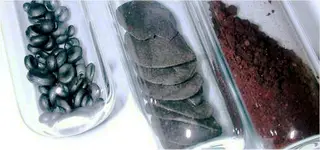
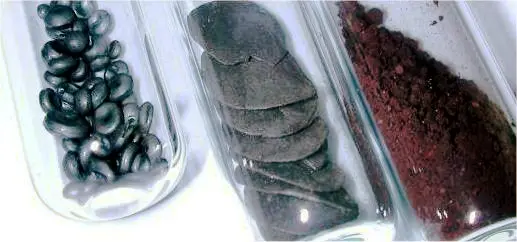
Selenium is a nonmetal that exists in several forms, including a gray, metallic-looking form and a red powder.
Gray selenium conducts electricity better in light than in the dark. That property once made it essential in photocopiers and light meters.
Quick answers
- What is selenium?
- Selenium (Se) is a nonmetal with atomic number 34. It is a solid at room temperature. An element whose electrical conductivity changes with light. The body needs a little selenium, but too much is toxic.
- Where is selenium found?
- Selenium is recovered mainly as a by-product of copper refining. Its amount in soils varies widely from place to place.
- What is selenium used for?
- Its main uses are glass; electronics and solar; nutrition and agriculture. Selenium removes the green tint from glass, or colors it red.
At a glance
| Atomic number | 34 |
|---|---|
| Symbol | Se |
| Standard atomic weight | 78.971 ± 0.008 |
| Natural isotopes | 6 (IUPAC CIAAW 2024) |
| Family | Nonmetal |
| Group | Group 16 |
| Period | Period 4 |
| Block | p |
| Electron configuration | [Ar] 3d10 4s2 4p4 orbital diagram → |
| State at room temperature | Solid |
| Melting point | 220.50 °C (428.9 °F, 493.65 K) |
| Boiling point | 685 °C (1,265 °F, 958 K) |
| Density | 4.809 g/cm³ |
| Electronegativity (Pauling) | 2.55 |
| Atomic radius | 190 pm |
| First ionization energy | 9.752 eV |
| Oxidation states | +6, +4, -2 |
| Discovery | 1817 · Jöns Jacob Berzelius |
Discovery
In 1817 Jöns Jacob Berzelius found selenium in a reddish deposit in the lead chambers of a sulfuric acid factory in Sweden.
Where the name comes from
From the Greek selene, the Moon, because tellurium, a similar element found earlier, had been named after the Earth.
Where is selenium found?
Selenium is recovered mainly as a by-product of copper refining. Its amount in soils varies widely from place to place.
Where every element is found →
What is selenium used for?
- Glass. Selenium removes the green tint from glass, or colors it red.
- Electronics and solar. It is used in some thin-film solar cells and was the light-sensitive layer in early photocopiers.
- Nutrition and agriculture. Selenium is added to animal feed and fertilizers in selenium-poor regions.
- Shampoo. Selenium sulfide is used in anti-dandruff shampoos.
What every element is used for → · Where are the elements found? →
Notable isotopes
- Se-740.86%
- Se-769.23%
- Se-777.6%
- Se-7823.69%
- Se-8049.8%
- Se-828.82%
Percent by number of atoms. The light band shows the range over which the share varies in natural samples. Source: IUPAC CIAAW 2024
| Isotope | Half-life | Note |
|---|---|---|
| Selenium-80 | Stable | About 49.6% of natural selenium. |
| Selenium-78 | Stable | About 23.8%. |
| Selenium-82 | far longer than the age of the universe | About 8.7%. It decays extremely slowly. |
Safety
Essential but toxic in excess
Selenium is an essential trace element, but the range between enough and too much is narrow. Large doses from supplements can cause poisoning.
Did you know?
- Brazil nuts are very rich in selenium; the amount depends on the soil where the trees grow.
- In 1873 the discovery that selenium’s conductivity changes with light inspired early ideas about sending pictures electrically.
- Selenium and tellurium were named as a Moon–Earth pair.
Frequently asked questions
Do we need selenium?
Yes, in small amounts. It is part of enzymes that protect cells from damage.
Which foods contain selenium?
Brazil nuts, fish, eggs and cereals grown in selenium-rich soils.
Is selenium a metal?
No. Selenium is a nonmetal.
What are the properties of selenium?
Atomic number 34, symbol Se, atomic mass 78.971. It is a solid at room temperature. It melts at 220.50 °C (428.9 °F) and boils at 685 °C (1,265 °F). Density 4.809 g/cm³. Electronegativity 2.55 (Pauling).
Sources
- Royal Society of Chemistry: Selenium
- Encyclopaedia Britannica: Selenium
- NNDC NuDat 3 (nuclear data)
- PubChem Periodic Table (NIH)
- IUPAC/CIAAW standard atomic weights
- Royal Society of Chemistry, Periodic Table
- Wikipedia: Selenium
Last checked: 16 November 2026
Other group 16 elements
Oxygen
The gas we need to breathe and the most abundant element in Earth’s crust. It makes up about a fifth of the air.
Sulfur
A bright yellow nonmetal known since ancient times as brimstone. Sulfuric acid, made from it, is the world’s most produced industrial chemical.
Tellurium
A rare, silvery metalloid named after the Earth. It goes into thin-film solar panels and devices that turn heat into electricity.
Polonium
An intensely radioactive element discovered by Marie and Pierre Curie and named after Poland. Tiny amounts remove static electricity in industry.
Livermorium
A superheavy element named after Lawrence Livermore National Laboratory in California.