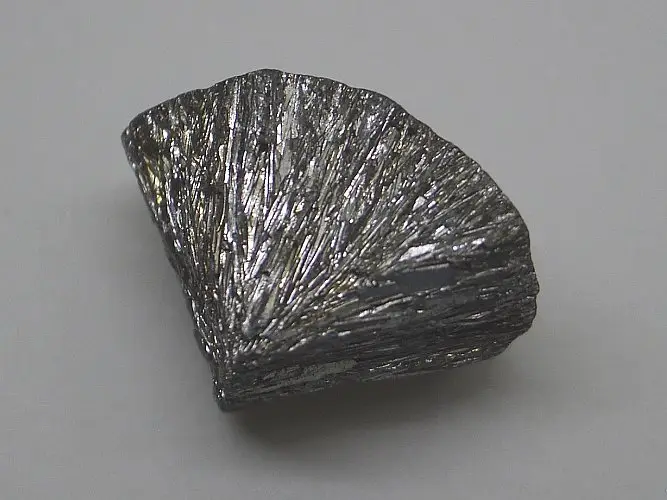
Tellurium is a brittle, silvery-white metalloid. It is one of the rarest stable elements in Earth’s crust.
It is a semiconductor, and its compounds with cadmium and bismuth are used in solar panels and thermoelectric devices.
Quick answers
- What is tellurium?
- Tellurium (Te) is a metalloid with atomic number 52. It is a solid at room temperature. A rare, silvery metalloid named after the Earth. It goes into thin-film solar panels and devices that turn heat into electricity.
- Where is tellurium found?
- Tellurium is recovered mainly from the residues of copper refining.
- What is tellurium used for?
- Its main uses are solar panels, thermoelectrics and metallurgy. Cadmium telluride thin-film panels.
At a glance
| Atomic number | 52 |
|---|---|
| Symbol | Te |
| Standard atomic weight | 127.60 ± 0.03 |
| Natural isotopes | 8 (IUPAC CIAAW 2024) |
| Family | Metalloid |
| Group | Group 16 |
| Period | Period 5 |
| Block | p |
| Electron configuration | [Kr] 4d10 5s2 5p4 orbital diagram → |
| State at room temperature | Solid |
| Melting point | 449.51 °C (841.1 °F, 722.66 K) |
| Boiling point | 988 °C (1,810 °F, 1,261 K) |
| Density | 6.232 g/cm³ |
| Electronegativity (Pauling) | 2.1 |
| Atomic radius | 206 pm |
| First ionization energy | 9.01 eV |
| Oxidation states | +6, +4, -2 |
| Discovery | 1783 · Franz-Joseph Müller von Reichenstein |
Discovery
In 1783 Franz-Joseph Müller von Reichenstein found a new element in a gold ore from Transylvania. Martin Heinrich Klaproth confirmed it in 1798 and named it.
Where the name comes from
From the Latin tellus, earth. Selenium, discovered later, was named after the Moon to match.
Where is tellurium found?
Tellurium is recovered mainly from the residues of copper refining.
Where every element is found →
What is tellurium used for?
- Solar panels. Cadmium telluride thin-film panels.
- Thermoelectrics. Bismuth telluride devices turn heat into electricity, or electricity into cooling.
- Metallurgy. Small amounts make steel and copper easier to machine.
What every element is used for → · Where are the elements found? →
Common compounds
| Compound | Formula | Note |
|---|---|---|
| Cadmium telluride | CdTe | Material of thin-film solar panels. |
Notable isotopes
- Te-1200.09%
- Te-1222.55%
- Te-1230.89%
- Te-1244.74%
- Te-1257.07%
- Te-12618.84%
- Te-12831.74%
- Te-13034.08%
Percent by number of atoms. The light band shows the range over which the share varies in natural samples. Source: IUPAC CIAAW 2024
| Isotope | Half-life | Note |
|---|---|---|
| Tellurium-130 | far longer than the age of the universe | The most common isotope, about 34%. |
| Tellurium-128 | about 2 × 10²⁴ years | The longest half-life ever measured for any isotope. |
Safety
Toxic; causes “garlic breath”
Tellurium compounds are toxic. Even small exposures can give a strong garlic smell to the breath.
Did you know?
- Tellurium-128’s half-life is more than a hundred trillion times the age of the universe.
- Tellurium is very rare in Earth’s crust but relatively common in the universe, probably because its volatile compounds escaped into space as Earth formed.
- Tellurium is one of the few elements found combined with gold in nature, in minerals called tellurides.
Frequently asked questions
Is tellurium a metal?
It is a metalloid, with a metallic look but semiconducting properties.
Why is tellurium important for solar power?
Cadmium telluride panels are among the cheapest thin-film solar technologies.
What are the properties of tellurium?
Atomic number 52, symbol Te, atomic mass 127.60. It is a solid at room temperature. It melts at 449.51 °C (841.1 °F) and boils at 988 °C (1,810 °F). Density 6.232 g/cm³. Electronegativity 2.1 (Pauling).
Sources
- Royal Society of Chemistry: Tellurium
- Encyclopaedia Britannica: Tellurium
- USGS Mineral Commodity Summaries: Selenium and tellurium
- NNDC NuDat 3 (nuclear data)
- PubChem Periodic Table (NIH)
- IUPAC/CIAAW standard atomic weights
- Royal Society of Chemistry, Periodic Table
- Wikipedia: Tellurium
Last checked: 16 November 2026
Other group 16 elements
Oxygen
The gas we need to breathe and the most abundant element in Earth’s crust. It makes up about a fifth of the air.
Sulfur
A bright yellow nonmetal known since ancient times as brimstone. Sulfuric acid, made from it, is the world’s most produced industrial chemical.
Selenium
An element whose electrical conductivity changes with light. The body needs a little selenium, but too much is toxic.
Polonium
An intensely radioactive element discovered by Marie and Pierre Curie and named after Poland. Tiny amounts remove static electricity in industry.
Livermorium
A superheavy element named after Lawrence Livermore National Laboratory in California.