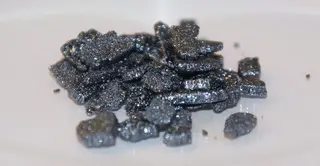
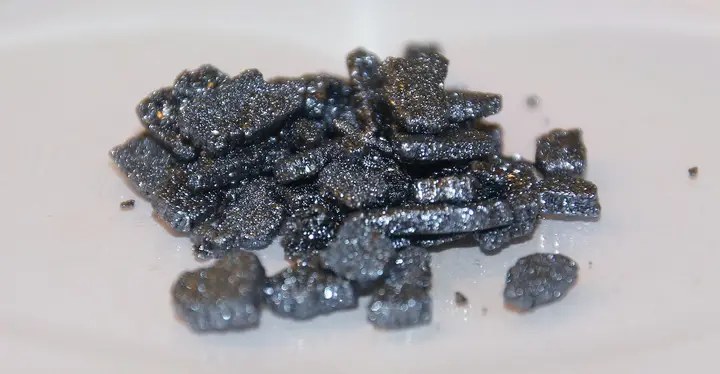
Iodine is a halogen. At room temperature it forms blue-black, shiny crystals, and when warmed it turns straight into a violet vapor.
The thyroid gland uses iodine to make hormones that control growth and metabolism. It is the heaviest element the human body is known to need.
Quick answers
- What is iodine?
- Iodine (I) is a halogen with atomic number 53. It is a solid at room temperature. Shiny dark crystals that give off a violet vapor. Our thyroid gland needs iodine, which is why it is added to table salt.
- Where is iodine found?
- Iodine is rare in Earth’s crust but concentrated in seawater, seaweed and some brines. Chile and Japan are the main producers.
- What is iodine used for?
- Its main uses are nutrition, disinfectants and medical imaging. Iodized salt is one of the simplest ways to prevent iodine deficiency.
At a glance
| Atomic number | 53 |
|---|---|
| Symbol | I |
| Standard atomic weight | 126.90 ± 0.01 |
| Natural isotopes | 1 (IUPAC CIAAW 2024; a single isotope in nature) |
| Family | Halogen |
| Group | Group 17 |
| Period | Period 5 |
| Block | p |
| Electron configuration | [Kr] 4d10 5s2 5p5 orbital diagram → |
| State at room temperature | Solid |
| Melting point | 113.70 °C (236.7 °F, 386.85 K) |
| Boiling point | 184.40 °C (363.9 °F, 457.55 K) |
| Density | 4.93 g/cm³ |
| Electronegativity (Pauling) | 2.66 |
| Atomic radius | 198 pm |
| First ionization energy | 10.451 eV |
| Oxidation states | +7, +5, +1, -1 |
| Discovery | 1811 · Bernard Courtois |
Discovery
In 1811 the French chemist Bernard Courtois was extracting chemicals from seaweed ash to make saltpeter for gunpowder. Adding sulfuric acid released a violet vapor that condensed into dark crystals: iodine.
Where the name comes from
From the Greek iodes, violet, after the color of its vapor.
Where is iodine found?
Iodine is rare in Earth’s crust but concentrated in seawater, seaweed and some brines. Chile and Japan are the main producers.
Where every element is found →
What is iodine used for?
- Nutrition. Iodized salt is one of the simplest ways to prevent iodine deficiency.
- Disinfectants. Iodine solutions such as povidone-iodine clean skin before surgery.
- Medical imaging. Iodine compounds are used as contrast agents in X-ray and CT scans.
- Industry. Iodine is used in LCD screen polarizers, catalysts and animal feed.
What every element is used for → · Where are the elements found? →
Common compounds
| Compound | Formula | Note |
|---|---|---|
| Potassium iodate | KIO₃ | Added to table salt in many countries to prevent iodine deficiency. |
| Potassium iodide | KI | Active ingredient of the tablets authorities hand out after nuclear accidents. |
Notable isotopes
| Isotope | Half-life | Note |
|---|---|---|
| Iodine-127 | Stable | The only stable isotope; all natural iodine. |
| Iodine-131 | about 8 days | Radioactive. Used to diagnose and treat thyroid disease; also released in nuclear accidents. |
Safety
Crystals and vapor are irritating
Pure iodine stains and irritates skin, eyes and lungs.
Potassium iodide tablets protect the thyroid only in specific nuclear emergencies and should be taken only when public health authorities advise it.
Did you know?
- According to the World Health Organization, iodine deficiency is one of the world’s most common preventable causes of impaired brain development.
- Iodine and starch together turn deep blue-black, a classic test for either substance.
- Iodine is the heaviest element the human body needs.
Frequently asked questions
Why is iodine added to salt?
Salt is eaten by almost everyone in small, steady amounts, so adding iodine to it is a cheap way to prevent deficiency.
Is iodine a metal?
No. It is a nonmetal (a halogen), even though its crystals have a metallic shine.
What are the properties of iodine?
Atomic number 53, symbol I, atomic mass 126.90. It is a solid at room temperature. It melts at 113.70 °C (236.7 °F) and boils at 184.40 °C (363.9 °F). Density 4.93 g/cm³. Electronegativity 2.66 (Pauling).
Sources
- Royal Society of Chemistry: Iodine
- Encyclopaedia Britannica: Iodine
- World Health Organization: Iodine deficiency
- NNDC NuDat 3 (nuclear data)
- PubChem Periodic Table (NIH)
- IUPAC/CIAAW standard atomic weights
- Royal Society of Chemistry, Periodic Table
- Wikipedia: Iodine
Last checked: 16 November 2026
Other group 17 elements
Fluorine
The most reactive element of all. As fluoride it protects teeth, and its compounds include non-stick coatings and many medicines.
Chlorine
A yellow-green, poisonous gas that, in small amounts, keeps drinking water and swimming pools safe. Half of table salt is chlorine.
Bromine
One of only two elements that are liquid at room temperature. Dark red and strong-smelling, it is used in flame retardants and water treatment.
Astatine
The rarest naturally occurring element on Earth. Nobody has ever seen a visible piece of it, but one isotope is being studied to fight cancer.
Tennessine
The most recently discovered element, made using a rare berkelium target produced in Tennessee.