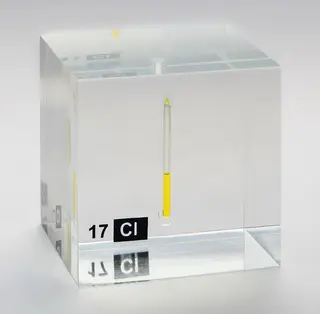
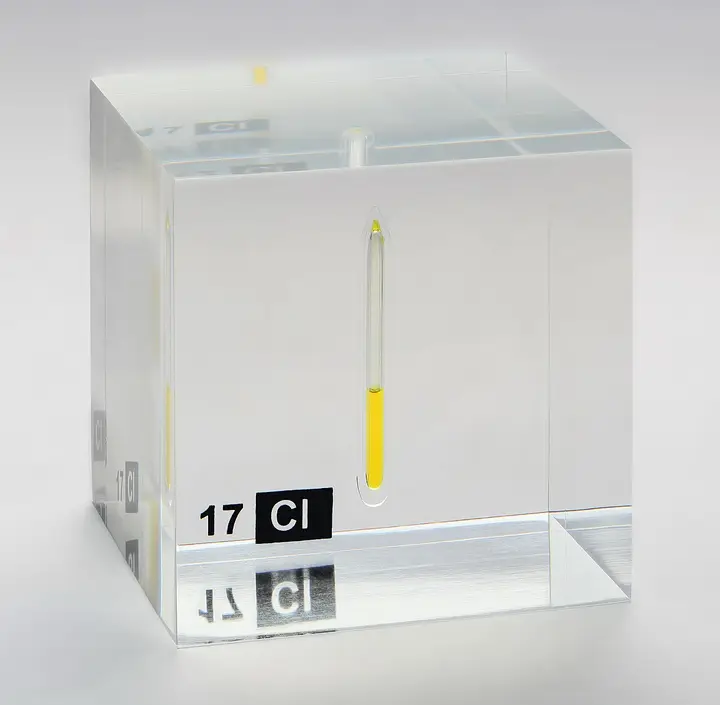
Chlorine is a halogen. As a gas it is yellow-green, sharp-smelling and toxic, and it is about two and a half times heavier than air.
Bonded to sodium it becomes harmless table salt. Its compounds disinfect water and are used to make plastics such as PVC and many medicines.
Quick answers
- What is chlorine?
- Chlorine (Cl) is a halogen with atomic number 17. It is a gas at room temperature. A yellow-green, poisonous gas that, in small amounts, keeps drinking water and swimming pools safe. Half of table salt is chlorine.
- Where is chlorine found?
- Chlorine is too reactive to occur free. It is found as chloride, above all in seawater and in rock salt deposits.
- What is chlorine used for?
- Its main uses are clean water; plastics; bleach and disinfectants. Adding small amounts of chlorine to drinking water kills disease-causing microbes.
At a glance
| Atomic number | 17 |
|---|---|
| Symbol | Cl |
| Standard atomic weight | 35.45 ± 0.01 |
| Natural isotopes | 2 (IUPAC CIAAW 2024) |
| Family | Halogen |
| Group | Group 17 |
| Period | Period 3 |
| Block | p |
| Electron configuration | [Ne] 3s2 3p5 orbital diagram → |
| State at room temperature | Gas |
| Melting point | −101.50 °C (−150.7 °F, 171.65 K) |
| Boiling point | −34.04 °C (−29.3 °F, 239.11 K) |
| Density | 3.214 g/L (0 °C, 1 atm) |
| Electronegativity (Pauling) | 3.16 |
| Atomic radius | 175 pm |
| First ionization energy | 12.968 eV |
| Oxidation states | +7, +5, +1, -1 |
| Discovery | 1774 · Carl Wilhelm Scheele |
Discovery
Carl Wilhelm Scheele made chlorine in 1774 by reacting hydrochloric acid with a manganese mineral, but thought it was a compound containing oxygen. In 1810 Humphry Davy showed it was an element and named it.
Where the name comes from
From the Greek khloros, pale green or yellow-green, describing the color of the gas.
Where is chlorine found?
Chlorine is too reactive to occur free. It is found as chloride, above all in seawater and in rock salt deposits.
Where every element is found →
What is chlorine used for?
- Clean water. Adding small amounts of chlorine to drinking water kills disease-causing microbes. It is one of the great public health advances of the 20th century.
- Plastics. PVC, used in pipes, window frames and cables, contains chlorine.
- Bleach and disinfectants. Household bleach is a solution of sodium hypochlorite.
- Chemicals and medicines. Chlorine is used to make a wide range of chemicals, including many drugs.
What every element is used for → · Where are the elements found? →
Common compounds
| Compound | Formula | Note |
|---|---|---|
| Sodium chloride | NaCl | Table salt. |
| Hydrochloric acid | HCl | Strong acid also found in the stomach; sold diluted as muriatic acid. |
| Polyvinyl chloride | PVC | Plastic used for pipes and window frames. |
Notable isotopes
- Cl-3575.5–76.1%
- Cl-3723.9–24.5%
Percent by number of atoms. The light band shows the range over which the share varies in natural samples. Source: IUPAC CIAAW 2024
| Isotope | Half-life | Note |
|---|---|---|
| Chlorine-35 | Stable | About 75.8% of natural chlorine. |
| Chlorine-37 | Stable | About 24.2%. The mix of these two isotopes is why chlorine’s atomic mass is not a whole number (35.45). |
| Chlorine-36 | about 301,000 years | Used to date groundwater. |
Safety
Toxic gas; never mix bleach with other cleaners
Chlorine gas damages the eyes and lungs. It was used as a weapon in the First World War.
Mixing bleach with acidic cleaners or ammonia can release toxic gases. Use cleaning products separately and in a well-ventilated space.
Did you know?
- Chlorine gas is about 2.5 times heavier than air, so after a leak it collects near the ground.
- The “swimming pool smell” is mostly chloramines, formed when chlorine reacts with sweat and urine, not chlorine itself.
- CFC gases damaged the ozone layer because of the chlorine atoms they release. The 1987 Montreal Protocol phased them out.
Frequently asked questions
Is the chlorine in tap water safe?
Yes. The small amounts used to disinfect drinking water are regulated and considered safe; they prevent much more serious waterborne diseases.
Is chlorine the same as chloride?
No. Chlorine is the reactive element; chloride is the stable ion (Cl⁻) found in salt.
Is chlorine a metal?
No. Chlorine is a nonmetal, one of the halogens.
What are the properties of chlorine?
Atomic number 17, symbol Cl, atomic mass 35.45. It is a gas at room temperature. It melts at −101.50 °C (−150.7 °F) and boils at −34.04 °C (−29.3 °F). Density 3.214 g/L. Electronegativity 3.16 (Pauling).
Sources
- Royal Society of Chemistry: Chlorine
- Encyclopaedia Britannica: Chlorine
- NNDC NuDat 3 (nuclear data)
- PubChem Periodic Table (NIH)
- IUPAC/CIAAW standard atomic weights
- Royal Society of Chemistry, Periodic Table
- Wikipedia: Chlorine
Last checked: 16 November 2026
Other group 17 elements
Fluorine
The most reactive element of all. As fluoride it protects teeth, and its compounds include non-stick coatings and many medicines.
Bromine
One of only two elements that are liquid at room temperature. Dark red and strong-smelling, it is used in flame retardants and water treatment.
Iodine
Shiny dark crystals that give off a violet vapor. Our thyroid gland needs iodine, which is why it is added to table salt.
Astatine
The rarest naturally occurring element on Earth. Nobody has ever seen a visible piece of it, but one isotope is being studied to fight cancer.
Tennessine
The most recently discovered element, made using a rare berkelium target produced in Tennessee.