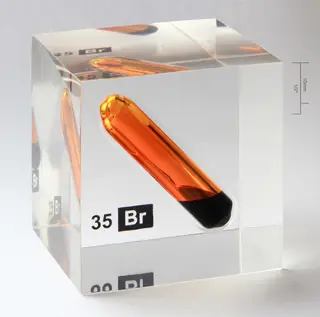
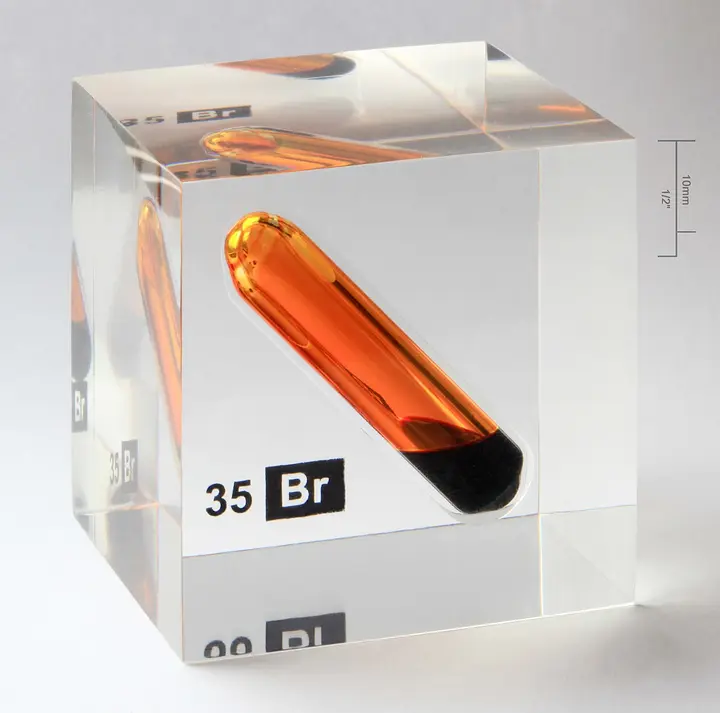
Bromine is a halogen. At room temperature it is a heavy, dark red-brown liquid that gives off a choking orange vapor; it boils at about 59 °C.
It is less reactive than chlorine but still highly corrosive. Most bromine is turned into compounds.
Quick answers
- What is bromine?
- Bromine (Br) is a halogen with atomic number 35. One of only two elements that are liquid at room temperature. Dark red and strong-smelling, it is used in flame retardants and water treatment.
- Where is bromine found?
- Bromine is extracted from salty brines and from the Dead Sea. Seawater contains it as bromide.
- What is bromine used for?
- Its main uses are flame retardants; oil and gas drilling; water treatment. Brominated compounds slow the spread of fire in plastics and electronics.
At a glance
| Atomic number | 35 |
|---|---|
| Symbol | Br |
| Standard atomic weight | 79.904 ± 0.003 |
| Natural isotopes | 2 (IUPAC CIAAW 2024) |
| Family | Halogen |
| Group | Group 17 |
| Period | Period 4 |
| Block | p |
| Electron configuration | [Ar] 3d10 4s2 4p5 orbital diagram → |
| State at room temperature | Liquid |
| Melting point | −7.20 °C (19 °F, 265.95 K) |
| Boiling point | 58.80 °C (137.8 °F, 331.95 K) |
| Density | 3.11 g/cm³ |
| Electronegativity (Pauling) | 2.96 |
| Atomic radius | 183 pm |
| First ionization energy | 11.814 eV |
| Oxidation states | +5, +1, -1 |
| Discovery | 1826 · Antoine-Jérôme Balard |
Discovery
In 1826 the young French chemist Antoine-Jérôme Balard found bromine in the brine of salt marshes near Montpellier. Carl Löwig in Germany had isolated it a little earlier but published later.
Where the name comes from
From the Greek bromos, stench, because of its sharp, unpleasant smell.
Where is bromine found?
Bromine is extracted from salty brines and from the Dead Sea. Seawater contains it as bromide.
Where every element is found →
What is bromine used for?
- Flame retardants. Brominated compounds slow the spread of fire in plastics and electronics.
- Oil and gas drilling. Dense bromide solutions are used in drilling fluids.
- Water treatment. Bromine compounds disinfect pools and hot tubs and treat industrial water.
- Chemicals and medicines. Bromine is used to make dyes, pharmaceuticals and other chemicals.
What every element is used for → · Where are the elements found? →
Common compounds
| Compound | Formula | Note |
|---|---|---|
| Potassium bromide | KBr | Window material in infrared spectroscopy. |
| Silver bromide | AgBr | The light-sensitive salt of film photography. |
Notable isotopes
- Br-7950.5–50.8%
- Br-8149.2–49.5%
Percent by number of atoms. The light band shows the range over which the share varies in natural samples. Source: IUPAC CIAAW 2024
| Isotope | Half-life | Note |
|---|---|---|
| Bromine-79 | Stable | About 50.7% of natural bromine. |
| Bromine-81 | Stable | About 49.3%. Because the two isotopes are almost equally common, bromine’s atomic mass is close to 80. |
Safety
Corrosive liquid and toxic vapor
Liquid bromine causes severe burns, and its vapor irritates the eyes and lungs. It is handled only with protective equipment and good ventilation.
Did you know?
- Tyrian purple, the costly dye of ancient royalty, is a bromine compound made by sea snails.
- Apart from bromine and mercury, no element is liquid at room temperature, though cesium and gallium melt just above room temperature, at about 28–30 °C.
- Some bromine compounds used in fire extinguishers and pesticides were phased out because they damage the ozone layer.
Frequently asked questions
Which elements are liquid at room temperature?
Only bromine and mercury.
Why does bromine smell so strong?
It evaporates easily at room temperature, and its vapor irritates the nose even at low concentrations.
Is bromine a metal?
No. Bromine is a nonmetal, one of the halogens.
What are the properties of bromine?
Atomic number 35, symbol Br, atomic mass 79.904. It is a liquid at room temperature. It melts at −7.20 °C (19 °F) and boils at 58.80 °C (137.8 °F). Density 3.11 g/cm³. Electronegativity 2.96 (Pauling).
Sources
- Royal Society of Chemistry: Bromine
- Encyclopaedia Britannica: Bromine
- USGS Mineral Commodity Summaries: Bromine
- NNDC NuDat 3 (nuclear data)
- PubChem Periodic Table (NIH)
- IUPAC/CIAAW standard atomic weights
- Royal Society of Chemistry, Periodic Table
- Wikipedia: Bromine
Last checked: 16 November 2026
Other group 17 elements
Fluorine
The most reactive element of all. As fluoride it protects teeth, and its compounds include non-stick coatings and many medicines.
Chlorine
A yellow-green, poisonous gas that, in small amounts, keeps drinking water and swimming pools safe. Half of table salt is chlorine.
Iodine
Shiny dark crystals that give off a violet vapor. Our thyroid gland needs iodine, which is why it is added to table salt.
Astatine
The rarest naturally occurring element on Earth. Nobody has ever seen a visible piece of it, but one isotope is being studied to fight cancer.
Tennessine
The most recently discovered element, made using a rare berkelium target produced in Tennessee.