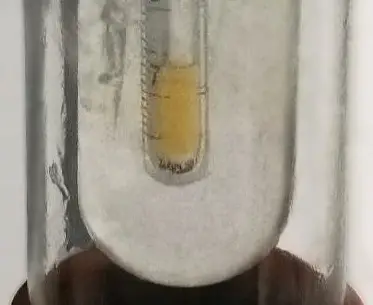
Fluorine is a pale yellow gas and the most electronegative element: it pulls electrons toward itself more strongly than any other.
It reacts with almost every substance, including glass and some noble gases. For this reason it is never found free in nature.
Quick answers
- What is fluorine?
- Fluorine (F) is a halogen with atomic number 9. It is a gas at room temperature. The most reactive element of all. As fluoride it protects teeth, and its compounds include non-stick coatings and many medicines.
- Where is fluorine found?
- Fluorine occurs in minerals such as fluorite (calcium fluoride) and fluorapatite. Small amounts of fluoride are dissolved in seawater and some drinking water.
- What is fluorine used for?
- Its main uses are toothpaste; non-stick and durable plastics; nuclear fuel. Fluoride compounds help harden tooth enamel and protect against decay.
At a glance
| Atomic number | 9 |
|---|---|
| Symbol | F |
| Standard atomic weight | 18.998 ± 0.001 |
| Natural isotopes | 1 (IUPAC CIAAW 2024; a single isotope in nature) |
| Family | Halogen |
| Group | Group 17 |
| Period | Period 2 |
| Block | p |
| Electron configuration | [He] 2s2 2p5 orbital diagram → |
| State at room temperature | Gas |
| Melting point | −219.62 °C (−363.3 °F, 53.53 K) |
| Boiling point | −188.12 °C (−306.6 °F, 85.03 K) |
| Density | 1.696 g/L (0 °C, 1 atm) |
| Electronegativity (Pauling) | 3.98 |
| Atomic radius | 135 pm |
| First ionization energy | 17.423 eV |
| Oxidation states | -1 |
| Discovery | 1886 · Henri Moissan |
Discovery
Chemists knew for decades that minerals such as fluorite held an unknown element, but attempts to free it failed and several experimenters were poisoned or injured.
In 1886 the French chemist Henri Moissan finally isolated fluorine by electrolysis at low temperature. He received the 1906 Nobel Prize in Chemistry.
Where the name comes from
Named after the mineral fluorite, from the Latin fluere, to flow, because fluorite was added to metal ores to help them melt.
Where is fluorine found?
Fluorine occurs in minerals such as fluorite (calcium fluoride) and fluorapatite. Small amounts of fluoride are dissolved in seawater and some drinking water.
Where every element is found →
What is fluorine used for?
- Toothpaste. Fluoride compounds help harden tooth enamel and protect against decay.
- Non-stick and durable plastics. PTFE (Teflon) and other fluoropolymers resist heat and chemicals.
- Nuclear fuel. Uranium hexafluoride gas is used to enrich uranium.
- Medicines. Many modern drugs contain fluorine atoms that change how the body processes them.
What every element is used for → · Where are the elements found? →
Common compounds
| Compound | Formula | Note |
|---|---|---|
| Calcium fluoride | CaF₂ | The mineral fluorite. |
| Hydrofluoric acid | HF | Etches glass; extremely dangerous to handle. |
| Polytetrafluoroethylene | PTFE | Teflon, the non-stick coating. |
Notable isotopes
| Isotope | Half-life | Note |
|---|---|---|
| Fluorine-19 | Stable | All natural fluorine is this isotope. |
| Fluorine-18 | about 110 minutes | The most widely used radioactive isotope in PET scans. |
Safety
Extremely toxic and corrosive gas
Fluorine gas attacks skin, eyes and lungs even at low concentrations. Only specialist laboratories handle it.
Hydrofluoric acid, a fluorine compound, is also very dangerous and can cause serious injury through the skin.
Did you know?
- Fluorine and hydrogen combine explosively even at very low temperatures.
- Roy Plunkett discovered PTFE by accident in 1938, when a cylinder of refrigerant gas turned into a white, slippery powder.
- Fluorite glows under ultraviolet light, which gave us the word “fluorescence”.
Frequently asked questions
Is fluoride the same as fluorine?
No. Fluorine is the reactive element; fluoride is the stable ion (F⁻) found in compounds such as sodium fluoride in toothpaste.
Why is fluorine so reactive?
Its small atoms have room for one more electron and hold it very strongly, so fluorine grabs electrons from almost anything.
Is fluorine a metal?
No. Fluorine is a nonmetal, one of the halogens.
What are the properties of fluorine?
Atomic number 9, symbol F, atomic mass 18.998. It is a gas at room temperature. It melts at −219.62 °C (−363.3 °F) and boils at −188.12 °C (−306.6 °F). Density 1.696 g/L. Electronegativity 3.98 (Pauling).
Sources
- Royal Society of Chemistry: Fluorine
- Encyclopaedia Britannica: Fluorine
- Nobel Prize in Chemistry 1906 (Henri Moissan)
- NNDC NuDat 3 (nuclear data)
- PubChem Periodic Table (NIH)
- IUPAC/CIAAW standard atomic weights
- Royal Society of Chemistry, Periodic Table
- Wikipedia: Fluorine
Last checked: 16 November 2026
Other group 17 elements
Chlorine
A yellow-green, poisonous gas that, in small amounts, keeps drinking water and swimming pools safe. Half of table salt is chlorine.
Bromine
One of only two elements that are liquid at room temperature. Dark red and strong-smelling, it is used in flame retardants and water treatment.
Iodine
Shiny dark crystals that give off a violet vapor. Our thyroid gland needs iodine, which is why it is added to table salt.
Astatine
The rarest naturally occurring element on Earth. Nobody has ever seen a visible piece of it, but one isotope is being studied to fight cancer.
Tennessine
The most recently discovered element, made using a rare berkelium target produced in Tennessee.