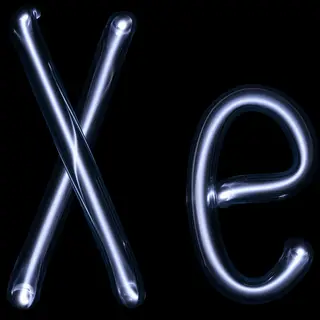
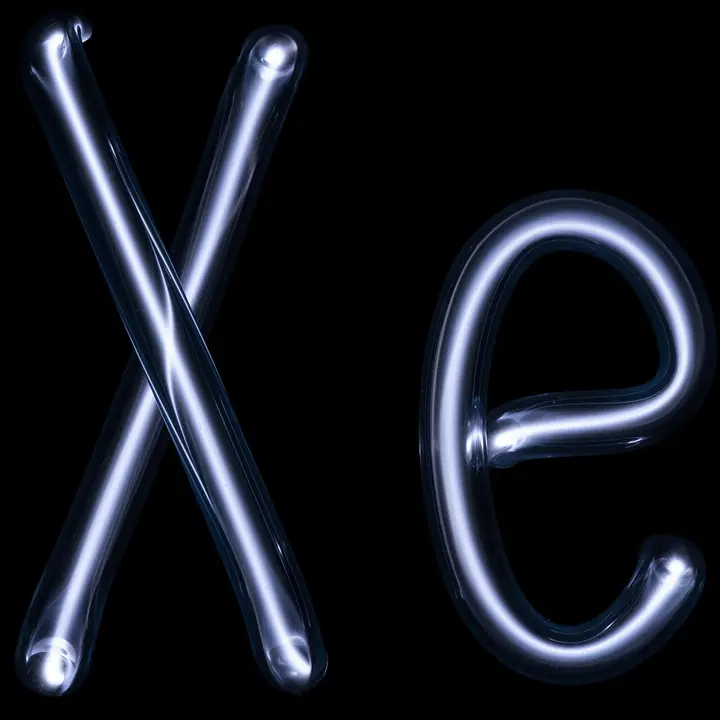
Xenon is a colorless, odorless and very heavy noble gas, about four and a half times denser than air. Air contains less than one part in ten million of it.
Unlike the lighter noble gases, xenon forms a number of stable compounds with fluorine and oxygen.
Quick answers
- What is xenon?
- Xenon (Xe) is a noble gas with atomic number 54. It is a gas at room temperature. A heavy, rare noble gas that glows blue in car headlights and pushes spacecraft with its ions. It was the first noble gas made to form a compound.
- Where is xenon found?
- Xenon is extracted from liquefied air. It is one of the rarest gases in the atmosphere.
- What is xenon used for?
- Its main uses are lighting, spacecraft propulsion and medicine. Xenon lamps light film projectors, camera flashes and some car headlights.
At a glance
| Atomic number | 54 |
|---|---|
| Symbol | Xe |
| Standard atomic weight | 131.29 ± 0.01 |
| Natural isotopes | 9 (IUPAC CIAAW 2024) |
| Family | Noble gas |
| Group | Group 18 |
| Period | Period 5 |
| Block | p |
| Electron configuration | [Kr] 4d10 5s2 5p6 orbital diagram → |
| State at room temperature | Gas |
| Melting point | −111.79 °C (−169.2 °F, 161.36 K) |
| Boiling point | −108.12 °C (−162.6 °F, 165.03 K) |
| Density | 5.887 g/L (0 °C, 1 atm) |
| Electronegativity (Pauling) | 2.6 |
| Atomic radius | 216 pm |
| First ionization energy | 12.13 eV |
| Oxidation states | 0 |
| Discovery | 1898 · William Ramsay and Morris Travers |
Discovery
In July 1898 William Ramsay and Morris Travers found xenon in the last traces left after evaporating liquid air, weeks after discovering krypton and neon.
Where the name comes from
From the Greek xenos, stranger or foreigner.
Where is xenon found?
Xenon is extracted from liquefied air. It is one of the rarest gases in the atmosphere.
Where every element is found →
What is xenon used for?
- Lighting. Xenon lamps light film projectors, camera flashes and some car headlights.
- Spacecraft propulsion. Ion thrusters accelerate xenon ions to push spacecraft such as NASA’s Dawn.
- Medicine. Xenon can act as an anesthetic, and radioactive xenon-133 is used in lung imaging.
- Chip making. Xenon is used in some lasers and etching processes for semiconductors.
What every element is used for → · Where are the elements found? →
Common compounds
| Compound | Formula | Note |
|---|---|---|
| Xenon difluoride | XeF₂ | One of the most stable xenon compounds known. |
Notable isotopes
- Xe-1240.095%
- Xe-1260.089%
- Xe-1281.91%
- Xe-12926.401%
- Xe-1304.071%
- Xe-13121.232%
- Xe-13226.909%
- Xe-13410.436%
- Xe-1368.857%
Percent by number of atoms. The light band shows the range over which the share varies in natural samples. Source: IUPAC CIAAW 2024
| Isotope | Half-life | Note |
|---|---|---|
| Xenon-132 | Stable | The most common isotope, about 27%. |
| Xenon-129 | Stable | Used in MRI scans of the lungs. |
| Xenon-135 | about 9.1 hours | Absorbs neutrons very strongly and affects how nuclear reactors are run. |
Safety
Not toxic, but can suffocate
Xenon is not poisonous, but it is heavy and can displace oxygen. Breathing it is dangerous and should never be tried.
Did you know?
- Breathing xenon makes the voice sound deeper, the opposite of helium, because sound travels more slowly in a heavy gas.
- In 1962 Neil Bartlett made the first xenon compound, overturning the belief that noble gases never react.
- Xenon headlights give a bluish-white light.
Frequently asked questions
Is xenon reactive?
It is mostly inert but can form compounds with very reactive elements such as fluorine and oxygen.
Why is xenon used in ion engines?
It is heavy, inert, easy to ionize and can be stored compactly.
Is xenon a metal?
No. Xenon is a nonmetal, one of the noble gases.
What are the properties of xenon?
Atomic number 54, symbol Xe, atomic mass 131.29. It is a gas at room temperature. It melts at −111.79 °C (−169.2 °F) and boils at −108.12 °C (−162.6 °F). Density 5.887 g/L. Electronegativity 2.6 (Pauling).
Sources
- Royal Society of Chemistry: Xenon
- Encyclopaedia Britannica: Xenon
- NASA: Dawn mission
- NNDC NuDat 3 (nuclear data)
- PubChem Periodic Table (NIH)
- IUPAC/CIAAW standard atomic weights
- Royal Society of Chemistry, Periodic Table
- Wikipedia: Xenon
Last checked: 16 November 2026
Other group 18 elements
Helium
A light, unreactive gas first spotted in sunlight before it was found on Earth. It fills party balloons and keeps MRI magnets cold.
Neon
The noble gas behind glowing red-orange signs. Neon is rare in air but common in the universe.
Argon
The third most common gas in the air we breathe. Argon is so unreactive that it shields welds and fills light bulbs and double glazing.
Krypton
A rare noble gas once used to define the length of the meter. It fills energy-saving windows and some high-performance lamps.
Radon
A radioactive gas that seeps from the ground into buildings. After smoking, it is a leading cause of lung cancer.
Oganesson
The heaviest known element, completing the seventh row of the periodic table. It is named after the physicist Yuri Oganessian.