Element 023
Vanadium (V)
A hard metal that makes steel tougher. Its compounds come in a rainbow of colors, and it stores energy in large flow batteries.
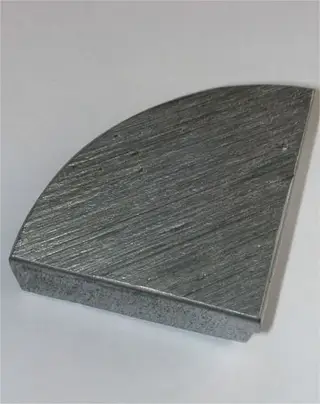
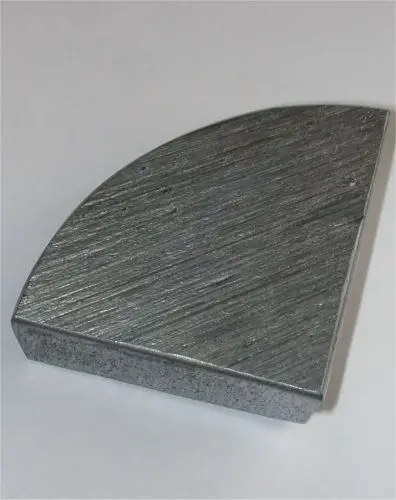
Vanadium is a hard, silvery-gray transition metal that resists corrosion. Most of it is added in small amounts to steel.
Its ions show four different colors in solution, from violet through green and blue to yellow, depending on their charge.
Quick answers
- What is vanadium?
- Vanadium (V) is a transition metal with atomic number 23. It is a solid at room temperature. A hard metal that makes steel tougher. Its compounds come in a rainbow of colors, and it stores energy in large flow batteries.
- Where is vanadium found?
- Vanadium is found in magnetite ores and in some crude oils and coals. China, Russia and South Africa are major producers.
- What is vanadium used for?
- Its main uses are steel, titanium alloys and batteries. Most vanadium goes into high-strength steels for tools, springs, pipelines and construction.
At a glance
| Atomic number | 23 |
|---|---|
| Symbol | V |
| Standard atomic weight | 50.942 ± 0.001 |
| Natural isotopes | 2 (IUPAC CIAAW 2024) |
| Family | Transition metal |
| Group | Group 5 |
| Period | Period 4 |
| Block | d |
| Electron configuration | [Ar] 3d3 4s2 orbital diagram → |
| State at room temperature | Solid |
| Melting point | 1,910 °C (3,470 °F, 2,183 K) |
| Boiling point | 3,407 °C (6,164 °F, 3,680 K) |
| Density | 6 g/cm³ |
| Electronegativity (Pauling) | 1.63 |
| Atomic radius | 179 pm |
| First ionization energy | 6.746 eV |
| Oxidation states | +5, +4, +3, +2 |
| Discovery | 1801 · Andrés Manuel del Río |
Discovery
In 1801 the mineralogist Andrés Manuel del Río found a new element in a lead ore from Mexico. He withdrew the claim after another chemist wrongly told him it was chromium.
In 1830 Nils Gabriel Sefström in Sweden rediscovered it and named it. Henry Roscoe isolated the metal in 1867.
Where the name comes from
From Vanadís, a name of the Norse goddess Freyja, because its compounds have such beautiful colors.
Where is vanadium found?
Vanadium is found in magnetite ores and in some crude oils and coals. China, Russia and South Africa are major producers.
Where every element is found →
What is vanadium used for?
- Steel. Most vanadium goes into high-strength steels for tools, springs, pipelines and construction.
- Titanium alloys. The common aerospace alloy Ti-6Al-4V contains 4% vanadium.
- Batteries. Vanadium redox flow batteries store electricity from solar and wind on a large scale.
- Catalysts. Vanadium oxide speeds up the production of sulfuric acid.
What every element is used for → · Where are the elements found? →
Common compounds
| Compound | Formula | Note |
|---|---|---|
| Vanadium pentoxide | V₂O₅ | Catalyst for making sulfuric acid. |
Notable isotopes
- V-500.25%
- V-5199.75%
Percent by number of atoms. The light band shows the range over which the share varies in natural samples. Source: IUPAC CIAAW 2024
| Isotope | Half-life | Note |
|---|---|---|
| Vanadium-51 | Stable | About 99.75% of natural vanadium. |
| Vanadium-50 | far longer than the age of the universe | Very weakly radioactive. |
Safety
Some compounds are toxic
Vanadium metal is not considered very hazardous, but vanadium pentoxide dust irritates the eyes and lungs.
Did you know?
- Henry Ford used vanadium steel in the Model T car, making parts both light and strong.
- Some sea creatures called sea squirts concentrate vanadium in their blood cells.
- Vanadium was discovered twice, about 30 years apart.
Frequently asked questions
What is vanadium mainly used for?
Strengthening steel. A small amount makes steel tougher and more resistant to wear.
What is a vanadium flow battery?
A rechargeable battery that stores energy in tanks of vanadium solutions; it can be scaled up for power grids.
Is vanadium a metal?
Yes. Vanadium is a metal, one of the transition metals.
What are the properties of vanadium?
Atomic number 23, symbol V, atomic mass 50.942. It is a solid at room temperature. It melts at 1,910 °C (3,470 °F) and boils at 3,407 °C (6,164 °F). Density 6 g/cm³. Electronegativity 1.63 (Pauling).
Sources
- Royal Society of Chemistry: Vanadium
- Encyclopaedia Britannica: Vanadium
- USGS Mineral Commodity Summaries: Vanadium
- NNDC NuDat 3 (nuclear data)
- PubChem Periodic Table (NIH)
- IUPAC/CIAAW standard atomic weights
- Royal Society of Chemistry, Periodic Table
- Wikipedia: Vanadium
Last checked: 16 November 2026
Other group 5 elements
Niobium
A metal that makes steel stronger and lighter and, as an alloy, carries current with zero resistance in MRI scanners and particle accelerators.
Tantalum
A dense, almost corrosion-proof metal hidden inside phones and laptops as tiny capacitors. It is also used in surgical implants.
Dubnium
A superheavy element named after Dubna, the Russian science town where much of the heaviest-element research was done.