Element 024
Chromium (Cr)
The shiny metal that makes steel stainless and taps gleam. Chromium also gives rubies their red and emeralds their green.
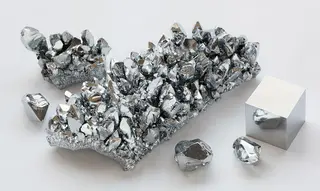
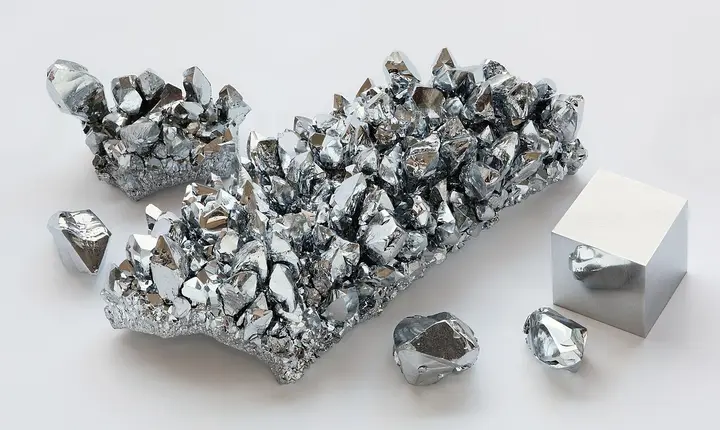
Chromium is a hard, brittle, silvery metal that takes a mirror-like polish. A thin oxide film protects it from corrosion.
Steel with at least about 10.5% chromium becomes stainless: the chromium forms a self-healing protective layer on the surface.
Quick answers
- What is chromium?
- Chromium (Cr) is a transition metal with atomic number 24. It is a solid at room temperature. The shiny metal that makes steel stainless and taps gleam. Chromium also gives rubies their red and emeralds their green.
- Where is chromium found?
- Chromium is mined as chromite (iron chromium oxide). South Africa is the largest producer.
- What is chromium used for?
- Its main uses are stainless steel, chrome plating and superalloys. The main use.
At a glance
| Atomic number | 24 |
|---|---|
| Symbol | Cr |
| Standard atomic weight | 51.996 ± 0.001 |
| Natural isotopes | 4 (IUPAC CIAAW 2024) |
| Family | Transition metal |
| Group | Group 6 |
| Period | Period 4 |
| Block | d |
| Electron configuration | [Ar] 3d5 4s1 orbital diagram → |
| State at room temperature | Solid |
| Melting point | 1,907 °C (3,464 °F, 2,180 K) |
| Boiling point | 2,671 °C (4,840 °F, 2,944 K) |
| Density | 7.15 g/cm³ |
| Electronegativity (Pauling) | 1.66 |
| Atomic radius | 189 pm |
| First ionization energy | 6.767 eV |
| Oxidation states | +6, +3, +2 |
| Discovery | 1797 · Louis-Nicolas Vauquelin |
Discovery
In 1797 Louis-Nicolas Vauquelin found a new element in crocoite, a bright orange-red mineral from Siberia, and isolated the metal the following year.
Where the name comes from
From the Greek chroma, color, because its compounds come in many vivid colors.
Where is chromium found?
Chromium is mined as chromite (iron chromium oxide). South Africa is the largest producer.
Where every element is found →
What is chromium used for?
- Stainless steel. The main use. Chromium makes steel resistant to rust and staining.
- Chrome plating. A thin chromium layer gives taps, tools and car trim a hard, shiny finish.
- Superalloys. Chromium helps nickel alloys resist heat in jet engines.
- Pigments and tanning. Chromium compounds color paints and ceramics and are used to tan leather.
What every element is used for → · Where are the elements found? →
Common compounds
| Compound | Formula | Note |
|---|---|---|
| Chromium(III) oxide | Cr₂O₃ | A green pigment. |
| Chromite | FeCr₂O₄ | The only important chromium ore. |
Notable isotopes
- Cr-504.345%
- Cr-5283.789%
- Cr-539.501%
- Cr-542.365%
Percent by number of atoms. The light band shows the range over which the share varies in natural samples. Source: IUPAC CIAAW 2024
| Isotope | Half-life | Note |
|---|---|---|
| Chromium-52 | Stable | About 83.8% of natural chromium. |
| Chromium-53 | Stable | About 9.5%. |
| Chromium-50 | Stable | About 4.3%. |
Safety
Some compounds are dangerous
Chromium metal and stainless steel are safe in normal use.
Hexavalent chromium compounds, used in some industrial processes, are toxic and can cause cancer when inhaled. Their use is tightly regulated.
Did you know?
- Stainless steel was developed in 1913 by Harry Brearley in Sheffield, England, while he was looking for a steel for gun barrels that would resist wear.
- Ruby and emerald are different minerals, but both usually owe their color to traces of chromium. In some emeralds the green comes from vanadium instead.
- Chromium is one of the few metals that is naturally antiferromagnetic at room temperature.
Frequently asked questions
What makes stainless steel stainless?
Chromium in the steel reacts with oxygen to form a very thin, invisible oxide layer that stops rust and reforms if scratched.
Is chrome the same as chromium?
“Chrome” usually means a chromium plating or finish; chromium is the element itself.
Is chromium a metal?
Yes. Chromium is a metal, one of the transition metals.
What are the properties of chromium?
Atomic number 24, symbol Cr, atomic mass 51.996. It is a solid at room temperature. It melts at 1,907 °C (3,464 °F) and boils at 2,671 °C (4,840 °F). Density 7.15 g/cm³. Electronegativity 1.66 (Pauling).
Sources
- Royal Society of Chemistry: Chromium
- Encyclopaedia Britannica: Chromium
- USGS Mineral Commodity Summaries: Chromium
- NNDC NuDat 3 (nuclear data)
- PubChem Periodic Table (NIH)
- IUPAC/CIAAW standard atomic weights
- Royal Society of Chemistry, Periodic Table
- Wikipedia: Chromium
Last checked: 16 November 2026
Other group 6 elements
Molybdenum
A metal with a very high melting point that makes steel strong and heat-resistant. It also helps bacteria turn air into fertilizer.
Tungsten
The metal with the highest melting point, about 3,422 °C. It glowed in old light bulbs and makes cutting tools hard enough to drill rock.
Seaborgium
The first element named after a person who was still alive: the chemist Glenn Seaborg.