Element 022
Titanium (Ti)
As strong as many steels but much lighter, and almost immune to corrosion. Titanium is used in aircraft, hip implants and white paint.
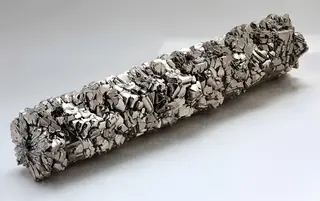
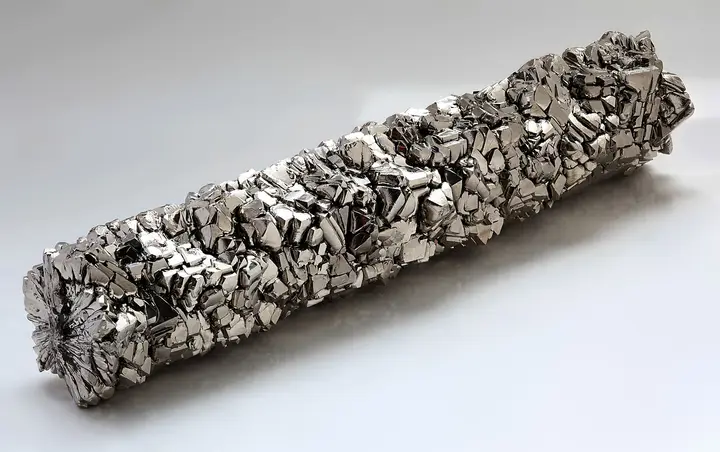
Titanium is a silvery transition metal with a very high strength-to-weight ratio. A protective oxide film makes it resistant to seawater and many chemicals.
The body tolerates it well, so it is used for implants. Most titanium ore, however, becomes titanium dioxide, the brilliant white pigment in paints and plastics.
Quick answers
- What is titanium?
- Titanium (Ti) is a transition metal with atomic number 22. It is a solid at room temperature. As strong as many steels but much lighter, and almost immune to corrosion. Titanium is used in aircraft, hip implants and white paint.
- Where is titanium found?
- Titanium is common in Earth’s crust, mainly in the minerals ilmenite and rutile, found in beach sands and rocks.
- What is titanium used for?
- Its main uses are white pigment, aerospace and medical implants. Titanium dioxide makes paint, paper, plastics and sunscreen white or opaque.
At a glance
| Atomic number | 22 |
|---|---|
| Symbol | Ti |
| Standard atomic weight | 47.867 ± 0.001 |
| Natural isotopes | 5 (IUPAC CIAAW 2024) |
| Family | Transition metal |
| Group | Group 4 |
| Period | Period 4 |
| Block | d |
| Electron configuration | [Ar] 3d2 4s2 orbital diagram → |
| State at room temperature | Solid |
| Melting point | 1,668 °C (3,034 °F, 1,941 K) |
| Boiling point | 3,287 °C (5,948 °F, 3,560 K) |
| Density | 4.5 g/cm³ |
| Electronegativity (Pauling) | 1.54 |
| Atomic radius | 187 pm |
| First ionization energy | 6.828 eV |
| Oxidation states | +4, +3, +2 |
| Discovery | 1791 · William Gregor |
Discovery
In 1791 William Gregor, a clergyman in Cornwall, England, found a new element in a black sand now called ilmenite. In 1795 the German chemist Martin Heinrich Klaproth found it independently and named it.
Pure titanium metal was first made in 1910. Large-scale production began only after the Kroll process was developed in the 1940s.
Where the name comes from
From the Titans of Greek mythology. Klaproth chose the name.
Where is titanium found?
Titanium is common in Earth’s crust, mainly in the minerals ilmenite and rutile, found in beach sands and rocks.
Where every element is found →
What is titanium used for?
- White pigment. Titanium dioxide makes paint, paper, plastics and sunscreen white or opaque.
- Aerospace. Jet engines and airframes use titanium alloys because they are strong, light and heat-resistant.
- Medical implants. Hip and knee replacements, dental implants and bone plates.
- Sports and consumer goods. Bicycle frames, golf clubs, watches and spectacle frames.
What every element is used for → · Where are the elements found? →
Common compounds
| Compound | Formula | Note |
|---|---|---|
| Titanium dioxide | TiO₂ | White pigment in paints and sunscreens. |
Notable isotopes
- Ti-468.25%
- Ti-477.44%
- Ti-4873.72%
- Ti-495.41%
- Ti-505.18%
Percent by number of atoms. The light band shows the range over which the share varies in natural samples. Source: IUPAC CIAAW 2024
| Isotope | Half-life | Note |
|---|---|---|
| Titanium-48 | Stable | About 73.7% of natural titanium. |
| Titanium-46 | Stable | About 8.3%. |
| Titanium-47 | Stable | About 7.4%. |
Safety
Solid metal is safe
Solid titanium is non-toxic. Fine titanium powder is flammable.
Did you know?
- The Guggenheim Museum in Bilbao, Spain, is clad in thin titanium sheets.
- The Cold War SR-71 Blackbird spy plane was built largely of titanium.
- Titanium is one of the few elements that can burn in nitrogen gas.
Frequently asked questions
Is titanium stronger than steel?
Some titanium alloys are as strong as many steels while weighing about 45% less, but the strongest steels are stronger.
Why is titanium used in implants?
It does not corrode in the body, is not toxic and bone can grow against it.
Is titanium a metal?
Yes. Titanium is a metal, one of the transition metals.
What are the properties of titanium?
Atomic number 22, symbol Ti, atomic mass 47.867. It is a solid at room temperature. It melts at 1,668 °C (3,034 °F) and boils at 3,287 °C (5,948 °F). Density 4.5 g/cm³. Electronegativity 1.54 (Pauling).
Sources
- Royal Society of Chemistry: Titanium
- Encyclopaedia Britannica: Titanium
- USGS Mineral Commodity Summaries: Titanium
- NNDC NuDat 3 (nuclear data)
- PubChem Periodic Table (NIH)
- IUPAC/CIAAW standard atomic weights
- Royal Society of Chemistry, Periodic Table
- Wikipedia: Titanium
Last checked: 16 November 2026
Other group 4 elements
Zirconium
A corrosion-proof metal that wraps the fuel in nuclear reactors. Its oxide makes ceramic knives, dental crowns and cubic zirconia.
Hafnium
A metal that hid inside zirconium for a century. It controls nuclear reactors and is a key insulator in modern computer chips.
Rutherfordium
The first element after the actinides, named after Ernest Rutherford, the father of nuclear physics.