Element 073
Tantalum (Ta)
A dense, almost corrosion-proof metal hidden inside phones and laptops as tiny capacitors. It is also used in surgical implants.
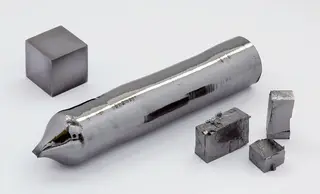
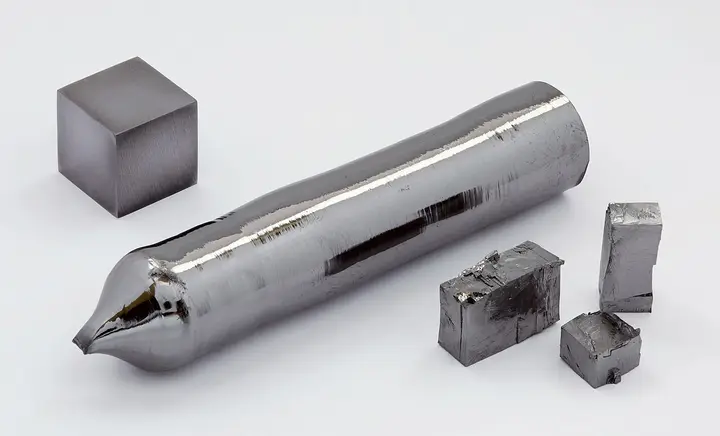
Tantalum is a hard, heavy, blue-gray metal that is almost immune to acids. It melts at about 3,017 °C.
It forms an extremely thin, stable oxide layer, which makes very small, reliable capacitors possible.
Quick answers
- What is tantalum?
- Tantalum (Ta) is a transition metal with atomic number 73. It is a solid at room temperature. A dense, almost corrosion-proof metal hidden inside phones and laptops as tiny capacitors. It is also used in surgical implants.
- Where is tantalum found?
- Tantalum is mined from tantalite and coltan ores, notably in the Democratic Republic of the Congo, Rwanda and Brazil.
- What is tantalum used for?
- Its main uses are capacitors, superalloys and medical implants. Tantalum capacitors in phones, laptops and cars store charge in a tiny space.
At a glance
| Atomic number | 73 |
|---|---|
| Symbol | Ta |
| Standard atomic weight | 180.95 ± 0.01 |
| Natural isotopes | 2 (IUPAC CIAAW 2024) |
| Family | Transition metal |
| Group | Group 5 |
| Period | Period 6 |
| Block | d |
| Electron configuration | [Xe] 4f14 5d3 6s2 orbital diagram → |
| State at room temperature | Solid |
| Melting point | 3,017 °C (5,462 °F, 3,290 K) |
| Boiling point | 5,458 °C (9,856 °F, 5,731 K) |
| Density | 16.4 g/cm³ |
| Electronegativity (Pauling) | 1.5 |
| Atomic radius | 217 pm |
| First ionization energy | 7.89 eV |
| Oxidation states | +5 |
| Discovery | 1802 · Anders Gustaf Ekeberg |
Discovery
In 1802 the Swedish chemist Anders Gustaf Ekeberg discovered tantalum. For decades it was confused with niobium, until Heinrich Rose showed in 1844 that they were different elements.
Where the name comes from
From Tantalus of Greek mythology, who was condemned to stand in water he could never drink, just as tantalum sits in acid without being able to “drink” it.
Where is tantalum found?
Tantalum is mined from tantalite and coltan ores, notably in the Democratic Republic of the Congo, Rwanda and Brazil.
Where every element is found →
What is tantalum used for?
- Capacitors. Tantalum capacitors in phones, laptops and cars store charge in a tiny space.
- Superalloys. It strengthens alloys for jet engine parts.
- Medical implants. The body tolerates tantalum well.
- Chemical equipment. Corrosion-resistant linings and parts.
What every element is used for → · Where are the elements found? →
Common compounds
| Compound | Formula | Note |
|---|---|---|
| Tantalum pentoxide | Ta₂O₅ | The thin insulating layer inside tantalum capacitors. |
Notable isotopes
- Ta-1800.01176%
- Ta-18199.98824%
Percent by number of atoms. The light band shows the range over which the share varies in natural samples. Source: IUPAC CIAAW 2024
| Isotope | Half-life | Note |
|---|---|---|
| Tantalum-181 | Stable | About 99.99% of natural tantalum. |
| Tantalum-180m | unknown (never observed) | About 0.012%. The only long-lived excited nucleus found in nature; its decay has never been observed. |
Safety
Low hazard
Tantalum is not toxic. Concerns about the metal relate mainly to mining conditions in conflict areas, which supply-chain rules try to address.
Did you know?
- Tantalum and niobium carry the names of a mythological father and daughter, Tantalus and Niobe.
- Tantalum-180m is one of the rarest naturally occurring isotopes, and its decay has never been observed.
- Coltan mining has been linked to conflicts, so tantalum is regulated as a “conflict mineral” in some countries.
Frequently asked questions
Why is tantalum used in phones?
Tantalum capacitors store a lot of charge in a very small, stable package.
What is coltan?
An ore containing columbite and tantalite, the main sources of niobium and tantalum.
Is tantalum a metal?
Yes. Tantalum is a metal, one of the transition metals.
What are the properties of tantalum?
Atomic number 73, symbol Ta, atomic mass 180.95. It is a solid at room temperature. It melts at 3,017 °C (5,462 °F) and boils at 5,458 °C (9,856 °F). Density 16.4 g/cm³. Electronegativity 1.5 (Pauling).
Sources
- Royal Society of Chemistry: Tantalum
- Encyclopaedia Britannica: Tantalum
- USGS Mineral Commodity Summaries 2025: Tantalum
- NNDC NuDat 3 (nuclear data)
- PubChem Periodic Table (NIH)
- IUPAC/CIAAW standard atomic weights
- Royal Society of Chemistry, Periodic Table
- Wikipedia: Tantalum
Last checked: 16 November 2026
Other group 5 elements
Vanadium
A hard metal that makes steel tougher. Its compounds come in a rainbow of colors, and it stores energy in large flow batteries.
Niobium
A metal that makes steel stronger and lighter and, as an alloy, carries current with zero resistance in MRI scanners and particle accelerators.
Dubnium
A superheavy element named after Dubna, the Russian science town where much of the heaviest-element research was done.