Element 041 · also columbium
Niobium (Nb)
A metal that makes steel stronger and lighter and, as an alloy, carries current with zero resistance in MRI scanners and particle accelerators.
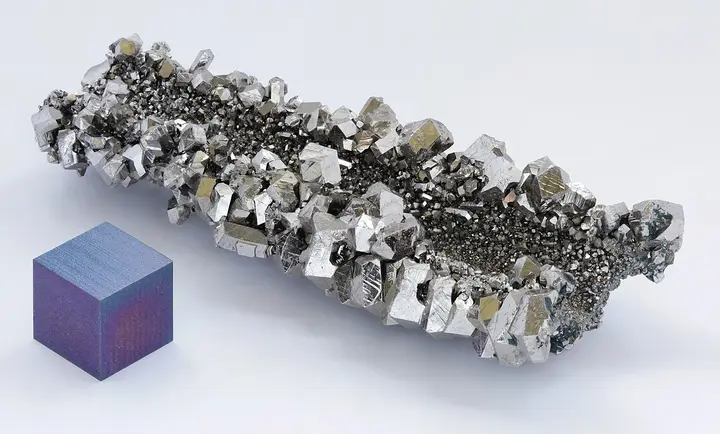
Niobium is a soft, gray, ductile transition metal that resists corrosion and is chemically almost identical to tantalum.
A tiny amount, often less than 0.1%, greatly strengthens steel. Niobium alloys become superconducting when cooled with liquid helium.
Quick answers
- What is niobium?
- Niobium (Nb) is a transition metal with atomic number 41. It is a solid at room temperature. A metal that makes steel stronger and lighter and, as an alloy, carries current with zero resistance in MRI scanners and particle accelerators.
- Where is niobium found?
- Niobium is mined mainly from pyrochlore. Brazil produces the great majority of the world’s supply.
- What is niobium used for?
- Its main uses are steel, superconducting magnets and superalloys. High-strength low-alloy steels for pipelines, cars and bridges.
At a glance
| Atomic number | 41 |
|---|---|
| Symbol | Nb |
| Standard atomic weight | 92.906 ± 0.001 |
| Natural isotopes | 1 (IUPAC CIAAW 2024; a single isotope in nature) |
| Family | Transition metal |
| Group | Group 5 |
| Period | Period 5 |
| Block | d |
| Electron configuration | [Kr] 4d4 5s1 orbital diagram → |
| State at room temperature | Solid |
| Melting point | 2,477 °C (4,490 °F, 2,750 K) |
| Boiling point | 4,744 °C (8,571 °F, 5,017 K) |
| Density | 8.57 g/cm³ |
| Electronegativity (Pauling) | 1.6 |
| Atomic radius | 207 pm |
| First ionization energy | 6.759 eV |
| Oxidation states | +5, +3 |
| Discovery | 1801 · Charles Hatchett |
Discovery
In 1801 the English chemist Charles Hatchett found a new element in a mineral sample from North America and called it columbium. It was long confused with tantalum. In 1844 Heinrich Rose showed the two were different and named it niobium; IUPAC adopted that name in 1949.
Where the name comes from
From Niobe, daughter of Tantalus in Greek mythology, reflecting its close resemblance to tantalum.
Where is niobium found?
Niobium is mined mainly from pyrochlore. Brazil produces the great majority of the world’s supply.
Where every element is found →
What is niobium used for?
- Steel. High-strength low-alloy steels for pipelines, cars and bridges.
- Superconducting magnets. Niobium–titanium wire in MRI scanners and particle accelerators such as the Large Hadron Collider.
- Superalloys. Jet engine and rocket parts.
- Jewelry and coins. Niobium can be anodized to vivid colors.
What every element is used for → · Where are the elements found? →
Notable isotopes
| Isotope | Half-life | Note |
|---|---|---|
| Niobium-93 | Stable | The only stable isotope; all natural niobium. |
| Niobium-95 | about 35 days | A fission product. |
Safety
Low hazard
Niobium metal is not considered toxic and is used in some body jewelry.
Did you know?
- In mythology Niobe is the daughter of Tantalus, a nod to niobium’s close kinship with tantalum.
- Some metallurgists in the Americas still use the old name columbium.
- Pure niobium becomes a superconductor below about −264 °C, the highest such temperature of any element.
Frequently asked questions
Niobium or columbium?
They are the same element. IUPAC adopted “niobium” in 1949; “columbium” survives in some industries.
Why is niobium added to steel?
It refines the grain structure, making steel stronger and tougher without much extra weight.
Is niobium a metal?
Yes. Niobium is a metal, one of the transition metals.
What are the properties of niobium?
Atomic number 41, symbol Nb, atomic mass 92.906. It is a solid at room temperature. It melts at 2,477 °C (4,490 °F) and boils at 4,744 °C (8,571 °F). Density 8.57 g/cm³. Electronegativity 1.6 (Pauling).
Sources
- Royal Society of Chemistry: Niobium
- Encyclopaedia Britannica: Niobium
- USGS Mineral Commodity Summaries 2025: Niobium
- NNDC NuDat 3 (nuclear data)
- PubChem Periodic Table (NIH)
- IUPAC/CIAAW standard atomic weights
- Royal Society of Chemistry, Periodic Table
- Wikipedia: Niobium
Last checked: 16 November 2026
Other group 5 elements
Vanadium
A hard metal that makes steel tougher. Its compounds come in a rainbow of colors, and it stores energy in large flow batteries.
Tantalum
A dense, almost corrosion-proof metal hidden inside phones and laptops as tiny capacitors. It is also used in surgical implants.
Dubnium
A superheavy element named after Dubna, the Russian science town where much of the heaviest-element research was done.