Element 074 · also wolfram
Tungsten (W)
The metal with the highest melting point, about 3,422 °C. It glowed in old light bulbs and makes cutting tools hard enough to drill rock.
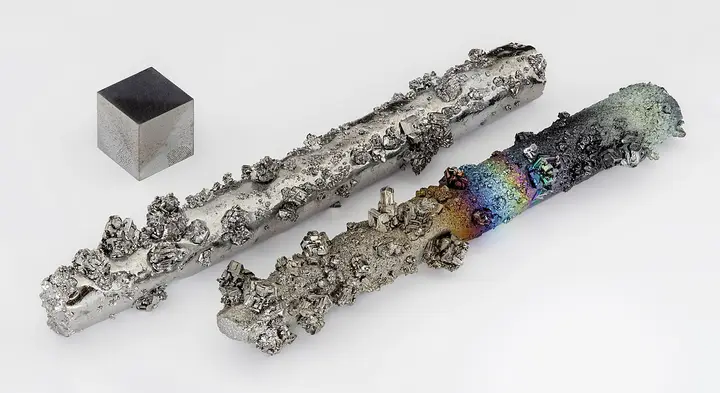
Tungsten is a dense, steel-gray transition metal. Its melting point is the highest of all metals, and its density is close to that of gold.
Combined with carbon it forms tungsten carbide, one of the hardest materials used in industry.
Quick answers
- What is tungsten?
- Tungsten (W) is a transition metal with atomic number 74. It is a solid at room temperature. The metal with the highest melting point, about 3,422 °C. It glowed in old light bulbs and makes cutting tools hard enough to drill rock.
- Where is tungsten found?
- Tungsten is mined from wolframite and scheelite. China produces most of the world’s supply.
- What is tungsten used for?
- Its main uses are tungsten carbide, heat-resistant parts and heavy alloys. The main use: drill bits, cutting tools, mining equipment and ballpoint pen tips.
At a glance
| Atomic number | 74 |
|---|---|
| Symbol | W |
| Standard atomic weight | 183.84 ± 0.01 |
| Natural isotopes | 5 (IUPAC CIAAW 2024) |
| Family | Transition metal |
| Group | Group 6 |
| Period | Period 6 |
| Block | d |
| Electron configuration | [Xe] 4f14 5d4 6s2 orbital diagram → |
| State at room temperature | Solid |
| Melting point | 3,422 °C (6,191 °F, 3,695 K) |
| Boiling point | 5,555 °C (10,031 °F, 5,828 K) |
| Density | 19.3 g/cm³ |
| Electronegativity (Pauling) | 2.36 |
| Atomic radius | 210 pm |
| First ionization energy | 7.98 eV |
| Oxidation states | +6 |
| Discovery | 1783 · Juan José and Fausto Elhuyar |
Discovery
In 1783 the Spanish brothers Juan José and Fausto Elhuyar extracted tungsten from the mineral wolframite. Carl Wilhelm Scheele had identified tungstic acid two years earlier.
Where the name comes from
From the Swedish tung sten, “heavy stone”. The symbol W comes from wolfram, the German name for the mineral wolframite.
Where is tungsten found?
Tungsten is mined from wolframite and scheelite. China produces most of the world’s supply.
Where every element is found →
What is tungsten used for?
- Tungsten carbide. The main use: drill bits, cutting tools, mining equipment and ballpoint pen tips.
- Heat-resistant parts. Electrodes for welding, rocket nozzles, furnace parts and X-ray tube targets.
- Heavy alloys. Dense tungsten alloys are used for counterweights and radiation shielding.
- Lighting. The glowing filament of incandescent bulbs was tungsten wire.
What every element is used for → · Where are the elements found? →
Common compounds
| Compound | Formula | Note |
|---|---|---|
| Tungsten carbide | WC | Very hard material for cutting tools and drill bits. |
Notable isotopes
- W-1800.12%
- W-18226.5%
- W-18314.31%
- W-18430.64%
- W-18628.43%
Percent by number of atoms. The light band shows the range over which the share varies in natural samples. Source: IUPAC CIAAW 2024
| Isotope | Half-life | Note |
|---|---|---|
| Tungsten-184 | Stable | About 30.6% of natural tungsten. |
| Tungsten-186 | Stable | About 28.4%. |
| Tungsten-182 | Stable | About 26.5%. |
Safety
Low hazard
Tungsten metal has low toxicity. Fine tungsten and tungsten carbide dust from grinding should not be inhaled.
Did you know?
- Some bacteria use enzymes that contain tungsten, making it the heaviest element known to play a biological role.
- In an incandescent bulb, the tungsten filament heats to over 2,000 °C to give off light.
- Its boiling point, about 5,555 °C, is also among the highest of all elements.
Frequently asked questions
Which metal has the highest melting point?
Tungsten, at about 3,422 °C.
Why is tungsten’s symbol W?
It comes from “wolfram”, the name used in German and several other languages.
Is tungsten a metal?
Yes. Tungsten is a metal, one of the transition metals.
What are the properties of tungsten?
Atomic number 74, symbol W, atomic mass 183.84. It is a solid at room temperature. It melts at 3,422 °C (6,191 °F) and boils at 5,555 °C (10,031 °F). Density 19.3 g/cm³. Electronegativity 2.36 (Pauling).
Sources
- Royal Society of Chemistry: Tungsten
- Encyclopaedia Britannica: Tungsten
- USGS Mineral Commodity Summaries: Tungsten
- NNDC NuDat 3 (nuclear data)
- PubChem Periodic Table (NIH)
- IUPAC/CIAAW standard atomic weights
- Royal Society of Chemistry, Periodic Table
- Wikipedia: Tungsten
Last checked: 16 November 2026
Other group 6 elements
Chromium
The shiny metal that makes steel stainless and taps gleam. Chromium also gives rubies their red and emeralds their green.
Molybdenum
A metal with a very high melting point that makes steel strong and heat-resistant. It also helps bacteria turn air into fertilizer.
Seaborgium
The first element named after a person who was still alive: the chemist Glenn Seaborg.