Element 042
Molybdenum (Mo)
A metal with a very high melting point that makes steel strong and heat-resistant. It also helps bacteria turn air into fertilizer.
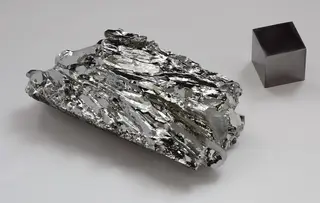
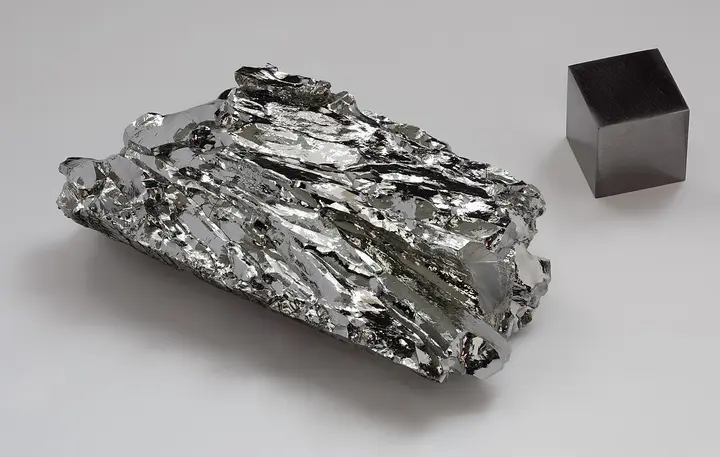
Molybdenum is a silvery-gray transition metal that melts at about 2,623 °C, one of the highest melting points of any element.
Small additions make steel stronger, harder and more resistant to heat and corrosion. Living things also need traces of it for several enzymes.
Quick answers
- What is molybdenum?
- Molybdenum (Mo) is a transition metal with atomic number 42. It is a solid at room temperature. A metal with a very high melting point that makes steel strong and heat-resistant. It also helps bacteria turn air into fertilizer.
- Where is molybdenum found?
- Molybdenum is mined mainly as molybdenite (molybdenum disulfide), often alongside copper. China, Peru and Chile are leading producers.
- What is molybdenum used for?
- Its main uses are steel, catalysts and lubricants. Most molybdenum goes into stainless and high-strength steels.
At a glance
| Atomic number | 42 |
|---|---|
| Symbol | Mo |
| Standard atomic weight | 95.95 ± 0.01 |
| Natural isotopes | 7 (IUPAC CIAAW 2024) |
| Family | Transition metal |
| Group | Group 6 |
| Period | Period 5 |
| Block | d |
| Electron configuration | [Kr] 4d5 5s1 orbital diagram → |
| State at room temperature | Solid |
| Melting point | 2,623 °C (4,753 °F, 2,896 K) |
| Boiling point | 4,639 °C (8,382 °F, 4,912 K) |
| Density | 10.2 g/cm³ |
| Electronegativity (Pauling) | 2.16 |
| Atomic radius | 209 pm |
| First ionization energy | 7.092 eV |
| Oxidation states | +6 |
| Discovery | 1781 · Peter Jacob Hjelm |
Discovery
In 1778 Carl Wilhelm Scheele showed that the mineral molybdenite was not graphite or a lead ore but contained a new element. In 1781 Peter Jacob Hjelm isolated the metal.
Where the name comes from
From the Greek molybdos, lead, because its ore was long confused with lead ores.
Where is molybdenum found?
Molybdenum is mined mainly as molybdenite (molybdenum disulfide), often alongside copper. China, Peru and Chile are leading producers.
Where every element is found →
What is molybdenum used for?
- Steel. Most molybdenum goes into stainless and high-strength steels.
- Catalysts. Molybdenum catalysts remove sulfur from fuels in refineries.
- Lubricants. Molybdenum disulfide is a slippery solid lubricant.
- Medicine. Molybdenum-99 decays to technetium-99m, the most widely used isotope in medical imaging.
What every element is used for → · Where are the elements found? →
Common compounds
| Compound | Formula | Note |
|---|---|---|
| Molybdenum disulfide | MoS₂ | The ore molybdenite and a dry lubricant. |
Notable isotopes
- Mo-9214.649%
- Mo-949.187%
- Mo-9515.873%
- Mo-9616.673%
- Mo-979.582%
- Mo-9824.292%
- Mo-1009.744%
Percent by number of atoms. The light band shows the range over which the share varies in natural samples. Source: IUPAC CIAAW 2024
| Isotope | Half-life | Note |
|---|---|---|
| Molybdenum-98 | Stable | The most common isotope, about 24%. |
| Molybdenum-99 | about 66 hours | Produced in reactors to make technetium-99m for medical scans. |
Safety
Low hazard
Molybdenum is an essential trace element and has low toxicity in normal exposure.
Did you know?
- Molybdenum sits at the heart of nitrogenase, the bacterial enzyme that lets legumes use nitrogen from the air.
- Its name comes from the Greek for lead, but molybdenum has nothing to do with lead.
- Molybdenum disulfide is used in greases for very heavy loads.
Frequently asked questions
What is molybdenum used for?
Mainly for alloy steels, plus catalysts, lubricants and producing a key medical imaging isotope.
Do we need molybdenum in our diet?
Yes, in tiny amounts, which a normal diet provides.
Is molybdenum a metal?
Yes. Molybdenum is a metal, one of the transition metals.
What are the properties of molybdenum?
Atomic number 42, symbol Mo, atomic mass 95.95. It is a solid at room temperature. It melts at 2,623 °C (4,753 °F) and boils at 4,639 °C (8,382 °F). Density 10.2 g/cm³. Electronegativity 2.16 (Pauling).
Sources
- Royal Society of Chemistry: Molybdenum
- Encyclopaedia Britannica: Molybdenum
- USGS Mineral Commodity Summaries: Molybdenum
- NNDC NuDat 3 (nuclear data)
- PubChem Periodic Table (NIH)
- IUPAC/CIAAW standard atomic weights
- Royal Society of Chemistry, Periodic Table
- Wikipedia: Molybdenum
Last checked: 16 November 2026
Other group 6 elements
Chromium
The shiny metal that makes steel stainless and taps gleam. Chromium also gives rubies their red and emeralds their green.
Tungsten
The metal with the highest melting point, about 3,422 °C. It glowed in old light bulbs and makes cutting tools hard enough to drill rock.
Seaborgium
The first element named after a person who was still alive: the chemist Glenn Seaborg.