Element 075
Rhenium (Re)
One of the rarest metals and one of the last stable elements to be discovered. It keeps jet engine blades strong at extreme temperatures.
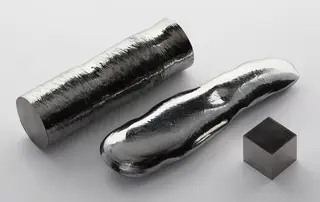
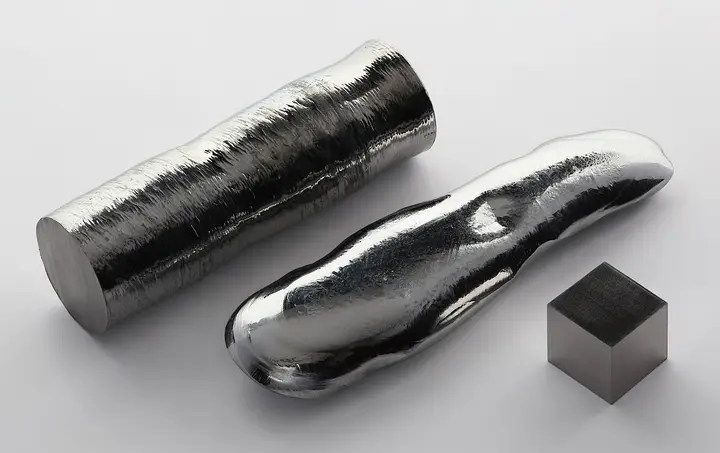
Rhenium is a dense, silvery-white metal with one of the highest melting points of any element, about 3,186 °C.
It is very rare and expensive, and most of it goes into high-temperature alloys and catalysts.
Quick answers
- What is rhenium?
- Rhenium (Re) is a transition metal with atomic number 75. It is a solid at room temperature. One of the rarest metals and one of the last stable elements to be discovered. It keeps jet engine blades strong at extreme temperatures.
- Where is rhenium found?
- Rhenium is recovered mainly as a by-product of molybdenum from copper mining, notably in Chile.
- What is rhenium used for?
- Its main uses are jet engines; petrol refining; electrical contacts and thermocouples. Nickel superalloys with rhenium make single-crystal turbine blades.
At a glance
| Atomic number | 75 |
|---|---|
| Symbol | Re |
| Standard atomic weight | 186.21 ± 0.01 |
| Natural isotopes | 2 (IUPAC CIAAW 2024) |
| Family | Transition metal |
| Group | Group 7 |
| Period | Period 6 |
| Block | d |
| Electron configuration | [Xe] 4f14 5d5 6s2 orbital diagram → |
| State at room temperature | Solid |
| Melting point | 3,186 °C (5,767 °F, 3,459 K) |
| Boiling point | 5,596 °C (10,105 °F, 5,869 K) |
| Density | 20.8 g/cm³ |
| Electronegativity (Pauling) | 1.9 |
| Atomic radius | 217 pm |
| First ionization energy | 7.88 eV |
| Oxidation states | +7, +6, +4 |
| Discovery | 1925 · Walter Noddack, Ida Tacke and Otto Berg |
Discovery
In 1925 Walter Noddack, Ida Tacke and Otto Berg in Germany detected rhenium by X-ray spectroscopy in platinum ores and the mineral columbite. It was the last stable element to be discovered.
Where the name comes from
From Rhenus, the Latin name for the river Rhine.
Where is rhenium found?
Rhenium is recovered mainly as a by-product of molybdenum from copper mining, notably in Chile.
Where every element is found →
What is rhenium used for?
- Jet engines. Nickel superalloys with rhenium make single-crystal turbine blades.
- Petrol refining. Platinum–rhenium catalysts produce high-octane fuel.
- Electrical contacts and thermocouples. Rhenium alloys withstand high temperatures.
What every element is used for → · Where are the elements found? →
Notable isotopes
- Re-18537.4%
- Re-18762.6%
Percent by number of atoms. The light band shows the range over which the share varies in natural samples. Source: IUPAC CIAAW 2024
| Isotope | Half-life | Note |
|---|---|---|
| Rhenium-185 | Stable | The only stable isotope, about 37%. |
| Rhenium-187 | about 41 billion years | About 63% of natural rhenium; used to date rocks and meteorites. |
Safety
Low hazard
Rhenium has low toxicity in normal use.
Did you know?
- Most natural rhenium is slightly radioactive, because about two thirds is rhenium-187, but it decays so slowly that it poses no practical danger.
- Rhenium is among the most expensive metals; only a few tens of metric tons are produced a year.
- Ida Tacke (later Noddack) also proposed, in 1934, that heavy nuclei might split apart, years before nuclear fission was confirmed.
Frequently asked questions
Which metal has the highest melting point?
Tungsten. Rhenium is close behind.
Why is rhenium used in jet engines?
It helps turbine blades keep their strength at very high temperatures.
Is rhenium a metal?
Yes. Rhenium is a metal, one of the transition metals.
What are the properties of rhenium?
Atomic number 75, symbol Re, atomic mass 186.21. It is a solid at room temperature. It melts at 3,186 °C (5,767 °F) and boils at 5,596 °C (10,105 °F). Density 20.8 g/cm³. Electronegativity 1.9 (Pauling).
Sources
- Royal Society of Chemistry: Rhenium
- Encyclopaedia Britannica: Rhenium
- USGS Mineral Commodity Summaries: Rhenium
- NNDC NuDat 3 (nuclear data)
- PubChem Periodic Table (NIH)
- IUPAC/CIAAW standard atomic weights
- Royal Society of Chemistry, Periodic Table
- Wikipedia: Rhenium
Last checked: 16 November 2026
Other group 7 elements
Manganese
A hard, brittle metal that almost all steel needs. It also goes into batteries and is an essential nutrient for plants and animals.
Technetium
The first element made artificially. One of its isotopes is used in tens of millions of medical scans every year.
Bohrium
A superheavy element named after Niels Bohr, who explained how electrons are arranged in atoms.