Element 040
Zirconium (Zr)
A corrosion-proof metal that wraps the fuel in nuclear reactors. Its oxide makes ceramic knives, dental crowns and cubic zirconia.
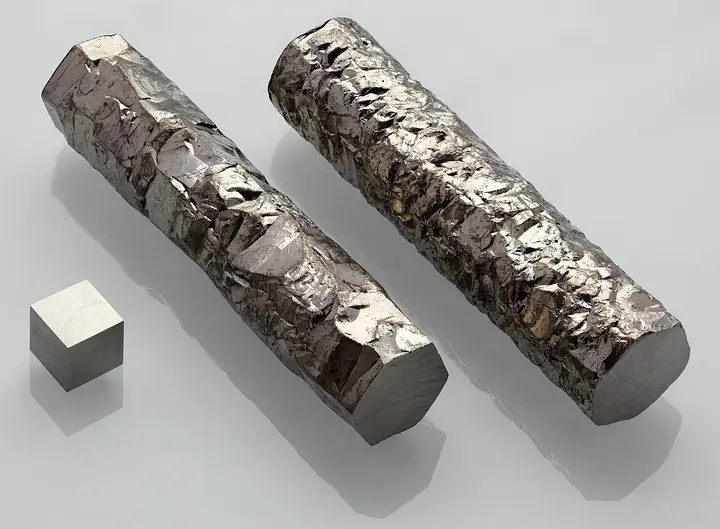
Zirconium is a strong, silvery-gray transition metal that resists corrosion extremely well.
Neutrons pass through it easily, so it is the standard material for the tubes that hold nuclear fuel.
Quick answers
- What is zirconium?
- Zirconium (Zr) is a transition metal with atomic number 40. It is a solid at room temperature. A corrosion-proof metal that wraps the fuel in nuclear reactors. Its oxide makes ceramic knives, dental crowns and cubic zirconia.
- Where is zirconium found?
- Zirconium is found mainly in the mineral zircon in beach sands; Australia and South Africa are leading producers.
- What is zirconium used for?
- Its main uses are nuclear reactors, ceramics and gemstones. Zirconium alloys form the cladding around reactor fuel.
At a glance
| Atomic number | 40 |
|---|---|
| Symbol | Zr |
| Standard atomic weight | 91.222 ± 0.003 |
| Natural isotopes | 5 (IUPAC CIAAW 2024) |
| Family | Transition metal |
| Group | Group 4 |
| Period | Period 5 |
| Block | d |
| Electron configuration | [Kr] 4d2 5s2 orbital diagram → |
| State at room temperature | Solid |
| Melting point | 1,855 °C (3,371 °F, 2,128 K) |
| Boiling point | 4,409 °C (7,968 °F, 4,682 K) |
| Density | 6.52 g/cm³ |
| Electronegativity (Pauling) | 1.33 |
| Atomic radius | 186 pm |
| First ionization energy | 6.634 eV |
| Oxidation states | +4 |
| Discovery | 1789 · Martin Heinrich Klaproth |
Discovery
In 1789 Martin Heinrich Klaproth found a new oxide in zircon gemstones. Jöns Jacob Berzelius isolated impure zirconium metal in 1824.
Where the name comes from
From the mineral zircon, a word that goes back to the Persian zargun, gold-colored.
Where is zirconium found?
Zirconium is found mainly in the mineral zircon in beach sands; Australia and South Africa are leading producers.
Where every element is found →
What is zirconium used for?
- Nuclear reactors. Zirconium alloys form the cladding around reactor fuel.
- Ceramics. Zirconia (zirconium oxide) makes tough ceramic knives, dental crowns and heat-resistant parts.
- Gemstones. Cubic zirconia is a synthetic diamond simulant.
- Industry. Zircon sand is used in foundries and ceramic glazes; zirconium resists corrosive chemicals.
What every element is used for → · Where are the elements found? →
Common compounds
| Compound | Formula | Note |
|---|---|---|
| Zircon | ZrSiO₄ | Among the oldest minerals on Earth. |
| Zirconium dioxide | ZrO₂ | Cubic zirconia; ceramic knives and dental crowns. |
Notable isotopes
- Zr-9051.47%
- Zr-9111.23%
- Zr-9217.16%
- Zr-9417.36%
- Zr-962.78%
Percent by number of atoms. The light band shows the range over which the share varies in natural samples. Source: IUPAC CIAAW 2024
| Isotope | Half-life | Note |
|---|---|---|
| Zirconium-90 | Stable | About 51.5% of natural zirconium. |
| Zirconium-94 | Stable | About 17.4%. |
| Zirconium-92 | Stable | About 17.2%. |
Safety
Low hazard; powder is flammable
Zirconium and its common compounds have low toxicity. Fine zirconium powder can ignite in air.
Did you know?
- Zircon crystals from the Jack Hills of Western Australia are about 4.4 billion years old, the oldest known solid pieces of Earth.
- Cubic zirconia and zircon are different: zircon is a natural mineral, cubic zirconia a synthetic zirconium oxide.
- Zirconium used in reactors must be stripped of hafnium, a near-twin element that absorbs neutrons.
Frequently asked questions
Is cubic zirconia a diamond?
No. It is a synthetic crystal of zirconium oxide that looks similar but is softer and denser.
Why is zirconium used in nuclear reactors?
It resists corrosion in hot water and barely absorbs neutrons.
Is zirconium a metal?
Yes. Zirconium is a metal, one of the transition metals.
What are the properties of zirconium?
Atomic number 40, symbol Zr, atomic mass 91.222. It is a solid at room temperature. It melts at 1,855 °C (3,371 °F) and boils at 4,409 °C (7,968 °F). Density 6.52 g/cm³. Electronegativity 1.33 (Pauling).
Sources
- Royal Society of Chemistry: Zirconium
- Encyclopaedia Britannica: Zirconium
- USGS Mineral Commodity Summaries: Zirconium and hafnium
- Wilde et al. (2001), Nature: 4.4-billion-year-old zircons
- NNDC NuDat 3 (nuclear data)
- PubChem Periodic Table (NIH)
- IUPAC/CIAAW standard atomic weights
- Royal Society of Chemistry, Periodic Table
- Wikipedia: Zirconium
Last checked: 16 November 2026
Other group 4 elements
Titanium
As strong as many steels but much lighter, and almost immune to corrosion. Titanium is used in aircraft, hip implants and white paint.
Hafnium
A metal that hid inside zirconium for a century. It controls nuclear reactors and is a key insulator in modern computer chips.
Rutherfordium
The first element after the actinides, named after Ernest Rutherford, the father of nuclear physics.