Element 072
Hafnium (Hf)
A metal that hid inside zirconium for a century. It controls nuclear reactors and is a key insulator in modern computer chips.
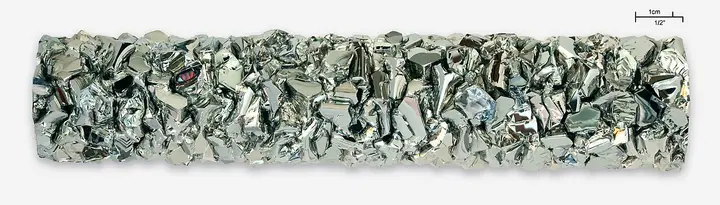
Hafnium is a shiny, silvery transition metal that resists corrosion. Chemically it is almost a twin of zirconium.
Unlike zirconium, it absorbs neutrons strongly, which makes it valuable in nuclear reactor control rods.
Quick answers
- What is hafnium?
- Hafnium (Hf) is a transition metal with atomic number 72. It is a solid at room temperature. A metal that hid inside zirconium for a century. It controls nuclear reactors and is a key insulator in modern computer chips.
- Where is hafnium found?
- Hafnium always accompanies zirconium in nature and is separated from it during zirconium processing.
- What is hafnium used for?
- Its main uses are nuclear reactors, microchips and superalloys. Control rods in some reactors, including those of nuclear submarines.
At a glance
| Atomic number | 72 |
|---|---|
| Symbol | Hf |
| Standard atomic weight | 178.49 ± 0.01 |
| Natural isotopes | 6 (IUPAC CIAAW 2024) |
| Family | Transition metal |
| Group | Group 4 |
| Period | Period 6 |
| Block | d |
| Electron configuration | [Xe] 4f14 5d2 6s2 orbital diagram → |
| State at room temperature | Solid |
| Melting point | 2,233 °C (4,051 °F, 2,506 K) |
| Boiling point | 4,603 °C (8,317 °F, 4,876 K) |
| Density | 13.3 g/cm³ |
| Electronegativity (Pauling) | 1.3 |
| Atomic radius | 212 pm |
| First ionization energy | 6.825 eV |
| Oxidation states | +4 |
| Discovery | 1923 · Dirk Coster and George de Hevesy |
Discovery
In 1923 Dirk Coster and George de Hevesy in Copenhagen found hafnium in zirconium minerals using X-ray spectroscopy, guided by Niels Bohr’s theory of atomic structure.
Where the name comes from
From Hafnia, the Latin name for Copenhagen.
Where is hafnium found?
Hafnium always accompanies zirconium in nature and is separated from it during zirconium processing.
Where every element is found →
What is hafnium used for?
- Nuclear reactors. Control rods in some reactors, including those of nuclear submarines.
- Microchips. Hafnium oxide is a key insulating layer in modern transistors.
- Superalloys. Small additions strengthen nickel alloys for turbine blades.
What every element is used for → · Where are the elements found? →
Common compounds
| Compound | Formula | Note |
|---|---|---|
| Hafnium dioxide | HfO₂ | Insulating layer in modern transistors. |
Notable isotopes
- Hf-1740.161%
- Hf-1765.24%
- Hf-17718.58%
- Hf-17827.28%
- Hf-17913.63%
- Hf-18035.12%
Percent by number of atoms. The light band shows the range over which the share varies in natural samples. Source: IUPAC CIAAW 2024
| Isotope | Half-life | Note |
|---|---|---|
| Hafnium-180 | Stable | The most common isotope, about 35%. |
Safety
Low hazard; powder is flammable
Hafnium metal has low toxicity. Fine hafnium powder can ignite.
Did you know?
- Hafnium and zirconium are so alike that hafnium went unnoticed in zirconium samples for more than a century.
- Hafnium carbide and nitride compounds have some of the highest known melting points.
- Zirconium for reactors must have its hafnium removed, and that hafnium is then used to make control rods.
Frequently asked questions
Why is hafnium hard to separate from zirconium?
Their atoms are almost the same size and behave nearly identically in chemical reactions.
Why is hafnium in computer chips?
Hafnium oxide insulates better than silicon dioxide, allowing smaller transistors that leak less current.
Is hafnium a metal?
Yes. Hafnium is a metal, one of the transition metals.
What are the properties of hafnium?
Atomic number 72, symbol Hf, atomic mass 178.49. It is a solid at room temperature. It melts at 2,233 °C (4,051 °F) and boils at 4,603 °C (8,317 °F). Density 13.3 g/cm³. Electronegativity 1.3 (Pauling).
Sources
- Royal Society of Chemistry: Hafnium
- Encyclopaedia Britannica: Hafnium
- USGS Mineral Commodity Summaries: Zirconium and hafnium
- NNDC NuDat 3 (nuclear data)
- PubChem Periodic Table (NIH)
- IUPAC/CIAAW standard atomic weights
- Royal Society of Chemistry, Periodic Table
- Wikipedia: Hafnium
Last checked: 16 November 2026
Other group 4 elements
Titanium
As strong as many steels but much lighter, and almost immune to corrosion. Titanium is used in aircraft, hip implants and white paint.
Zirconium
A corrosion-proof metal that wraps the fuel in nuclear reactors. Its oxide makes ceramic knives, dental crowns and cubic zirconia.
Rutherfordium
The first element after the actinides, named after Ernest Rutherford, the father of nuclear physics.