Element 021
Scandium (Sc)
A light, silvery metal predicted by Mendeleev before anyone found it. Small amounts make aluminum alloys much stronger.
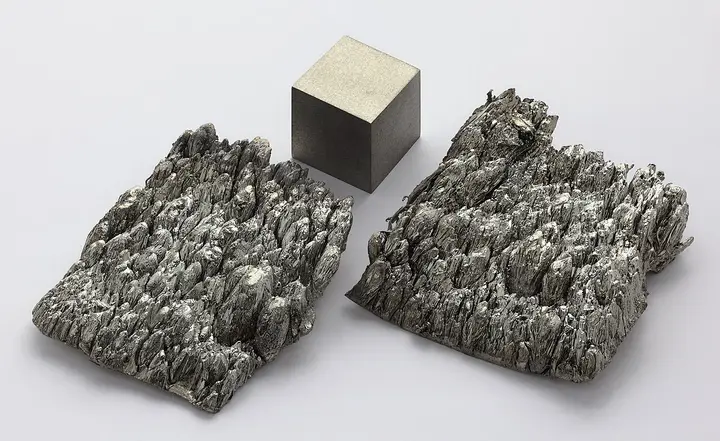
Scandium is a soft, silvery transition metal, almost as light as aluminum. It tarnishes slightly yellow or pink in air.
It is not especially rare in Earth’s crust, but it is spread thinly and seldom concentrated, so it is expensive and used mostly in small quantities.
Quick answers
- What is scandium?
- Scandium (Sc) is a transition metal with atomic number 21. It is a solid at room temperature. A light, silvery metal predicted by Mendeleev before anyone found it. Small amounts make aluminum alloys much stronger.
- Where is scandium found?
- Scandium is usually recovered as a by-product of processing other ores, such as those of uranium, titanium and rare earths.
- What is scandium used for?
- Its main uses are aluminum–scandium alloys, lighting and fuel cells. A fraction of a per cent of scandium makes aluminum stronger and easier to weld; used in aerospace parts and sports equipment.
At a glance
| Atomic number | 21 |
|---|---|
| Symbol | Sc |
| Standard atomic weight | 44.956 ± 0.001 |
| Natural isotopes | 1 (IUPAC CIAAW 2024; a single isotope in nature) |
| Family | Transition metal |
| Group | Group 3 |
| Period | Period 4 |
| Block | d |
| Electron configuration | [Ar] 3d1 4s2 orbital diagram → |
| State at room temperature | Solid |
| Melting point | 1,541 °C (2,806 °F, 1,814 K) |
| Boiling point | 2,836 °C (5,137 °F, 3,109 K) |
| Density | 2.99 g/cm³ |
| Electronegativity (Pauling) | 1.36 |
| Atomic radius | 211 pm |
| First ionization energy | 6.561 eV |
| Oxidation states | +3 |
| Discovery | 1879 · Lars Fredrik Nilson |
Discovery
In 1871 Dmitri Mendeleev predicted an element he called eka-boron to fill a gap in his periodic table.
In 1879 the Swedish chemist Lars Fredrik Nilson found a new element in Scandinavian minerals. Per Teodor Cleve soon showed it matched Mendeleev’s prediction.
Where the name comes from
From Scandia, the Latin name for Scandinavia, where its minerals were found.
Where is scandium found?
Scandium is usually recovered as a by-product of processing other ores, such as those of uranium, titanium and rare earths.
Where every element is found →
What is scandium used for?
- Aluminum–scandium alloys. A fraction of a per cent of scandium makes aluminum stronger and easier to weld; used in aerospace parts and sports equipment.
- Lighting. Scandium iodide in metal halide lamps gives a bright light close to daylight, used in stadiums and film sets.
- Fuel cells. Scandium-stabilized zirconia is used in solid oxide fuel cells.
What every element is used for → · Where are the elements found? →
Notable isotopes
| Isotope | Half-life | Note |
|---|---|---|
| Scandium-45 | Stable | All natural scandium is this isotope. |
| Scandium-46 | about 84 days | Has been used as a tracer to follow flows in oil refineries. |
Safety
Low hazard
Scandium is not known to be particularly toxic, but its dust and compounds should be handled with care like other fine metal powders.
Did you know?
- Gallium, scandium and germanium are the three most famous confirmations of Mendeleev’s predictions.
- Because it is so costly, scandium is used in far smaller amounts than its useful properties might suggest.
- All natural scandium is a single isotope, scandium-45.
Frequently asked questions
Is scandium a rare earth element?
Yes. Scandium and yttrium are usually grouped with the lanthanides as rare earth elements because they occur in the same minerals.
Why is scandium expensive?
It is rarely concentrated in ores, so it is produced in small amounts as a by-product.
Is scandium a metal?
Yes. Scandium is a metal, one of the transition metals.
What are the properties of scandium?
Atomic number 21, symbol Sc, atomic mass 44.956. It is a solid at room temperature. It melts at 1,541 °C (2,806 °F) and boils at 2,836 °C (5,137 °F). Density 2.99 g/cm³. Electronegativity 1.36 (Pauling).
Sources
- Royal Society of Chemistry: Scandium
- Encyclopaedia Britannica: Scandium
- USGS Mineral Commodity Summaries: Scandium
- NNDC NuDat 3 (nuclear data)
- PubChem Periodic Table (NIH)
- IUPAC/CIAAW standard atomic weights
- Royal Society of Chemistry, Periodic Table
- Wikipedia: Scandium
Last checked: 16 November 2026