Element 079
Gold (Au)
The yellow metal that never tarnishes. Gold has been money, jewelry and a symbol of value for thousands of years, and it is also used in electronics and spacecraft.
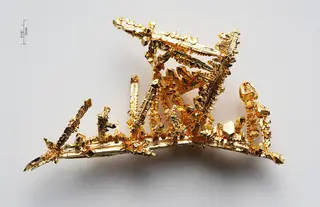
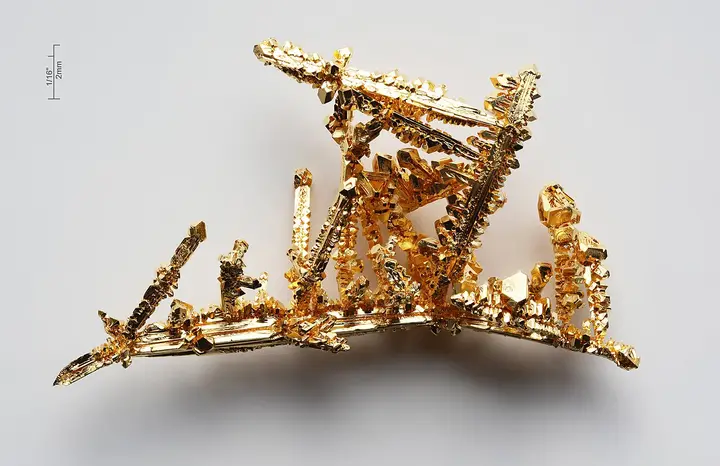
Gold is a dense, soft, bright yellow precious metal. It is the most malleable of all metals: a single gram can be beaten into a sheet about one square meter in area.
It barely reacts with anything. Air, water and most acids leave it untouched, which is why ancient gold objects still shine.
Quick answers
- What is gold?
- Gold (Au) is a transition metal with atomic number 79. It is a solid at room temperature. The yellow metal that never tarnishes. Gold has been money, jewelry and a symbol of value for thousands of years, and it is also used in electronics and spacecraft.
- Where is gold found?
- Gold is found as native metal in quartz veins and in river gravels, and in small amounts in many ores. China, Russia and Australia are among the largest producers.
- What is gold used for?
- Its main uses are jewelry; investment and reserves; electronics. The largest use.
At a glance
| Atomic number | 79 |
|---|---|
| Symbol | Au |
| Standard atomic weight | 196.97 ± 0.01 |
| Natural isotopes | 1 (IUPAC CIAAW 2024; a single isotope in nature) |
| Family | Transition metal |
| Group | Group 11 |
| Period | Period 6 |
| Block | d |
| Electron configuration | [Xe] 4f14 5d10 6s1 orbital diagram → |
| State at room temperature | Solid |
| Melting point | 1,064.18 °C (1,947.5 °F, 1,337.33 K) |
| Boiling point | 2,856 °C (5,173 °F, 3,129 K) |
| Density | 19.282 g/cm³ |
| Electronegativity (Pauling) | 2.54 |
| Atomic radius | 166 pm |
| First ionization energy | 9.226 eV |
| Oxidation states | +3, +1 |
| Discovery | Known since ancient times |
Discovery
Gold has been known since prehistoric times. It occurs as nuggets and flakes of pure metal, so people could collect and work it long before they could smelt other metals.
Where the name comes from
From Old English gold, related to words for yellow. The symbol Au comes from the Latin aurum.
Where is gold found?
Gold is found as native metal in quartz veins and in river gravels, and in small amounts in many ores. China, Russia and Australia are among the largest producers.
Where every element is found →
What is gold used for?
- Jewelry. The largest use. Pure gold is 24 carat; most jewelry is alloyed to make it harder.
- Investment and reserves. Bars and coins are bought by investors, and central banks hold gold as a reserve.
- Electronics. Thin gold coatings on connectors and contacts do not corrode.
- Space and medicine. The mirrors of the James Webb Space Telescope are coated with gold to reflect infrared light; gold is also used in dentistry.
What every element is used for → · Where are the elements found? →
Common compounds
| Compound | Formula | Note |
|---|---|---|
| Chloroauric acid | HAuCl₄ | Formed when gold dissolves in aqua regia. |
Notable isotopes
| Isotope | Half-life | Note |
|---|---|---|
| Gold-197 | Stable | The only stable isotope; all natural gold. |
Safety
Safe metal
Metallic gold is non-toxic and is even used as a food decoration. Some gold compounds used in medicine and industry are toxic.
Did you know?
- Gold’s yellow color is a relativistic effect: in heavy gold atoms, inner electrons move so fast that the metal absorbs blue light and reflects yellow and red.
- Gold dissolves in aqua regia, a mixture of nitric and hydrochloric acids.
- Much of the universe’s gold may have formed in collisions of neutron stars. A merger observed in 2017 supported this idea.
Frequently asked questions
What does 24 carat mean?
Carat measures purity in 24ths. 24-carat gold is pure; 18-carat is 18/24, or 75% gold.
Why doesn’t gold rust or tarnish?
Gold holds its electrons very tightly, so it does not react with oxygen, water or most chemicals.
Is gold a metal?
Yes. Gold is a metal, one of the transition metals.
What are the properties of gold?
Atomic number 79, symbol Au, atomic mass 196.97. It is a solid at room temperature. It melts at 1,064.18 °C (1,947.5 °F) and boils at 2,856 °C (5,173 °F). Density 19.282 g/cm³. Electronegativity 2.54 (Pauling).
Sources
- Royal Society of Chemistry: Gold
- Encyclopaedia Britannica: Gold
- NASA: James Webb Space Telescope mirrors
- NNDC NuDat 3 (nuclear data)
- PubChem Periodic Table (NIH)
- IUPAC/CIAAW standard atomic weights
- Royal Society of Chemistry, Periodic Table
- Wikipedia: Gold
Last checked: 16 November 2026
Other group 11 elements
Copper
One of the first metals people used and still the metal of electrical wiring. Bronze and brass are copper alloys.
Silver
The best conductor of electricity and the most reflective metal. Silver has been money and jewelry for millennia and now goes into solar panels and electronics.
Roentgenium
A superheavy element named after Wilhelm Röntgen, discoverer of X-rays. It sits below gold in the table.