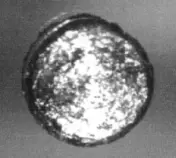
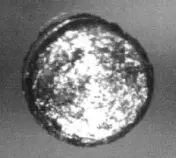
Californium is a radioactive actinide metal. It does not occur in nature in usable amounts and is made in nuclear reactors or particle accelerators.
Californium-252 splits spontaneously and gives off large numbers of neutrons.
Quick answers
- What is californium?
- Californium (Cf) is an actinide with atomic number 98. It is a solid at room temperature. A synthetic element that is a powerful source of neutrons. It helps start nuclear reactors and find gold, oil and explosives.
- Where is californium found?
- Californium does not occur naturally. Small amounts are made in specialized reactors.
- What is californium used for?
- Its main uses are neutron sources and research. Starting up nuclear reactors, analyzing minerals and detecting explosives.
At a glance
| Atomic number | 98 |
|---|---|
| Symbol | Cf |
| Mass number (most stable isotope) | [251] |
| Family | Actinide |
| Group | f-block (the row below the main table) |
| Period | Period 7 |
| Block | f |
| Electron configuration | [Rn] 5f10 7s2 orbital diagram → |
| State at room temperature | Solid |
| Melting point | 900 °C (1,652 °F, 1,173 K) |
| Boiling point | Unknown |
| Density | Unknown |
| Electronegativity (Pauling) | 1.3 |
| Atomic radius | 245 pm |
| First ionization energy | 6.3 eV |
| Oxidation states | +3 |
| Discovery | 1950 · Stanley Thompson, Kenneth Street, Albert Ghiorso and Glenn Seaborg |
Discovery
In 1950 a team at Berkeley made californium by bombarding curium-242 with alpha particles.
Where the name comes from
Named after the state and the University of California.
Where is californium found?
Californium does not occur naturally. Small amounts are made in specialized reactors.
Where every element is found →
What is californium used for?
- Neutron sources. Starting up nuclear reactors, analyzing minerals and detecting explosives.
- Research. Making heavier elements, including oganesson.
What every element is used for → · Where are the elements found? →
Notable isotopes
| Isotope | Half-life | Note |
|---|---|---|
| Californium-251 | about 900 years | The longest-lived isotope. |
| Californium-252 | about 2.6 years | A strong neutron emitter. |
Safety
Highly radioactive
All its isotopes are radioactive. It is handled only in specialized laboratories, in tiny amounts and under strict controls.
Did you know?
- Only fractions of a gram of californium-252 are produced worldwide each year.
- A microgram of californium-252 gives off millions of neutrons every second.
Frequently asked questions
Why is californium valuable?
It is one of the few portable, intense sources of neutrons.
Is californium a metal?
Yes. Californium is a metal, one of the actinides.
What are the properties of californium?
Atomic number 98, symbol Cf, atomic mass [251]. It is a solid at room temperature. It melts at 900 °C (1,652 °F). Electronegativity 1.3 (Pauling).
Sources
- Royal Society of Chemistry: Californium
- Encyclopaedia Britannica: Californium
- NNDC NuDat 3 (nuclear data)
- PubChem Periodic Table (NIH)
- IUPAC/CIAAW standard atomic weights
- Royal Society of Chemistry, Periodic Table
- Wikipedia: Californium
Last checked: 16 November 2026
Other actinides
Actinium
The radioactive metal that gives the actinides their name. It glows blue in the dark, and one isotope is being developed to treat cancer.
Thorium
A weakly radioactive metal named after the Norse god Thor. It once made gas lamps glow and is studied as a possible nuclear fuel.
Protactinium
One of the rarest and most dangerous natural elements. Its name means “before actinium”, because it decays into actinium.
Uranium
The heaviest element found in large amounts in nature. Its radioactivity was the first ever discovered, and its fission powers nuclear reactors.
Neptunium
The first element heavier than uranium ever made. It is the starting material for the plutonium that powers deep-space probes.
Plutonium
A radioactive metal made in nuclear reactors. One isotope fuels reactors; another powers space probes that travel too far from the Sun for solar panels.
Americium
A synthetic radioactive element that is probably in your home: a tiny amount sits inside many smoke alarms.
Curium
A synthetic element named after Marie and Pierre Curie. Curium sources have analyzed rocks on Mars.