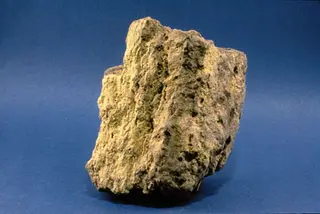
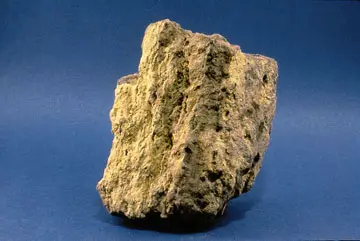
Uranium is a dense, silvery-gray radioactive metal. All its isotopes are unstable, but the two most common decay so slowly that much of Earth’s original uranium is still here.
One isotope, uranium-235, can split (fission) when struck by a neutron, releasing a great deal of energy. Nuclear power stations use this chain reaction to make electricity.
Quick answers
- What is uranium?
- Uranium (U) is an actinide with atomic number 92. It is a solid at room temperature. The heaviest element found in large amounts in nature. Its radioactivity was the first ever discovered, and its fission powers nuclear reactors.
- Where is uranium found?
- Uranium is more common in Earth’s crust than silver or gold. Kazakhstan is the largest producer, followed by countries including Canada, Namibia and Australia.
- What is uranium used for?
- Its main uses are nuclear power, naval reactors and depleted uranium. Reactor fuel is uranium enriched to a few per cent uranium-235.
At a glance
| Atomic number | 92 |
|---|---|
| Symbol | U |
| Standard atomic weight | 238.03 ± 0.01 |
| Natural isotopes | 3 (IUPAC CIAAW 2024) |
| Family | Actinide |
| Group | f-block (the row below the main table) |
| Period | Period 7 |
| Block | f |
| Electron configuration | [Rn] 5f3 6d1 7s2 orbital diagram → |
| State at room temperature | Solid |
| Melting point | 1,135 °C (2,075 °F, 1,408 K) |
| Boiling point | 4,131 °C (7,468 °F, 4,404 K) |
| Density | 18.95 g/cm³ |
| Electronegativity (Pauling) | 1.38 |
| Atomic radius | 240 pm |
| First ionization energy | 6.194 eV |
| Oxidation states | +6, +5, +4, +3 |
| Discovery | 1789 · Martin Heinrich Klaproth |
Discovery
In 1789 the German chemist Martin Heinrich Klaproth identified a new element in the mineral pitchblende. The pure metal was first made by Eugène-Melchior Péligot in 1841.
In 1896 Henri Becquerel found that uranium salts emit invisible radiation: the discovery of radioactivity. In 1938 experiments by Otto Hahn and Fritz Strassmann led to the discovery of nuclear fission, explained by Lise Meitner and Otto Frisch.
Where the name comes from
Named after the planet Uranus, discovered eight years earlier. The planet is named after the Greek sky god Ouranos.
Where is uranium found?
Uranium is more common in Earth’s crust than silver or gold. Kazakhstan is the largest producer, followed by countries including Canada, Namibia and Australia.
Where every element is found →
What is uranium used for?
- Nuclear power. Reactor fuel is uranium enriched to a few per cent uranium-235.
- Naval reactors. Some submarines and aircraft carriers run on nuclear power.
- Depleted uranium. Left over from enrichment, it is very dense and used in counterweights, radiation shielding and some military applications.
What every element is used for → · Where are the elements found? →
Common compounds
| Compound | Formula | Note |
|---|---|---|
| Uranium dioxide | UO₂ | The chemical form of most nuclear power plant fuel. |
| Uranium hexafluoride | UF₆ | Volatile compound used in uranium enrichment. |
Notable isotopes
- U-2340.0054%
- U-2350.7204%
- U-23899.2742%
Percent by number of atoms. The light band shows the range over which the share varies in natural samples. Source: IUPAC CIAAW 2024
| Isotope | Half-life | Note |
|---|---|---|
| Uranium-238 | about 4.47 billion years | About 99.3% of natural uranium. Does not sustain a chain reaction by itself. |
| Uranium-235 | about 704 million years | About 0.7% of natural uranium. The fissile isotope used in reactors. |
| Uranium-234 | about 245,500 years | A trace isotope formed in the decay chain of uranium-238. |
Safety
Radioactive and chemically toxic
Uranium is both a radioactive material and a toxic heavy metal that can damage the kidneys. It is handled under strict regulation.
Natural uranium is only weakly radioactive; the main risks come from swallowing or breathing in uranium dust.
Did you know?
- About 2 billion years ago, natural fission reactions started on their own in uranium deposits at Oklo in Gabon. They are the only natural nuclear reactors known.
- Henri Becquerel shared the 1903 Nobel Prize in Physics with Marie and Pierre Curie for the discovery and study of radioactivity.
- Old “uranium glass” glows bright green under ultraviolet light.
Frequently asked questions
Is uranium dangerous to touch?
Natural uranium is only weakly radioactive, and its radiation barely penetrates skin. It is more dangerous inside the body, as dust or in solution.
What is enriched uranium?
Uranium processed to raise the share of uranium-235 above the natural 0.7%. Power reactors typically use about 3–5%.
Is uranium a metal?
Yes. Uranium is a metal, one of the actinides.
What are the properties of uranium?
Atomic number 92, symbol U, atomic mass 238.03. It is a solid at room temperature. It melts at 1,135 °C (2,075 °F) and boils at 4,131 °C (7,468 °F). Density 18.95 g/cm³. Electronegativity 1.38 (Pauling).
Sources
- Royal Society of Chemistry: Uranium
- Encyclopaedia Britannica: Uranium
- World Nuclear Association: What is uranium?
- IAEA: Meet Oklo, Earth’s only known natural nuclear reactor
- Nobel Prize in Physics 1903 (Becquerel and the Curies)
- NNDC NuDat 3 (nuclear data)
- PubChem Periodic Table (NIH)
- IUPAC/CIAAW standard atomic weights
- Royal Society of Chemistry, Periodic Table
- Wikipedia: Uranium
Last checked: 16 November 2026
Other actinides
Actinium
The radioactive metal that gives the actinides their name. It glows blue in the dark, and one isotope is being developed to treat cancer.
Thorium
A weakly radioactive metal named after the Norse god Thor. It once made gas lamps glow and is studied as a possible nuclear fuel.
Protactinium
One of the rarest and most dangerous natural elements. Its name means “before actinium”, because it decays into actinium.
Neptunium
The first element heavier than uranium ever made. It is the starting material for the plutonium that powers deep-space probes.
Plutonium
A radioactive metal made in nuclear reactors. One isotope fuels reactors; another powers space probes that travel too far from the Sun for solar panels.
Americium
A synthetic radioactive element that is probably in your home: a tiny amount sits inside many smoke alarms.
Curium
A synthetic element named after Marie and Pierre Curie. Curium sources have analyzed rocks on Mars.
Berkelium
A synthetic element named after the city of Berkeley. It was used as a target to create element 117, tennessine.