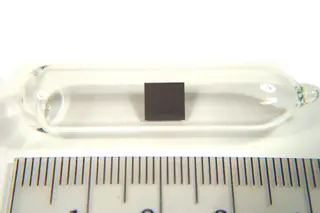
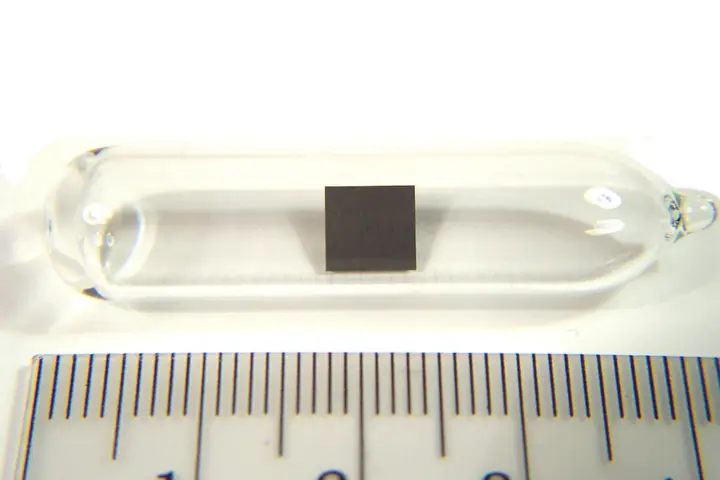
Thorium is a silvery, slightly radioactive metal that tarnishes black in air. It is about three times more common in Earth’s crust than uranium.
Thorium-232 decays so slowly that almost all the thorium present when Earth formed is still here.
Quick answers
- What is thorium?
- Thorium (Th) is an actinide with atomic number 90. It is a solid at room temperature. A weakly radioactive metal named after the Norse god Thor. It once made gas lamps glow and is studied as a possible nuclear fuel.
- Where is thorium found?
- Thorium is found mainly in monazite, a mineral concentrated in some beach sands. India and Brazil have large deposits.
- What is thorium used for?
- Its main uses are gas mantles, welding electrodes and nuclear research. Thorium oxide made gas lamp mantles glow brightly; safer materials have largely replaced it.
At a glance
| Atomic number | 90 |
|---|---|
| Symbol | Th |
| Standard atomic weight | 232.04 ± 0.01 |
| Natural isotopes | 2 (IUPAC CIAAW 2024) |
| Family | Actinide |
| Group | f-block (the row below the main table) |
| Period | Period 7 |
| Block | f |
| Electron configuration | [Rn] 6d2 7s2 orbital diagram → |
| State at room temperature | Solid |
| Melting point | 1,750 °C (3,182 °F, 2,023 K) |
| Boiling point | 4,788 °C (8,650 °F, 5,061 K) |
| Density | 11.72 g/cm³ |
| Electronegativity (Pauling) | 1.3 |
| Atomic radius | 237 pm |
| First ionization energy | 6.08 eV |
| Oxidation states | +4 |
| Discovery | 1829 · Jöns Jacob Berzelius |
Discovery
In 1829 Jöns Jacob Berzelius identified a new element in a black mineral from Norway, now called thorite. He reused a name he had given in 1815 to a supposed element that turned out not to exist.
Where the name comes from
From Thor, the Norse god of thunder.
Where is thorium found?
Thorium is found mainly in monazite, a mineral concentrated in some beach sands. India and Brazil have large deposits.
Where every element is found →
What is thorium used for?
- Gas mantles. Thorium oxide made gas lamp mantles glow brightly; safer materials have largely replaced it.
- Welding electrodes. Thoriated tungsten electrodes are used in some welding.
- Nuclear research. Thorium can be converted into fissile uranium-233, and thorium reactors are being studied.
What every element is used for → · Where are the elements found? →
Common compounds
| Compound | Formula | Note |
|---|---|---|
| Thorium dioxide | ThO₂ | The glowing material of old gas lantern mantles. |
Notable isotopes
- Th-2300.02%
- Th-23299.98%
Percent by number of atoms. The light band shows the range over which the share varies in natural samples. Source: IUPAC CIAAW 2024
| Isotope | Half-life | Note |
|---|---|---|
| Thorium-232 | about 14 billion years | Almost all natural thorium. |
| Thorium-230 | about 75,000 years | Formed in the uranium-238 decay chain; used to date corals and cave deposits. |
Safety
Weakly radioactive
Thorium is only weakly radioactive, but its dust should not be inhaled. Its decay produces radon-220.
Did you know?
- Berzelius first used the name “thorium” in 1815 for a substance that turned out to be yttrium phosphate. In 1829 he gave the name to the real element.
- Thorium-232’s half-life is about the age of the universe, so most of Earth’s original thorium remains.
- Heat from thorium, uranium and potassium decay helps keep Earth’s interior hot.
Frequently asked questions
Is thorium a nuclear fuel?
Not directly. It must first absorb a neutron and turn into uranium-233, which can then sustain fission.
Is thorium dangerous?
It is weakly radioactive; the main risk is breathing in thorium dust.
Is thorium a metal?
Yes. Thorium is a metal, one of the actinides.
What are the properties of thorium?
Atomic number 90, symbol Th, atomic mass 232.04. It is a solid at room temperature. It melts at 1,750 °C (3,182 °F) and boils at 4,788 °C (8,650 °F). Density 11.72 g/cm³. Electronegativity 1.3 (Pauling).
Sources
- Royal Society of Chemistry: Thorium
- Encyclopaedia Britannica: Thorium
- USGS Mineral Commodity Summaries: Thorium
- NNDC NuDat 3 (nuclear data)
- PubChem Periodic Table (NIH)
- IUPAC/CIAAW standard atomic weights
- Royal Society of Chemistry, Periodic Table
- Wikipedia: Thorium
Last checked: 16 November 2026
Other actinides
Actinium
The radioactive metal that gives the actinides their name. It glows blue in the dark, and one isotope is being developed to treat cancer.
Protactinium
One of the rarest and most dangerous natural elements. Its name means “before actinium”, because it decays into actinium.
Uranium
The heaviest element found in large amounts in nature. Its radioactivity was the first ever discovered, and its fission powers nuclear reactors.
Neptunium
The first element heavier than uranium ever made. It is the starting material for the plutonium that powers deep-space probes.
Plutonium
A radioactive metal made in nuclear reactors. One isotope fuels reactors; another powers space probes that travel too far from the Sun for solar panels.
Americium
A synthetic radioactive element that is probably in your home: a tiny amount sits inside many smoke alarms.
Curium
A synthetic element named after Marie and Pierre Curie. Curium sources have analyzed rocks on Mars.
Berkelium
A synthetic element named after the city of Berkeley. It was used as a target to create element 117, tennessine.